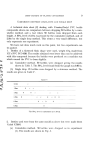
44 JOURNAL OF THE SOCIETY OF COSMETIC CHEMISTS These calculations quoted can all be made in reverse if it is desired to quote a given declaration and then determine the standard fill necessary. A word of warning, however, in the case of two part fills if the ratio of the two fills is critical: as an example, in the third case. if a declared fill of 292 g is desired with a ratio of 95:5 the initial individual fills will be 279.3 g and 14.7 g (Total 294 g at the filling stage). Adding the variations of 3 g for spray testing, 1 g on propellant and 2 g on concentrate filling still gives a total fill of 300 g, but the ratio then becomes 281.3:15.7 or 5.29}/0 of propel- lant instead of 5.0%. It is therefore necessary to re-allocate the total fill in the ratio of 95:5. I am merely suggesting these calculations as suitable ground for discus- sion, and I cannot accept any responsibility that they will always give protection against the Weights and Measures Act. CONSIDERATIONS TO DESIGN OF PACK AND PLANT In a competitive industry such as ours, the influence of the Weights and Measures Act on packaging can manifest itself in different ways. Some manufacturers may design their packs and plant in order to get the maxi- mum declared contents for the fill employed. This is probably used more in the standardised packs, such as tubes, aerosols, and standard or similar design bottles. A further effect of this principle may be seen in the choice of weight or volume for the declaration. In the case of a product of low specific gravity, such as a cologne or pre-shave it is possible to declare 70 c.c. as against 59 g. Conversely, if the gravity is high as in a toothpaste, 120 g may be declared compared to 80 c.c. These are, of course, equivalent figures, but does the customer think so? Other manufacturers may wish to ignore completely the effect of the declaration and go entirely for the competitive impact of the pack shape and design. This approach is more likely in the true cosmetic field where it may be felt that it is the appearance, perfume and name which is selling the product and not its quantity. Even so, why not declare the maximum possible figure by the use of efficient plant? In either of these approaches, it should be borne in mind that the spirit of the Weights and Measures Act implies that the declared contents should be as close as possible to the actual contents - a good point to remember. What therefore can be done to promote this in the design of packs and plant?

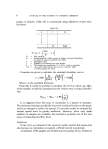
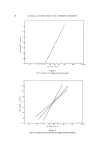
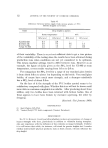
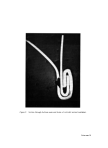
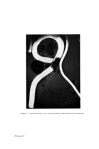
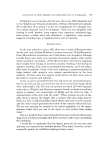
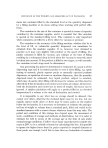
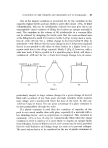
INFLUENCE OF THE WEIGHTS AND MEASURES ACT ON PACKAGING 45 One of the largest variations is accounted for by the variation in the capacity of glass bottles and jars which is quite often about +5%. If filled volumetrically, this can be considerably reduced but may give rise to an unacceptable visual variation of filling level unless an opaque material is used. The variation in the volume of fill attributable to a vacuum filler can be reduced by designing the bottle such that the cross-sectional area at the filling level is small. For instance bottle A (Fig. 1) may show a varia- tion of +0.2 -3.5 cm 3 for a +3mm change in level but bottle B (Fig. 1) only shows +0.2 -0.8 cm 3 for the same change in level. It has been assumed that it is not possible to fill either of these bottles to a higher level in a narrow neck due to the ullage required. Bottle C (Fig. 1), however, with a wide bore neck, if this is possible or if a sprinkler plug is fitted, will show a variation of _+0.5 cm 3 for the _+ 3 mm level change. Design A is, of course, Standard f•11 Maximum ................ •-•Mlnlmu (o) (b) (c) Figure 1. particularly suspect to large volume changes for a given change of level if filled with a product of low flash point and high volatility which requires more ullage, and a standard fill below the base of the neck. In this case +3.5 cm3 may be found. The one great advantage of a glass container is its zero permeability through the walls. If a plastic container is used then the variation of capacity of the pack is very much smaller than with glass, especially if a material with a low shrinkage factor, such as polystyrene, is employed. This variation is commonly + 1% or less. It may be volumetrically filled when the visual variation in level is small or it is more likely to employ an opaque finish than with glass. It may be filled to a level, and vacuum can be used, provided that the wall thickness and design shape are such as to prevent collapse. The most serious factor to be considered in the use of plastic containers is
Purchased for the exclusive use of nofirst nolast (unknown)
From: SCC Media Library & Resource Center (library.scconline.org)