46 JOURNAL OF THE SOCIETY OF COSMETIC CHEMISTS that of permeability. In this respect, considerations raised by the Weights and Measures Act go hand in hand with other technical aspects of the use of plastics. It is obviously necessary to conduct extensive testing to find the correct grade of material, wall thickness, shape, etc. Considerable reductions in losses can often be obtained by increasing the capacity/surface area ratio. Another area where losses occur is the closure of the pack which requires special attention and a simple thing such as a change of wad lining material can sometimes reduce this loss very appreciably. There are several factors involving the use of filling equipment and its control where variations can be reduced. For example, it is not always the most rapid speed of filling that produces the most economical results. It could, for instance, necessitate a higher standard filling level to compensate for increased inaccuracy of filling volume and increased foaming if the product or method of filling promotes this. A change in the method of filling could perhaps reduce foaming. An interesting, if somewhat un- pleasant, outcome of the Weights and Measures legislation is the use by a few publicans of a small quantity of liquid designed to save time in the measurement of beers. Three drops of this liquid will instantly render a "pint" as flat as rainwater. These are but a few of the possible means of assisting us not only to satisfy more closely the requirements of the Weights and Measures Act, but in some cases they may also lead to improved efficiency. (Received: $1st January 1968) REFERENCES (1) Weights and Measures Act (1963). Chapter 31, Part 2 Sections 9 and 10 (H.M. Stationery Office). (2) Statutory Instruments. No. 1710 (1963) (H.M. Stationery Office). (3) Statutory Instruments. No. 1711 (1963). (H.M. Stationery Office). (4) Statutory Instruments. Nos. 1139 and 1140 (1964). (H.M. Stationery Office). (5) Weights and Measures Act (1968). Chapter 31. Part 4. Sections gl to 24. (H.M. Stationery Office). (6) ibid. Chapter 31. Schedule 7. Parts V and VI. Schedule 8. (H.M. Stationery Office). (7) ibid. Chapter 31. Part 4. Sections 29, 32, 48, 49. (H.M. Stationery Office). (8) ibid. Chapter 31. Part 2. Section 9. Part 4 Section gl. (H.M. Stationery Office). (9) ibid. Chapter 31. Part 4 Section 26. (H.M. Stationery Office). (10) Combined Weights • Measures Authorities for Westminster, Kensington and Chelsea, and Hammersmith Report (1967). (11) Northern Dispatch. (3rd November, 1967).

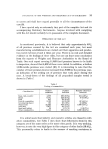
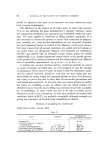
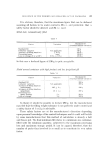
INFLUENCE OF THE WEIGHTS AND MEASURES ACT ON PACKAGING 47 Introduction by the lecturer There are a number of places in this paper where the terms "volume" and "capacity", particularly the latter, appear to be incorrectly used. This is because I am. quoting precisely from the Weights and Measures Act or its accompanying statu- tory instruments and 1 personally feel that in quite a number of cases in that Act the xvord "capacity" is used where it would in fact be re. ore precise to use the word "volume". In page 33 I have stated that vehicles on a highway are not covered by the Act. I have since found that this statement is not entirely true as a Weights and Measures officer m. ay examine equipment and goods on a vehicle provided that vehicle is stationary. He is not, however, permitted to stop it. Also, I have quoted in the same page that only about 40% of premises liable to inspection are believed to be covered each year. This figure I originally obtained for boroughs in the London area where it is still true, but having studied reports from other areas, I noxv believe that for the country as a whole this figure is rather low--it is probably between 50 and 60% and in some counties it m. ay even be in excess of 700//0 . The contents of Tables I-1II refer to the results obtained in a consortium of London boroughs. I have since studied reports from other areas in the provinces and, in general, the pattern which is sho•vn in Tables I-III is reasonably true for the country as a •vhole--the main differences are that the number of faulty instruments and •veights found in the provinces are rather lower than in the London area. I)[SCUSSION Mu. C. lu•: Referring to page 42 and Table IV--in calculating your minimum fill you are accepting a 99.7% confidence limit which, to my mind, implies that you are taking a statistical approach in measuring tolerances. Instead of summing your tolerances, should you not in this case have summed the variances and recalculated the tolerances from the square root of your sum variances? It does seem to me that one could have rather more close tolerances by using statistical approaches with some profit, for frequently one does wish to declare a content and then put above it the minimum one can get away with in order to achieve all round satisfaction. Tu• LF•cxrm•: I have quoted only a suggested method of calculating the declared contents, as there is no fixed rule. The calculation is not statistically based, but is merely derived from totting up the estimated tolerances at each stage, and I would emphasize estimated. If the calculation could be made after the whole process had been running for a sufficiently long time then a statistical calculation could be carried out and it would basically give the results that you have suggested. The problem here, however, is that the calculation of declared quantity has to be made before the product has, in most cases, ever been manufactured in bulk, before any components have been received, or before the filling and packing machinery has been used on this particular product. The weight loss on storage will probably have been estimated by extrapolation from relatively short term storage tests, probably in non-standard components. For these reasons all the tolerances that I have used are in fact estimated, and consequently the calculations here are not statistically
Purchased for the exclusive use of nofirst nolast (unknown)
From: SCC Media Library & Resource Center (library.scconline.org)