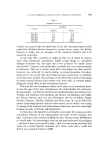
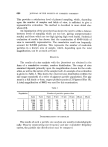
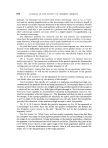
654 JOURNAL OF THE SOCIETY OF COSMETIC CHEMISTS I must therefore resort to talking mostly about the subject I know best of all - myself, my experiences and my thoughts. As you know, I was intimately connected with the cosmetic industry from the early 30's to the early 50's - the first seven years learning my business, the next seven trying to preserve or save it, and the last seven trying to adapt it to the new conditions, both political and technological, that emerged as a result of a world upheaval. These were the days when we were striving in a situation which was always secondary to national survival. Subsequently, when victory was ours, we battled to plan the national reconstruction of industry at a time when one knew that the technological revolution,• greatly stimulated by the war, must spill over into our industry. We had to grasp this opportunity with both hands if our competitive strength was to be developed in this new era, where world demand would be vastly increased by improved living standards for the great mass of the working population of the world. One foresaw all that then, and it was an exciting prospect, but it was at this time that I left the industry proper. For the last eighteen years I have been watching closely from the side- lines, as an increasingly large supplier on the packaging side. My activities took me also into wider industrial fields and I have been able to view the kaleidoscope of the industry's efforts and progress in a more general sense, and from a more detached standpoint. I have watched with absorbing interest - and not without profit - the progress of your industry through four decades. I have had experience of almost every facet - theatrical make-up, wigs and toupees (now, of course, called hair-pieces), manufacture, international selling, trade affairs in war and peace and, from the outside, supply and service to the industry. I propose to examine briefly each decade and then to try to suggest what may happen in the next ten years. Statistical information, both from the government and the industry, has unfortunately never been too reliable. Because of some pretty harsh legislation during the war and constant changes in bases, it is difficult to get truly comparative figures. I would gamble, however, that Table I is not too far out. It excludes soaps and dentifrices, and makes no allowances for the retailer's margin or Purchase Tax. Yes, yours is one of the phenomenal growth industries, so let us try to see why, how, and where this growth comes from. The 30's saw the emergence from the depressive 20's and were, in fact, a growth period for the industry, particularly in the U.S.A. I mention this

AN INDUSTRIALIST LOOKS AT 'rite COSMETIC INDUSTRY 655 Table I Apparent turnover Decade The 20's The 30's The 40's The 50's The 60's Export 1.0 3.8 18.0 oe million Home 5.0 8.5 14.5 44.0 100.0 because one cannot help but admit that it was this American impetus that pushed the British industry forward to a point where, today, the British industry is really only an extension of the American industry and is in American ownership. In the early 30's, cosmetics or make-up (the use of which by anyone other than theatricals, prostitutes, bright young things or coronetted dowager duchesses was 'not quite nice') were products of a small "paint and powder" industry, not particularly scientific but very entrepreneurial in character. This was a decade when little advertising was done and the turnover was achieved by hard-working, pavement-pounding travellers, whose job it was to sell. The advertising was also educational, or snobbish, or in some cases, horrific. By and large, it was directed towards accentuating the good natural features that women were born with, or towards dimin- ishing the visual effect of the bad natural features. This was the era of nuisance claims and I expect you remember those. It was the age of the true entrepreneur, the individualist, the character, the personality - the Factors, the Revsons,the Rubinsteins, the Ardens, Coty, Yardley and Atkinson, the Gardners, the Hesses, the Haslams, the Vailis, the Horace Barrets and, yes, the Albermans the era of Icilma, Papier Poudre, Dubarry, Tokalon, Bubbles and Pears soap an era in which the phrase 'marketing director' had not been coined an era which was trying to emerge from national and international depression and was unseeingly heading towards worldwide self-destruction. In those days the lipstick was virtually a loss leader for creams, powders and lotions. Because of the small market, the price of the container was high. Containers were ordered in 200 gross lots, whereas today 10 000 gross is a small order. It is interesting to note on this particular piece of packaging - and here I must give myself a plug - that you are paying one-third less today for a better lipstick container after thirty years and a world war than I was paying for them in 1936.
Purchased for the exclusive use of nofirst nolast (unknown)
From: SCC Media Library & Resource Center (library.scconline.org)