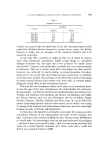
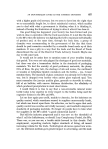
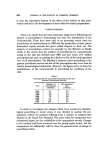
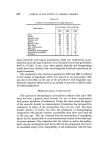
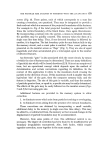
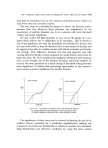
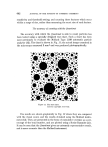
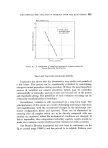
AN INDUSTRIALIST LOOKS AT 'rite COSMETIC INDUSTRY 655 Table I Apparent turnover Decade The 20's The 30's The 40's The 50's The 60's Export 1.0 3.8 18.0 oe million Home 5.0 8.5 14.5 44.0 100.0 because one cannot help but admit that it was this American impetus that pushed the British industry forward to a point where, today, the British industry is really only an extension of the American industry and is in American ownership. In the early 30's, cosmetics or make-up (the use of which by anyone other than theatricals, prostitutes, bright young things or coronetted dowager duchesses was 'not quite nice') were products of a small "paint and powder" industry, not particularly scientific but very entrepreneurial in character. This was a decade when little advertising was done and the turnover was achieved by hard-working, pavement-pounding travellers, whose job it was to sell. The advertising was also educational, or snobbish, or in some cases, horrific. By and large, it was directed towards accentuating the good natural features that women were born with, or towards dimin- ishing the visual effect of the bad natural features. This was the era of nuisance claims and I expect you remember those. It was the age of the true entrepreneur, the individualist, the character, the personality - the Factors, the Revsons,the Rubinsteins, the Ardens, Coty, Yardley and Atkinson, the Gardners, the Hesses, the Haslams, the Vailis, the Horace Barrets and, yes, the Albermans the era of Icilma, Papier Poudre, Dubarry, Tokalon, Bubbles and Pears soap an era in which the phrase 'marketing director' had not been coined an era which was trying to emerge from national and international depression and was unseeingly heading towards worldwide self-destruction. In those days the lipstick was virtually a loss leader for creams, powders and lotions. Because of the small market, the price of the container was high. Containers were ordered in 200 gross lots, whereas today 10 000 gross is a small order. It is interesting to note on this particular piece of packaging - and here I must give myself a plug - that you are paying one-third less today for a better lipstick container after thirty years and a world war than I was paying for them in 1936.

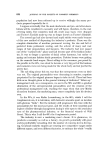
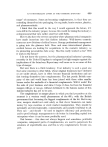
656 JOURNAL OF THE SOCIETY OF COSMETIC CHEMISTS The eosins for stains and pigments were dull and drab. Now there is a whole range of stains with new type lakes, which are bright and transparent with colour. The United States Food and Drug Administration forced such tight controls on medically acceptable colours for use on skin and hair, that the manufacturers of them have become aware of their responsibility to produce pure, clean, bright colours on a repetitive basis. These were the days of wood alcohol, and Q spirit was yet to come. Base formulations were not very scientific today they are. Most materials were of natural origin. Now many are especially synthesized for specific effect, compatibility and prolonged shelf life. You fellows can now produce more or less any type of emulsion and it will only break under circumstances of your choosing. In the $0's emulsions were liable to break at very embarras- sing moments - for example, the undesirable elements of wool fat have been eliminated. But let me now get on to the second decade, the 40's, the war period. These were the years of frustration and awakening, of growth despite control, of improvisation, of hard-fought-for but eventually accepted recognition of the industry by the government, of black marketeering because of ridiculous Purchase Tax and LIMOSO legislation, and of final governmental recognition in everything but taxation, that cosmetic products were a necessary part of the life of our female population, and not a luxury that should be discouraged. It was in this period that manufacturers really helped one another and barriers were broken down. Mind you, they had little option - the Concen- tration of Industry Regulations saw to that. Industrial and military uses were found for our products. Barrier creams against dermatitis in govern- ment filling factories during the critical period of the war, reduced enforced absenteeism enormously when the problem was tackled by the industry's experts instead of by civil servants. Facial camouflage was developed for the Chindits. The high conversion factor of your products was eventually seen by the authorities, and your industry was then able to expand at home in direct relationship to the way in which it expanded abroad, but by its own efforts. This was a period when the industry's standing with the government was at its highest point. True, this was brought about through adversity, but there was a great togetherness. In subsequent years, this deteriorated to a point where the relations between top government and the industry have, it seems to me, reverted to the complacently bad, old pre-war days. I hasten to add here that I think that today maybe we deal generally
Purchased for the exclusive use of nofirst nolast (unknown)
From: SCC Media Library & Resource Center (library.scconline.org)