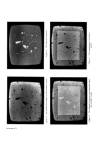
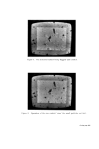
702 JOURNAL OF THE SOCIETY OF COSMETIC CHEMISTS (36) Williams, ]. C. Process. Engng. 173 (April 1965). (37) Wolf, E. E. and Hohenleilen, H. L. Trans. A.S.M.E. 67, 585 (1945). (38) Richards, J. C. Brit. Coal Util. Res. Assoc. Monthly Bull.,57, Nos. 27 (February 1968) Review No. 219. Introduction by the lecturer Films just sho•vn illustrated examples of the complex regimes of motion that may take place •vithin mechanical equipment. The feature to be noted is that motion in the bulk is rarely completely even and although slip planes may form on boundary layers of static material or bet•veen masses moving at different speeds, bulk shear allo•vs local differences in voidage (or compaction) according to the local stresses. Oper- ationally, the vie•vs •vere taken through sectionalized glass-sided hoppers fitted •vith discharge scre•vs and sho•ved the •videly ranging patterns of flo•v given by various scre•v designs and different test materials, thus confirming the inadequacy of design predictions based on mechanical features, dimensions or speeds of operation only. The change of state of po•vder in its path through various regions of the equipment also illustrated ho•v the elemental approach to po•vder route can indicate overall performance characteristics and expose detailed potential hazards to smooth oper- ation. DISCUSSION A MEMBER OF T}•E Am)•F•C•: Mention is made of "free surface activity" in relation to the unconfined moving boundary of a bulk mass. This brings to mind the concept of surface films and the like. Perhaps the definitions could be rephrased as "free surface motion" to distinguish the effect from particle surface effect. T}• L•CTURER: This is fair comment. At present there does not appear to be a firm terminology on such points and the basic difficulty is to tie do•vn the subject so that reference to phenomena is made •vith a common meaning. "Free surface activity" or "motion" is not a simple mechanism and one •vould •vish to define the depth of the active surface, size scan of particles and other aspects of the situation to have a reasonable appreciation of likely events. A dictionary of terms is certainly needed to introduce consistency and explain j argon essential to understanding and discussion. British Standard 3810: Part 2 defines many points for mechanical handling equip- ment and there is good uniformity of specialised terms and symbols amongst the academic teams now working in the field. When one descends to simple practical aspects and considers the many styles of motion which occur, simple group terms are inadequate to concisely express all particular styles and detail is frequently required on a fragmented basis. A M•.MB•.R OF T•. AuI)•c•: In the film a considerable length of uniform screw was exposed to the product and this common practice frequently leads to trouble. Should not one fayour a screw geometry which changes in section every 1• pitches or so? T• L•cTu•R: The most suitable form of screw to select depends on a number of economic and process factors but is most usually dictated by the flow pattern that

SOME ASPECTS OF HANDLING POWDERS IN MECHANICAL EQUIPMENT 703 one xvishes to generate in the hopper. A screw of uniform pitch and diameter is adequate to discharge an inert powder from the hopper, where the sole duty is to eventually evacuate the total contents without regard for zone order and where the product is not subject to segregation or deterioration of flow properties due to time consolidation. A long slot outlet, and uniform screw construction, are economical means of securing maximum hopper capacity within a limited headroom. A taper form of screxv is virtually essential when outflow is required in all regions of the outlet slot, such as in a mass flow hopper design. In this case a main virtue of the slot construction lies in generating a plane type flow permitting lower wall angles than radially converging flow. "Mass flow" is the term applied when, during dis- charge, the whole contents of the hopper are in motion without dead pockets of material. This avoids adverse flow effects or deterioration of the product due to excessive storage times. A secondary effect of taper worm construction is to reduce the starting and running torque required to cause rotation of the screw. A screw form which generates a live outlet flow pattern also fayours a more consistent rate of volumetric discharge as the contents of the screw tend to be subjected to a more even pressure than a discharge screw working with static material superimposed over a section of its working length. A screw uniform in pitch and diameter will usually give a live outlet at an exposed length of two pitches at low speed, rising to three or four pitch lengths at high speed of rotation. The most suitable specifications for a particular duty resolves to detail design taking account of all these various simple but related process and product factors. MR. J. C. W•LL•A•4S: I would like to revert to the question of terminology. In a comparatively new and rapidly growing technology it is inevitable that there will be semantic problems, particularly since information is being drawn in from a number of academic disciplines and industries. There is need for some agreement about the terms and symbols to be used. In particular, I would refer to the equation in page 695 in which ), is used for shear stress. The general practice of workers in the field of powder technology is to use • for the purpose and I would be glad to see you make this alteration. TI•E L•.CTURER: • tends to be similar to the capital T which is accepted for tensile strength, which is a little unfortunate but I agree that it is desirable to make this alteration.
Purchased for the exclusive use of nofirst nolast (unknown)
From: SCC Media Library & Resource Center (library.scconline.org)