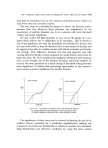
694 JOURNAL OF TttE SOCIETY OF COSMETIC CHEMISTS bulk is basically determined by the degree of compaction or dilation of the solids. An important consideration therefore, is whether motion takes place within fixed boundaries under some compacting pressures or in unconfined conditions as shear strength is related to the stresses normal to the failure surface and high pressures can be generated under confined powder con- ditions. POXVDER STATE The pioneering work of Jenike (2, 3), stimulated the study of industrial powders in various states of stress and a framework is now set to relate the storage, handling and mixing of powders to the flow properties of the material in these various states, and the mode of operation of each section of the equipment. Although various rheological models have been built froIn elementary mechanisms to examine the complex behaviour of materials such as dough and paint (4), particulate solids are usually found in rigid plastic, elastic or quasi-fluid states depending on the conditions of stress and strain to which they are subjected and due to the many variable of materials, no simple model is adequate. However, flow is essentially a mechanism in- volving interparticulate motion in the form of shear, therefore, it is of primary interest to establish how the resistance to such motion, i.e. shear strength, varies in the differing conditions to which the bulk materials are subject. It is found that the degree of consolidation of the powder has a funda- mental relationship to the shear strength developed. Hvorslev (5) showed that the shear stress to cause material flow can be uniquely related to normal stress and the voids ratio of the mass. The "critical state" condition is attained by a yielding, confined, particulate material when flow continues without change in voids ratio for a given relationship of normal and shear stress. This state is shown by Rosco, Schofield and Wroth (6) to be independent of starting or transitional conditions. Shearing of surfaces from static conditions will. generally, cause local increase in voids on the failure plane due to particle interference (7) resulting in some dilation or "dilitancy" (8) in the shearing regions. Williams and Birks (9) have suggested that the work done in shear may be considered in the two parts of that lost in internal friction and that necessary to displace the normal load. A review of considerations affecting powder behaviour under various

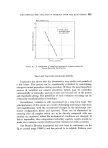
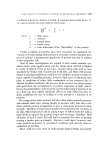
SOME ASPECTS OF HANDLING POWDERS IN MECHANICAL EQUIPMENT t305 conditions is given by Ashton et al (10). A constant shear index factor, N, for a given poxvder has been derived of the form where ¾ : shear stress C • cohesion c• = normal stress T = tensile stress N = some indication of the "flowability" of the powder. Tensile strengths of powders have been measured by equipment de- veloped at Warren Spring Laboratory (11) and some evidence has •also been given to indicate a fundamental significance of particle size only in relation to flow properties (12). Most of these investigations are related to flow within confined con- ditions under some applied stress and the Jenike shear cell (12) is limited to study of limited strain at low rates. Annular shear cells such as that described by Walker (14), Scarlett and Todd (15), and Birks (1t3) provide means of reaching equilibrium conditions for indefinite periods of strain. In many regions of handling powders, however, high rates of distortion take place in conditions of either little confinement or low pressures due to dilation. In dilate conditions, the presence of air creates a two phase system and apart from the circumstances of particle separation or light contact forces, the permeability of the material and the lubricating properties of air as a fluid can have highly significant effects on bulk behaviour (17). In static conditions the rate of settling of a fine powder is a function of its porosity. The escape of air under pressure will then allow higher particle pressures and reduced voids ratio, causing density to increase with time due to the closer particle packing arrangement to give a consequent increase in shear strength. The effect of temperature should not be ignored as the viscosity of air rises with temperature and in taking longer to diffuse from the bulk is more likely to support the particles longer and encourage "flooding". Mild vibration of such a static bed will tend to increase the order of packing causing a further gain in strength. Excessive work input, however, may cause particle separation in unconfined conditions and prevent close co- ordination of particles. Much work has been done on bulk storage hopper design and specific
Purchased for the exclusive use of nofirst nolast (unknown)
From: SCC Media Library & Resource Center (library.scconline.org)