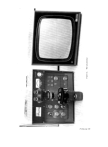
690 JOURNAL OF THE SOCIETY OF COSMETIC CHEMISTS consecutive evaluations of the same material), but it increases the observed level of difference between different samples. If increased counting loads are expected above those normally handled by the system, they may be accommodated by means of extensions to it. These include a data multiplexer which may be used in combination with a variety of display and output systems, such as typewriter output, punched tape, and accumulating digital displays. In combination with this there is an automatic stage device which moves the stage in a predetermined manner so as to present up to 500 fields of view for examination in 10 min. This means one immediately has a problem of handling data, rather than evaluating the specimen. Just as with the output, a variety of input systems may be used, enabling us to cover a wide range of sizes, from nanometres to centimetres. These include an electron microscope, visual microscopy (with incident or transmitted light, and dark field or phase contrast) and, at the macro end of the scale, there is an epidiascope attachment. This flexibility allows for a wide variety of applications and the Quantimet is beginning to enter a variety of fields, including experimental pathology and neurology bac~ teriology, for measuring the size of bacteria colonies and quantifying measurements taken from microbiological assaying haematology for counting cells odentology for measuring the size and number of cracks in the teeth in X-rays pharmacology, botany, and a very large field involving metallurgy, which is the original application of the instrument. It will size anything provided a suitable visual image is provided for it, including grain size of inclusions, and various phases in the metal. It is being used in solid state physics, mineralogy, nuclear physics, photography, radiobiology, air pollution, fibre technology, powder technology, pigment technology, and to study sieves, and aerosols. DISCUSSION MR. C. PUGH: How much does this rather versatile instrument cost? Ta•. L•.CTUR•R: The basic instrument as described above costs just under f5 000. It varies a little, depending on the optical system. This stage is really a research instrument. The time involved is largely taken up by winding from one field of view in the specimen to another, and recording the results manually. The next stage of the instrument, the Multiplexer Unit and a teletype output, add another •3 000 to the basic price. This considerably reduces the work load in- volved and releases a maj or part of the operators' time for other things. DR. R. PUGH: The Quaniim•t converts a volume into a projected area. Hence for solid suspensions, the volume to area conversion is only 100% true for perfect spheres. Do you have any data which will assess the amount of error incurred with irregular particles? T•I• L•.CTUR•R: Quite a lot of information has been published on this problem, which is a steriological one. The variations in particle shape can introduce many errors when the surfaces are randomly orientated. I myself am not particularly qualified to answer your question because I have no direct personal experience. The

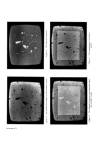
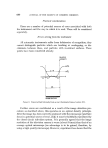
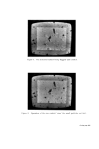
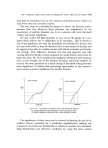
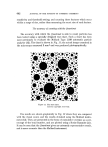
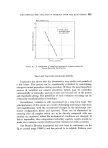
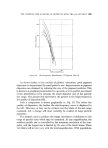
THE PARTICLE SIZE ANALYSIS OF PIGMENTS WITH THE QUANTIMET {591 pigment particles as studied by us, when distributed in a plastic matrix, are fairly regular--almost spherical. Dry. R. PucK: May I have some information on how your results compare with those obtained by a method which measures the volumetric characteristics of the particle? T}•E LECTURER: I do not know of any published results which compare a volumetric type of instrument, such as a Coulter counter, with the Quantimet or microscopic examination. The basis of selection of instruments for an evaluation is very much dictated by the samples which are being examined. Since a Coulter counter (or any other method come to that) which does not involve microscopy cannot be used to evaluate the type of specimen with which I am faced, the result is largely academic. For this reason I have made no attempts to compare the Quantliner •vith other instruments. Powders are not very easily evaluated on the Quantimet, simply because one cannot examine the particles before they have been separated. This imrnediately introduces the problem of the reproducibility of dispersion techniques. PROF. H. E. ROSE: You say--"however, such microscopic methods have been of value in directly measuring the dimensions of the particle unlike sedimentation which gives the equivalent size". What does this mean? Sedimentation gives a definite size, that is the size of a sphere which has the same rate of fall as the particle. So to that extent i•is a direct measurement. But when you use a microscope and the particle is non-spherical, what dimension do you get? It depends on the orientation of the particle. So I am not at all convinced of the accuracy of the statement that microscopes are more direct and definite. I feel that Fig. 1• will give the unwary a completely unjustified feeling of confidence. Doubtless this result is true for a sample such as that shown in Fig. 11, where all the particles lie in one plane. But in a real sample the particles do not lie in a plane and the fine particles will be lost. Particles within the depth of focus will be seen, so will those just outside it. Particles right outside it will be out of focus. So, depending on the depth of focus of the instrument, there is a risk of losing some particles, if they are beyond the plane of focus. In the section dealing with solids suspension (page 685) it is not quite clear what is being measured. Is it the size of the intersection figure on the cut surface or is it the diameter of the particle? As regards Fig. 13, I find it rather difficult to see what that really proves. The curves are smooth but there seem to be no experimental points. Furthermore, the results do not appear to have been tested against any independent method. TEE L•c•um•: Hoxvever one looks at a technique such as sedimentation, the answer obtained is purely an average of the particular particle characteristic being measured, in terms of an equivalent size. One can bring in such things as form factors when examining a particle by a microscopic tenchique, simply because one is able to determine the size of the particle in any particular direction. One cannot necessarily do this with other forms of technique. Therefore the dimension, provided it is defined, is absolute. Concerning depth of focus in relation to large particles as coinpared with small
Purchased for the exclusive use of nofirst nolast (unknown)
From: SCC Media Library & Resource Center (library.scconline.org)