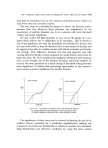
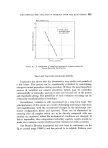
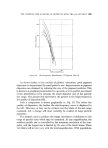
692 JOURNAL OF THE SOCIETY OF COSMETIC CHEMISTS particles, our technique has involved thin section microscopy, and so far we have not used an optical magnification on the microscope which has involved a depth of focus which was smaller than the thickness of the section which we examined. For this reason it is unlikely that the small particles will be lost. If the small particles cannot be resolved, (and this is just as much of a problem with the Quantimet as with any other microscopic system) one must resort to a higher degree of magnification, e.g. the electron microscope. The difference between the observed and the real particle size distributions arises from the possibility that a random section may not cross a particle at its maxi- mum diameter. Although corrections can be made statistically so as to overcome this problem, we have not attmnpted such a transformation as yet. On your final point--these results have not been tested against any other method because of the difficulties presented by the presence of the plastic matrix. It was the very presence of this matrix, which prevents us from being able to use the better established techniques. However, I see no reason why this should detract from the general usefulness of the Quantimet. DR. J. GLAsB¾: Surely the question of which diameter you measure does not really come into it. The camera sees a silhouette of the particle against the illumination source. The size of the particles therefore is the projected area in the direction of viewing and you will not see the smaller diameter at all. THE LECTURER: I agree that since we are viewing all our specimens under trans- mirtent conditions, we will see the maximum diameter of that part of the particle which is in the section. DR. N. A. R. LEROUX: Can the Quantimet be used to examine emulsions and can you clarify what you mean by the opacity of the sample? TaE L•CTUR•R: The opacity of a sample is a limitation resulting from high con- centrations of the particles which are being examined. If, for example, there is a lot of titanium present there will be a lot of light scattering, and the opacity of the sample as a whole will be very high. Very little light will pass through it. The television camera does have some capacity to accommodate variations in illumination. but it is very small in comparison with the human eye. The Quantliner will thus be able to evaluate the sample, if the opaque particles are relatively far apart, and if the concentration is not too high. If the particles are transparent you will only detect the boundaries, provided the refraction of the medium is high enough to show the particle. DR. N. A. R. LEROUX: Should the particle frequency in Fig. 18 be expressed as a percentage? You state, that "the better the quality of dispersion, the further the size frequency curve moves to the left." Should this not be the cumulative size frequency curve? T•E LECTURER: No. What I may not have made completely clear is the fact that the complete size range of those pigment particles which we are examining is beyond the range of our examination. A large percentage of the particle population, whatever the pigment, is in fact beyond the lower limits of resolution. Therefore that part of the curve which I have drawn, is the upper range of the total population plotted as size frequency. If the size distribution does improve, then it will move back towards the origin, due to the disappearance of the larger particles.

J. Soc. Cosmetic Che•nists 20 693-703 (1969) ¸ 1969 Society of Cosmetic Chemists of Great Britait, Some aspects of handling powders in mechanical equipment L. BATES* Presented at the sym,posium on "Powders", organised by the Pharmaceutical Society of Ireland and the Society of Cos•nelic Chemists of Great Britain, at Dublin, on 17th April 1969. $ynopq•--The paper outlines the concept of controlled powder state throughout its complete route in the factory with particular reference to mechanical bulk handling techniques. INTRODUCTION Mechanical equipment for handling particulate solids falls into two broad categories. Either they are moved via a supporting surface or con- tainer, e.g. belt conveyor, bucket elevators, or are promoted to motion by the influence of one or more pressure faces and the effect of gravity. A summary of the various types of machines is given in British stan- dards (1). In the former cases, the effect of material characteristics are mainly related to feed and discharge conditions. Features such as dust, abrasion contamination, etc., are generally predictable from an understanding of the specific characteristics of the material being conveyed. Attendant feed hoppers and chutes are subject to independent design considerations taking account of possible vibration, air flow, condensation, or other extraneous interference from the local conditions. En masse conveyors, on the other hand, achieve a condition in the powder due to the influence of relative motion in the mass, slip on walls and blades, and free surface activity in- fluenced by gravity. The behaviour of a powder is determined by this state which it attains as the relative freedom of interparticulate motion of the *Fairxvay Engineering Co. Ltd., •rorsley, nr. Manchester. 693
Purchased for the exclusive use of nofirst nolast (unknown)
From: SCC Media Library & Resource Center (library.scconline.org)