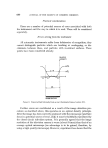
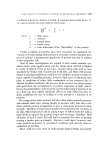
JOURNAL OF THE SOCIETY OF COSMETIC CHEMISTS design technique is available with supporting theory (18, 19). Modulations of various kinds have been proposed (20-25) and a comprehensive collection of many aspects of powder storage and flow has been published (26). The influence of gravity in the effective regions of mechanical equipment is significant by stimulating motion in a preferential direction. Notes on gravity flow of solids in bulk (27) are equally relevant to the behaviour of powder in machines. MECHANISMS OF POWDER MOVEMENT A detailed study of the elemental mechanisms and regimes of motion for bulk solids in live conditions will often outline significant characteristics of equipment which may or may not be dominant operational features. The mechanisms repeat in different classes of equipment and often may be isolated for tests. (a) With references to the machine walls, bed, blades, buckets etc., the boundary layers may be either static or sliding. (b) The internal particle structure may be virtually rigid, i.e. static or moving En masse, possess narrow failure planes where one section is moving relative to another, or be in bulk shear where there is a general flow or readjustment of particle arrangement. (a) "Static" powder/wall effects are mainly due to wall pressure but the duration of contact may also contribute to time compaction or increased adhesion to the surface. The main point to consider is whether the forces acting on the powder will cause a firrn compact to be created which will not fail when required to do so in the equipment. In the case of hoppers, such a prediction can be made from a Jenike cell test (13). In mechanical equip- ment the compacting forces and stresses available to cause failure are less easy to establish but if the relationship is understood one can draw general guide lines. In respect of adhesion, one should take account not only of surface relationships of the wall outside solid and contact pressure but also the effect of contact surface area and sh.ape in relation to prospective attached masses, e.g. in vertical 90 ø crevices with bulk material tending to hold up in a simple radiused crevice, the cross-sectional area of solid, hence weight of fillet, is proportional to R2 1--• whereas the surface area is proportional to 2R. Thus there is a linear function a- 1-- tending to 2

SOME ASPECTS ()F HANI)LING POWDERS IN MECHANICAL EQUIPMENT 697 limit the size at which residue clinging to a corner will be stable and usually some idea can be gained of the internal radius which would stay free of material. Similarly, there is a critical tube diameter which will pass weight a solid plug of cohesive material en masse as the surface area increases in direct proportion to diameter. The effect of slip on walls or working faces is easily appreciated. In some cases relative motion is essential for the equipment to work, e.g. scraper conveyors and helical screws. However, even in such cases, the full casing contact areas may not be slipping and one may be faced with a conveyed bulk in one state of turbulence and a relatively dead layer against the walls. The flow pattern of matehal with or around the moving blade may be complex (28, 29). Where the movement is relatively near to a fixed wall surface, "leakage" may take place and the flow or no-flow through the gap has similarities to the form of flow through a slot outlet of an asymmetric hopper. Apart from the obvious danger of particles jamming in the clearance. a form of structural arching may occur unless the gap is many times wider than the particle diameter, the actual ratio depending mainly on the blade angle, particle shape and powder state. Structural arches of this kind are statistical probabilities extremely sensitive to low ratios of particle/ orifice sizes (27, 30). The movement of a layer of material in the clearance space will depend on the strength of the material shear plane, area of failure and pressure normal to this shearing surface on the one hand and the cohesion to the wall, wall pressure and contact area on the other. The point may be vital with relation to contamination, degradation of the residue or flow pattern from a hopper {,31), in which case minimum clearance and a low friction surface minimises the stability of a dead layer and assists slip. (b) Completely undisturbed beds of material are rare in practice. Apart from spurious minor vibrations, there are usually small amounts of yielding or plastic deformation due to self-pressure. Solids in motion are relatively roughly handled and compaction is stimulated by vertical accelerations whereas segregation is favoured by vibration of a bed in a mild state of dilation. Motion en masse as in belt conveyors and mass flow hoppers, usually minimises segration and changes in powder state but loading and unloading techniques are major conditioning processes as dealt with below under chutes and "streams".
Purchased for the exclusive use of nofirst nolast (unknown)
From: SCC Media Library & Resource Center (library.scconline.org)