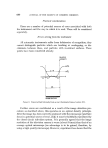
SOME ASPECTS OF HANDLING POWDERS IN MECHANICAL EQUIPMENT 699 transitional points of the route into and out of machines should receive detailed attention (36) with reference to the powder change of state, e.g. "slow" chutes passing a live plug of matehal should be provided with room for expansion of the mass at a change of direction {37) even if subsequent reduction of the flow channel is required. This feature is often given unconsciously by "wear boxes" designed to avoid abrasion of chute matehal at points of change in direction of chutes. It is common practice to consider chutes as mere sealed communicating channels between sections of plant whereas vertical falls, projecting ledges, wall irregularities, crevices and impingement points all contribute to the conditioning of the powder stream and apparently minor features can lead to flow stoppage (38). Once a chute even of modest length is blocked, in- creasing the feed pressure invariably fails to promote flow due to regener- ative wall friction and if the feed in is by mechanical means, overload or failure of some part is incurred. LIMITATIONS OF PRESENT THEORY 1. It appears obvious that no refinement of theory can accommodate a lack of fundamental data relating to variations of moisture content, tem- perature, organic or chemical reactions, variation in product, surface finish, etc., but in many cases precision is not possible for reasons of un- certainty, or confounding of variables. It may not be economic or possible to design for the worst combination of conditions but the effect of ex- ceptional conditions on both plant and production should be assessed in budget and contingency planning. 2. On the smaller scale, a large number of detail problems may not be economic to solve or even investigate. This is a practical rather than negative approach for example, the flow properties of small hoppers can frequently be established most economically by full scale test. Whether to do this by a "bare" trial hopper or manufacture the final item of equip- ment, is an economic calculation taking account of a subjective judgement of risk and cost based on experience. 3. Various forms of "imperfect" materials create testing problems, fibrous, rod shaped, flocculent, interlocking, materials with transient properties, indeterminate moisture distribution or slip-stick character- istics. 4. Safety factors included in theoretical designs may lead to conser- vative solutions incompatible with other limiting considerations of site or

700 JOURNAL OF THE SOCIETY OF COSMETIC CHEMISTS economy. The main practical aspects of such a situation is to relate the savings given by incurring the risk of operational failure, taking account of the cost and certainty of various means of redress. 5. Expressions for flow formulae are limited to simple channels of conical or plane symetrical flow. 6. No account is usually taken of accelerations, isotropy, local failure planes, the effect of discrete particles as opposed to a continuum, and certain simplifying assumptions are necessarily included in theoretical analysis. 7. Indeterminate operational conditions, e.g. filling hopper or mixers do not permit starting conditions of a system to be predictable. CONCLUSION The subject contains a great many variables of which some may be trivial or irrelevant in some cases and dominant in others. It is hoped that in context it is permissible to outline a few simple notes and rules. (a) The sheer number of locations in a system where powder conditions are likely to change in state preclude any comprehensive analysis or tests to give absolute determination of powder condition. The object therefore should be to understand the cause and effect of various powder conditions and review each detailed point with respect to potential hazards. Major dangers such as arching, blocking, flooding, and compacting should receive detailed consideration where appropriate. The basic concept of a powder existing in a unique state for a specific voids ratio and state of stress enables:- (i) The consistency of the handling properties of various samples of a powder to be measured and compared. (ii) Specific design parameters for hoppers to be derived. (iii) Classification by comparison of flowability of powders. (iv) Prediction of bulk behaviour to be made in specified conditions. (v) The breakdown of powder/mechanical activities to be considered on the elemental scale of a system. (vi) Attention to be directed to the conditioning of powder state by the mechanisms and transfer points of a continuous handling system for a stream of powder. (b) The entire flow path of a powder should be reviewed in the light of powder condition and local behaviour under the separate features of flow failure or flooding, segregation, attrition, dust, wear, contamination, residue, dead pockets, cleaning, etc., taking account of all variable con-
Purchased for the exclusive use of nofirst nolast (unknown)
From: SCC Media Library & Resource Center (library.scconline.org)