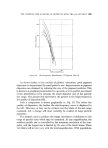
SOME ASPECTS OF HANDLING POWDERS IN MECHANICAL EQUIPMENT 703 one xvishes to generate in the hopper. A screw of uniform pitch and diameter is adequate to discharge an inert powder from the hopper, where the sole duty is to eventually evacuate the total contents without regard for zone order and where the product is not subject to segregation or deterioration of flow properties due to time consolidation. A long slot outlet, and uniform screw construction, are economical means of securing maximum hopper capacity within a limited headroom. A taper form of screxv is virtually essential when outflow is required in all regions of the outlet slot, such as in a mass flow hopper design. In this case a main virtue of the slot construction lies in generating a plane type flow permitting lower wall angles than radially converging flow. "Mass flow" is the term applied when, during dis- charge, the whole contents of the hopper are in motion without dead pockets of material. This avoids adverse flow effects or deterioration of the product due to excessive storage times. A secondary effect of taper worm construction is to reduce the starting and running torque required to cause rotation of the screw. A screw form which generates a live outlet flow pattern also fayours a more consistent rate of volumetric discharge as the contents of the screw tend to be subjected to a more even pressure than a discharge screw working with static material superimposed over a section of its working length. A screw uniform in pitch and diameter will usually give a live outlet at an exposed length of two pitches at low speed, rising to three or four pitch lengths at high speed of rotation. The most suitable specifications for a particular duty resolves to detail design taking account of all these various simple but related process and product factors. MR. J. C. W•LL•A•4S: I would like to revert to the question of terminology. In a comparatively new and rapidly growing technology it is inevitable that there will be semantic problems, particularly since information is being drawn in from a number of academic disciplines and industries. There is need for some agreement about the terms and symbols to be used. In particular, I would refer to the equation in page 695 in which ), is used for shear stress. The general practice of workers in the field of powder technology is to use • for the purpose and I would be glad to see you make this alteration. TI•E L•.CTURER: • tends to be similar to the capital T which is accepted for tensile strength, which is a little unfortunate but I agree that it is desirable to make this alteration.

Book reviews PROGRESS IN ORGANIC CHEMIS- TRY-7. Editors: Sir James Cook and W. Carruthers. Pp. vii + 166 + Ill. (1968). Butterworths, London. •4. "Another 'Progress' or 'Advances' book?" - a casual reader might say - but he should recognise that this is a new volume in a well established and impres- sive series that began in 1952, although it has appeared less frequently in the sixties. The ambit lies somewhere between periodic monographs restricted to advances in specialist areas such as chromatography, spectrometry or specific natural products such as fats and lipids, and superficially compre- hensive reviews such as those annually compiled by the Chemical Society. Even in the later publication the rate of growth and complexity of contemporary endearour is forcing in the concept of what in today's idiom might be termed 'mini-monographs'. Previous volumes in the series presently under review have tended to emphasize the advance in our knowledge of natural products and this number is no exception. Thus, two of its five chapters are devoted to areas of natural product chemistry a third chapter is concerned with phosphoryl transfer processes of fundamental bio- chemical significance a fourth supplies a dissertation on the mechanisms of electrophilic molecular rearrangements and in the fifth two West German authors contribute an examination of theory and observation of (mainly aromatic) hydrocarbons having some acidic character. The tetracycline family of broad spectrum antibiotics constitutes a firmly consolidated area of natural product chemistry and biochemistry. Although in several ways less systematic than the recent review by Clive (1), Scott and Money's chapter is perhaps more read- able especially in its helpful structural 'flow charts'. In their largest section they survey the chemical reactivity of the numerous functional groups of the tetracyclines and their transformations. The section on biogenesis is both succinct and informative and, like Clive (1), they wisely do not attempt to condense the earlier exhaustive review of syn- thetic methods by G. C. Barrett (2) but instead confine comment to salient features. The other natural products chapter rehearses evidence, some of it recently provided by the author himself, for the structure of the salamander alkaloids. Despite one of these bases having been first isolated a century ago, the structure has only recently been definitively established for the series of steroid related alkaloidal toxins found in the skin gland secretion of a veno- mous Salamander species that may cause respiratory paralysis in any animal. Dr. I-tabermehl briefly refers to his own tracer studies in making some highly speculative comments on bio- synthesis: in view of the isolation of several esters of cholesterol in the skin gland secretion, this may be of some interest to cosmetic chemists. I-Ie con- jectures that oxidafire degradation comparable to that in toad secretion 705
Purchased for the exclusive use of nofirst nolast (unknown)
From: SCC Media Library & Resource Center (library.scconline.org)