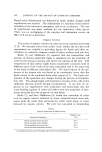
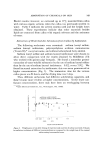
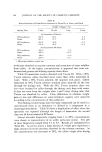
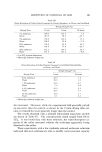
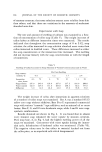
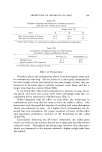
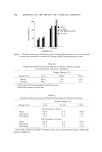
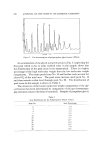
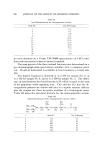
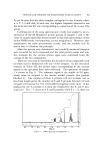
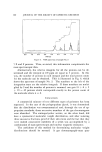
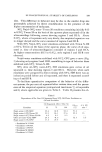
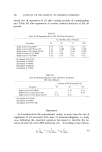
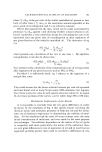
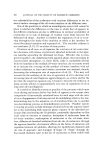
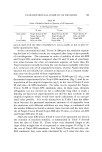
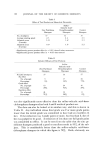
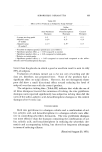
ABSORPTION OF CHEMICALS ON SKIN 151 The experiments with polyethylene glycol in water (Table X) showed that high amounts of this humectant reduce uptake of water by the callus piece and thereby restrict swelling, while at the same time soluble components were retained in the stratum comeurn. The table shows weight changes of callus pieces immersed in water, immersed in a 20% solution of polyethylene glycol, and immersed in a 50% solution of polyethylene glycol. The results were similar to the ones obtained pre- viously with a surfactant (Tween 80). CONCLUSION Use of callus is a fast screening method for the study of the effect of various compounds on ordinary skin, especially if one takes into con- sideration that there are differences in skin properties according to loca- tion on the body and the particular individual. It is assumed that the same chemicals, which have an effect on tough, hard callus, will behave similarly with thin stratum corneum. Extension to wider ranges of concentration than usually investigated indicated that it is fallacious to make generalized conclusions from single concentrations. It was also shown that the water-binding properties of stratum corneum can be modified by water-soluble materials. Finally, when a mixture of compounds acts on stratum comeurn, there is an inter- action of these compounds as shown in the effect of soap and humectant on skin swelling in water. ACKNOWLEDGMENTS We wish to thank Dr. Fred Siegel for his helpful discussions during our investigations, and Mr. M. Baki for his assistance in conducting the experiments. (Received August 6, 1971) REFERENCES (1) Polano, M. K., The interaction of detergents and the human skin, J. Soc. Cosmet. Chem., 19, 3 (1968). (2) Marzulli, F. N., Barriers to skin penetration. J. Invest.. Dermatol., 39, 387 (1962). (3) Ginn, M. E., Noyes, C. M., and Jungermann, E., The contact angle of water on viable human skin, J. Colloid Interface Sci., 26, 146 (1968). (4) Ginn, M. E., Dunn, S.C., and Jungermann, E., Contact angle studies on viable human skin. Effect of surfactant ionic type in pretreatment, J. Amer. Oil Chem. Soc., 47, 83 (1970). (5) Carney, R. G., Confusing keratotic lesions of the sole, Cutis, 7, 32 (1971). (6) Pillsbury, D. M., Shelley, W. B., and Kligman, A.M., Dermatology, W. B. Saunders Co., Philadelphia, Pa., 1965.

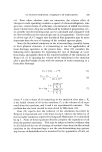
152 JOURNAL OF THE SOCIETY OF COSMETIC CHEMISTS (7) Blank, I. H., Further obsexwations on factors which influence the water content of the stratum corneum, J. Invest. Dermatol., 21, 259 (1953). (8) Singer, E. J., and Vinson, L. J., The water-binding properties of skin, Proc. Sci. Sect. Toilet Goods Ass., 46, 29 (1966). (9) Middleton, J. D., The mechanism of water binding in stratum comeurn, Brit. J. Der- matol., 80, 437 (1968). (10) Wheatley, V. R., The role of cutaneous lipiris in emollient action, Proc. Sci. Sect. Toilet Goods Ass., 40, 17 (1963). (ll) Reinertson, R. P., and Wheatley, V. R., Studies on the chemical composition of human epidermal lipids, ]. Invest. Dermatol., $2, 49 (1959). (12) Kooyman, D. J., Lipiris of the skin, Arch. Dermatol. Syphilol., 25, 444 (1932). (13) Middleton, J. D., The mechanism of action of surfactants on the water binding prop- erties of isolated stratum corneum, J. Soc. Cosmet. them., 20, 899 (1969).
Purchased for the exclusive use of nofirst nolast (unknown)
From: SCC Media Library & Resource Center (library.scconline.org)