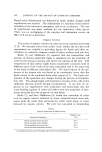
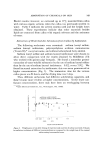
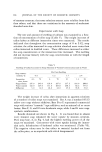
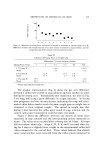
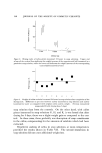
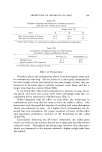
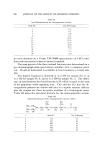
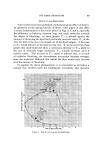
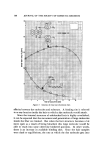
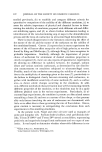
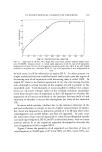
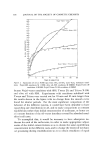
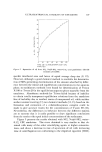
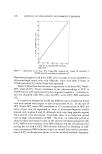
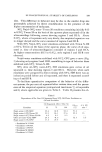
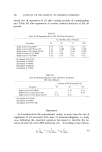
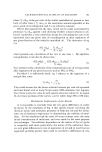
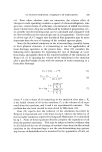
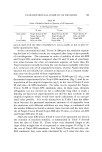
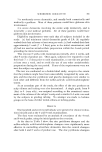
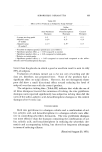
ULTRACENTRIFUGAL STABILITY OF EMULSIONS Table IV Order of Stability Based on Quantity of Oil Separated 185 % Oil Separated After Oilmax 25 min 75 min (%) Most stable Nujol-Triton X-100 Nujol-Triton X-100 Nujol-Tween 20 • Nujol-Tween 20• Nujol-Tween 20 Olive oil-SDS Nujol-SDS Olive oil-SDS• Nujol-SDS Least stable Olive oil-SDS Nujol-SDS j tant as used with the other emulsifiers it was so stable as not to give re- liable quantitative data. At the concentrations used, Triton X-100 gave the emulsion separat- ing the least oil whether results are compared after long or short periods of centrifugation. The inversion in order of stability of olive oil-SDS and Nujol-SDS emulsions compared after 25 and 75 min of centrifuga- tion arises because the olive oil emulsions separate oil faster than the Nujol emulsions initially but then the rate decreases markedly with time (i.e., as the per cent of oil separated increases), whereas Nujol emulsions separate less oil initially but continue to separate it at a constant steady- state rate over the period of these experiments. The maximum amount of oil separated at 39,400 rpm (% oilmax) was determined experi•nentally for Nujol-SDS emulsions (Fig. 1) and by ex- trapolation of the empirical equation (eq 1) in the case of Nujol-Tween 20 and olive oil-SDS emulsions. No value can be reported for Nujol- Triton X-100 or Nujol-CPC emulsions since, in these cases, ultracen- trifugation was not carried out for a sufficiently long time to reach a limiting oil separation experimentally nor did the data conform to the empirical equation which would have made calculation of an extrapo- lated value possible. It is worth noting here in Table I that the differ- ences between the presumed maximum amounts of oil separable from the emulsions with different stabilizers are very large, as contrasted with the smaller differences found at shorter time intervals and the near-iden- tity of Nujol-Tween 20 and Nujol-SDS after 25 min, or of olive oil-SDS and Nujol-SDS after 75 min. Much the same difficulty is found if rates of oil separation are used as the criterion of emulsion stability, as summarized in Table V derived from the data of Table II. These values were obtained simply as the slope of the straight line of oil separated rs. time (region II of Fig. 1) in the case of Nujol-SDS emulsions. For Nujol-Tween 20 and olive oil- SDS emulsions, they were easily calculated by eq 2, since the data con-

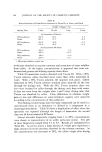
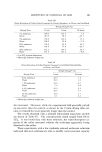
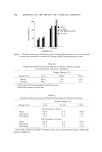
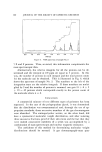
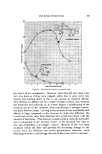
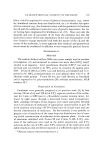
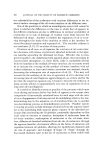
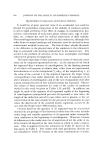
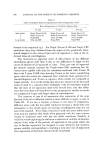
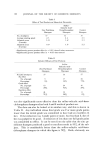
186 JOURNAL OF THE SOCIETY OF COSMETIC CHEMISTS Table V Order of Stability Based on Instantaneous Rate of Separation of Oil Rate of Separation in % Oil Per Minute After 25 min 75 min 100 rain Most stable Nujol-Triton X-100 Nujol-Tween 20 Nujol-Tween 20 • Nujol-Tween 20 Nujol-Triton X-100 Nujol-Triton X-100 Nujol-SDS Olive oil-SDS Olive oiI-SDS Least stable Olive oil-SDS Nujol-SDS Nujol-SDS formed to the empirical eq 1. For Nujol-Triton X-100 and Nujol-CPC emulsions, they were obtained from the slopes of the graphically deter- mined tangents to the curves of per cent oil separated rs. time at the in- dicated times of centrifugation. The inversions in apparent order of effectiveness of the different emulsifying agents with time is due to the differences in shape of the curves of amount of oil separated vs. time. Thus, per cent oil separated per minute remains constant for Nujol-water-SDS emulsions but de- creases more rapidly with time for emulsions stabilized with Tween 20 than with Triton X-100, thus showing Triton as the better emulsifying agent when the results are compared after relatively short periods of ul- tracentrifugation and Tween as superior when results are compared at longer periods. It is worth noting that since the amount of oil separated seems to tend to a constant limit ultimately with all emulsions studied that the rates of oil separation must tend toward zero, and that differ- ences between them will therefore become progressively smaller as results are compared at longer and longer times of centrifugation. The criterion of rate of oil separation after separation of the same fraction of the oil in different systems is more difficult to apply, as seen in Table III. If too low a fraction is chosen as the basis of comparison, difficulty arises with the less stable emulsions because a steady-state rate subsequent to the initial spurt on starting centrifugation may not yet have been reached. If too high a fraction is used, the more stable emul- sions may not separate that much when prepared with the same concen- tration of surfactant used with the less stable emulsions. Possibly, it would be worth exploring the utility as a criterion of stability of determi- nation of the value of the percent oil separated at the point where the rate of further separation has dropped to some arbitrary low number, greater stability corresponding to reaching a near zero rate of separation after separation of the lesser amount of the oil present.
Purchased for the exclusive use of nofirst nolast (unknown)
From: SCC Media Library & Resource Center (library.scconline.org)