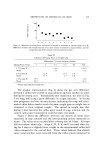
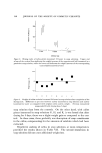
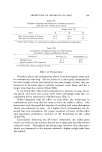
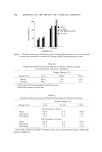
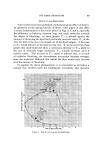
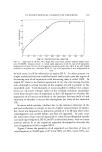
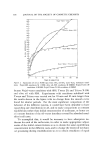
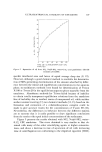
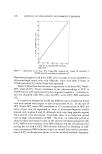
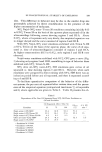
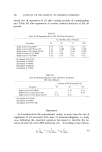
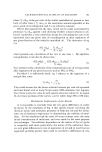
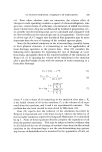
ULTRACENTRIFUGAL STABILITY OF EMULSIONS 181 where % oilsep is the per cent of the initial emulsified oil present as free bulk oil after time t, % Oilma• is the maximum amount separable at the given speed of centrifugation, and b is an arbitrary constant. Where this equation fits the data, which can be easily ascertained by plotting t/% oilsep against t and checking whether a linear relation is ob- tained, it provides a very convenient means for calculating the rate of oil separation after any given time of centrifugation or after separation of any given fraction of the initially emulsified oil. The derivative of eq 1 is d(•o oil•ep) % oilm•x.b - (2) dt (1 q- bt) 2 which permits easy calculation of the rate at any time t. By algebraic manipulation, it can also be shown that d(• oil•ep) b(•o Oilmax -- •0 oilsep) 2 - (3) dt • Oilm• Eq 3 permits ready calculation of the instantaneous rate of oil separation after separation of any given fraction, such as 10% or 30%. Provided b is sufficiently small, eq 1 reduces to the equation of a straight line, since Kt % oilsop -- 1 q- bt (4) This could account for the linear relation between per cent oil separated and time found with so many Nujol-water-SDS emulsions, but requires that b have a very low value in such systems since the values of t in region II--the linear portions of the curves--can be rather large (90 to 120 min). Mechanistic Implications of the Results It is reasonable to conclude from the very great differences in stabil- ity shown by the emulsions of Fig. 2 that specific factors involving the chemical nature and molecular geometry of both the oils and the suffac- rants are of dominant importance in determining the stability of emul- sions. All the emulsions had the same oil-water volume ratio, the same initial concentration of suffactant, and were made by the same prepara- tive technique. Nevertheless, dependent on the nature of the oil (polar rs. nonpolar), and, more particularly, the nature of the suffactant, there are very great differences in rate of separation of oil and in total fraction separated, probably greater than could be ascribed to differences in rela-

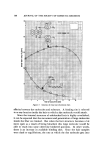
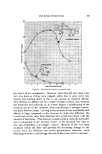
182 JOURNAL OF THE SOCIETY OF COSMETIC CHEMISTS rive adsorbability of the surfactants with resultant differences in the ex- tent of surface coverage of the oil-water interface in the different cases. One of the questions to which an unambiguous answer still cannot be given is whether the differences in the rates at which free oil appears in the different emulsions are due to differences in intrinsic probability of coalescence or in rate of drainage of residual water from between the deformed oil drops. Another is whether the separation of oil is occur- ring throughout the body of the emulsion or solely at the interface be- tween flocculated emulsion and separated oil. The available evidence is not conclusive (2, 12, 17) on either of these points. However, in all cases, as oil separates the total area of oil-water inter- face decreases, with release of previously adsorbed surfactant to the aque- ous lamellae separating the deformed oil drops. Whether this is trans- ported rapidly to the underlying bulk aqueous phase, thus increasing its concentration throughout, or, more likely, some is readsorbed directly from the lamellae at the residual oil-water interface, the net result would be to increase the coverage of the residual oil-water interface with ad- sorbed surfactant, at least until surface saturation was attained, thereby decreasing the subsequent rate of separation of oil (9). This may well account for the tendency of the rate of separation of oil to decrease with increasing time of centrifugation, approaching zero as a limit, and for the fact that the empirical equation (eq 1) found to describe the behavior of many systems reduces to approximately zero rate of separation of oil at long times of centrifugation. It is useful to identify as many as possible of the processes which must occur during coalescence before free bulk oil appears in the system, since comparison of theoretically calculated rates for such steps with the over- all rate of appearance of oil may succeed in establishing which is the rate- determining step in the sequence, or of transition from one to another rate-determining process as demulsification proceeds. Possible rate-de- termining processes include drainage of solution from the aqueous lamel- lae to the underlying bulk aqueous phase rupture of the adsorbed sur- factant film surrounding the oil globules, presumably dependent on film yield value or viscosity or elasticity desorption of surfactants from the oil-water interface readsorption of surfactants at the oil-water inter- face diffusion of desorbed surfactant from the site .of coalescence through the aqueous lamellae electrostatic effects on the forces of attraction and repulsion between oil globules, affecting the equilibrium distances and the rate of approach and transport of larger oil "drops" through the ttocculated emulsion layer to the site of coalescence to form visible bulk
Purchased for the exclusive use of nofirst nolast (unknown)
From: SCC Media Library & Resource Center (library.scconline.org)