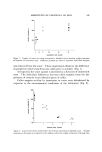
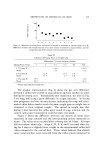
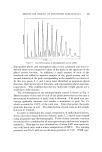
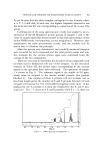
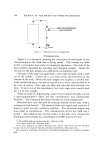
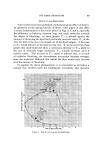
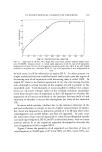
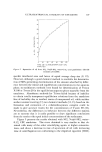
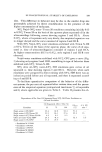
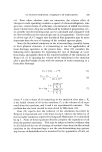
ULTRACENTRIFUGAL STABILITY OF EMULSIONS 177 36 32 2• 24 • 2o -- 0 e 4 o • 4o do d• •6o ' •20 TIME OF ULTRACENTRIFUGATION, MINUTES Figure 3. Separation of oil from 50% Nujol-50% water-0.1% cetyl pyridinium chloride emulsion (A 112669) specific interfacial area and hence of equal average drop size (8, 12). However, although a good chemical method is available for determina- tion of SDS, permitting determination of the amount adsorbed by differ- ence between the initial and equilibrium concentrations in the aqueous phase, no satisfactory methods were found for determination of Triton X-100 or Tween 20 in the equilibrium aqueous phase separable from the emulsions. Absorbance methods for Triton failed because of inability to obtain totally transparent equilibrium solutions from the emulsions free of turbidity due to residual traces of unseparated oil, while neither surface tension lowering (13) nor chemical methods (14, 15) based on the formation and estimation of a cobaltothiocyanate complex could be made to give accurate results for the concentration of Tween 20 (16). Nevertheless, the differences in behavior between the different systems are so extreme that it is easily possible to draw significant conclusions from the results with equal initial concentrations of the surfactants. Figure 3 presents the results obtained with 50% Nujol-50% water- 0.1% CPC emulsions. The curve obtained is very similar to that ob- tained with many of the other emulsifying agents at higher concentra- tions, and shows a decrease in rate of separation of oil with increasing time of centrifugation not conforming to the empirical equation (III-B).

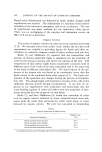
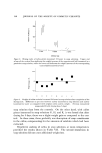
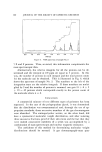
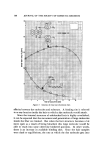
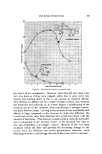
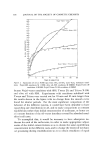
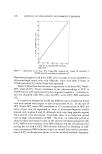
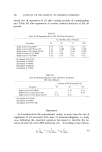
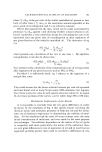
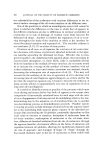
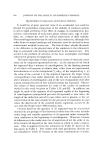
178 JOURNAL OF THE SOCIETY OF COSMETIC CHEMISTS •2 x ¸ 0 •:0 40 60 80 I00 120 TIME OF ULTRACENTRIFUGATION, MINUTES Figure 4. Separation of oil from 50% Nujol-50% water-0.15% Tween 20 emulsion (A 091069) plotted according to empirical eq 1 Emulsions prepared with 0.2% CPC were so stable as to be amenable to ultracentrifugal study only with difficulty, since even after 2 hours at 39,460 rpm only 8% of the Nujol had separated. Figure 4 illustrates that the rate of separation of oil from 50% Nujol- 50% water-0.15% Tween emulsions in the ultracentrifuge at 25øC at 39,460 rpm is well represented by the empirical equation. A similar re- suit was obtained with 50% olive oil-50% water-0.2% SDS emulsions (ll). It is useful to summarize briefly the different types of behavior found with each system with respect to rate of separation of oil. In the case of 50% Nujol-50% water-$D$ emulsions at all concentrations of 8D8, the curve of per cent oil separated vs. time of ultracentrifugation usually showed only regions I and II, although with very long periods regions III-A and IV were also found. Generally, there is no induction period even at high concentrations of 8D8. However, an induction period of about 12 rain was found in some of the present emulsions prepared with 0.4% 8D8 by direct mixing of the $D$ solution and the oil instead of by mixing the oil with a 0.2% $D$ solution followed by blending in suffi- cient concentrated 8D8 solution to give an overall final initial concentra- tion of 0.4% in the aqueous phase, as in the standard method of prepara-
Purchased for the exclusive use of nofirst nolast (unknown)
From: SCC Media Library & Resource Center (library.scconline.org)