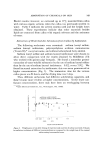
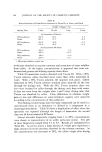
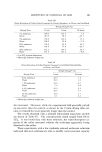
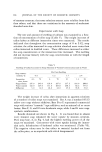
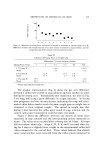
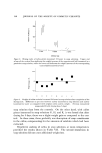
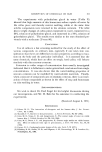
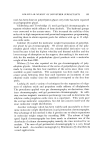
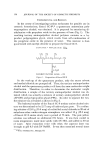
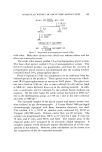
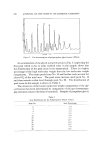
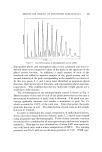
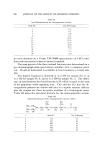
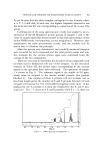
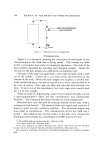
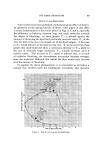
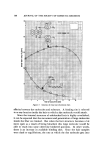
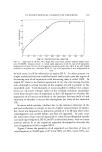
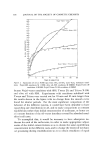
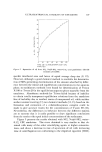
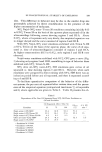
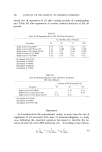
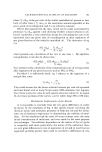
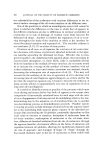
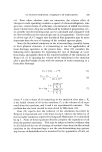
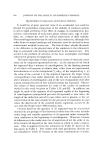
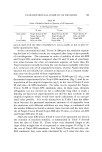
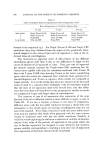
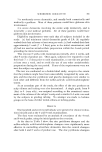
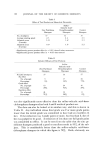
MOLECULAR WEIGHT OF POLYETHER SUKFACTANTS 161 It can be seen that the three samples correspond to the formula where n • 2, $, 4 and that, in each case, the highest fragment observed is not the molecular ion but one corresponding to a mass loss of 15, or one CHa group. Confirmation of the mass spectroscopic results was sought by an ex- amination of the 60 Megahertz proton spectra of samples 1 and $. Be- cause of sample impurities demonstrated in the mass spectroscopic analy- sis the NMR results, by themselves, are not unequivocal. However, they complement the mass spectroscopic results, and the analysis will be shown here to illustrate the principle. After the spectra were determined, two carefully measured integrals were recorded for each compound and the total proton counts and rela- tive integrals for the various proton types were calculated from the average of the two integrations. There are two ways to determine the structure of the compound, each of which will be illustrated with one of the samples. In the structural formula in Table III, the proton types corresponding to the various signals in the spectrum have been indicated. The spectrum of sample 1 is shown in Fig. 5. The reference signal is the singlet at 2.0 ppm, which must be assigned to the acetate methyl protons (the protons labelled A). The number of these A protons will not increase, but as the chain length grows the number of E and F protons between $.2 and 3.8 ppm will increase by 3 for every added propylene oxide unit. If the integral for the A protons is $, then the integral for the E and F pro- tons is 6.$. If n z l, there are 4 E and F protons, while if n z 2, there are 8.0 7.0 6.0 õ.0 4.0 3.0 2.0 1.0 0 PPM f'igure 5. NMR spectrum of sample No. 1

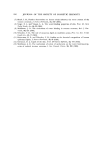
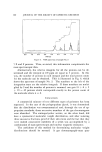
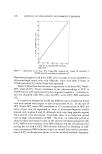
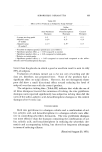
162 JOURNAL OF THE SOCIETY OF COSMETIC CHEMISTS t I I t i I 6.0 5.0 4.0 3.0 2.0 1.0 0 PPM ( • ) Figure 6. NMR spectrum of sample N,o. 3 8.0 7.0 7 E and F protons. Thus, as stated, this information complements the mass spectroscopic data. Alternatively, the relative integrals for all the protons can be de- termined and the integral at 2.0 ppm set equal to 3 protons. In this way, the number of protons in each integral and the total proton count for the molecule can be obtained. This is illustrated in Fig. 6, which shows the spectrum of sample No. 3. The numbers to the left of the integration trace are the relative integrals. If these numbers are multi- plied by 3 and the number of protons is summed, one gets 15 -[- 6 q- 3 q- 19: 43 protons which corresponds exactly to the proton count of the molecule where n = 4. CONCLUSION A commercial mixture of two different types of polymers has been separated. In the case of the polypropylene glycol, it was determined that the distribution was nonsymmetrical and, through the use of ap- propriate standards, three successive members of the gas chromatogram were identified. The aminopolyether acetate, on the other hand, did have a symmetrical molecular weight distribution, and after isolating three successive fractions, proof of their structures and the fact that they were indeed consecutive members of a series was accomplished by a combination of mass spectroscopy and nuclear magnetic resonance. The usefulness of this method for determining molecular weight distributions should be stressed. A gas chromatograph-mass spec-
Purchased for the exclusive use of nofirst nolast (unknown)
From: SCC Media Library & Resource Center (library.scconline.org)