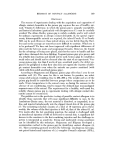
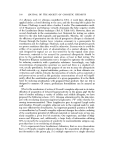
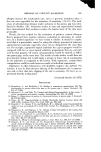
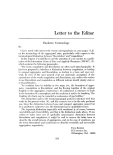
Letter to the Editor Emulsion Terminology Sir: I have noted with interest the recent correspondence in your pages (1,2) on the terminology of the aggregated state, particularly with respect to the terminological distinction between "flocculation" and "coagulation." In this respect, I would like to call the attention of your readers to a publi- cation of the Internation Union of Pure and Applied Chemistry (IUPAC) (3) which contains the following paragraphs: "The terms coagulation and lqocculation are often used interchangeably. It has been proposed to introduce a distinction between coagulation, as leading to compact aggregates, and fiocculation, as leading to a loose and open net- work. In view of the more general (but not universal) acceptance of the equivalence of the words coagulation and fiocculation, any author who wishes to use flocculation and coagulation as different notions should clearly state so in his publication... "An emulsion loses its stability in two steps, viz., the formation of aggre- gates (coagulation or ]tocculation) and the flowing together of the original droplets in the aggregates (coalescence). If coalescence is extensive it leads to the formation of a macrophase and the emulsion is said to be breaking. The breaking of a foam may be regarded as coalescence of gas bubbles." The distinction made in the second paragraph quoted is identical with that made by the present writer (4), and this seems to me to be the only pertinent one. Since the distinction between loose and compact aggregates cannot but be a qualitative, subjective one, the distinction has no quantitative force. The important distinction (especially with emulsions) is, of course, between reversibility and irreversibility, and that is the distinction made above. If one wishes to make some sort of (probably unnecessary) distinction between fiocculation and coagulation, it might be well to reserve the latter term to describe the overall process of aggregation, and, in the case of emulsions, use the terms flocculation and coalescence to describe reversible and irreversible aggregation, respectively. PAUL B•C•Ea ICI America Inc. Wilmington, Del. 19899 213

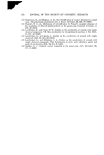
214 JOURNAL OF THE SOCIETY OF COSMETIC CHEMISTS REFERENCES (1) Mittal, K., Conceptual clarification of the terms used to describe emulsion behavior, J. Soc. Co,met. Chem., 22, 815-24 (1971). (2) Evanow, B., Balagot, R., Gold, B., and Evanow, C., Emulsion terminology (letter to editor), Ibid., 23, 681 (1972). (3) Information Bulletin--Ap•endices on Tentative Nomenclature, Symbols, Units, and Standards, No. 3. Manual of Definitions, Terminology and Symbols in Colloid and Sur- face Chemistry, IUPAC, Butterworths, London, 1970, p. 39. (4) Becher, P., Emulsions: Theory arut Practice, 2nd ed., Reinhold Publishing Corp., New York, 1965, pp. 171-2.
Purchased for the exclusive use of nofirst nolast (unknown)
From: SCC Media Library & Resource Center (library.scconline.org)