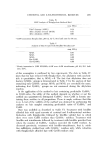
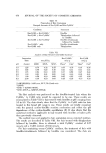
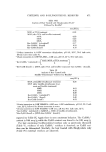
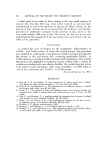
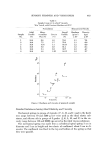
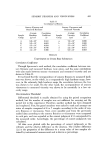
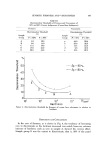
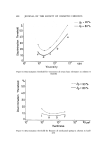
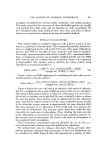
462 JOUBNAL OF THE SOCIETY OF COSMETIC CHEMISTS in determining the relative amounts of cysteinyl (CySH) and S-sulfoeysteinyl (CySSO3-) residues produced in the reaction since, under certain reaction conditions, one might not be expected to obtain equal amounts of each group. The objective of this work was, therefore, to develop an analytical method which quantitatively determines the amounts of CySSOa- Bunte salt and CySH thiol groups in chemically modified keratin. The analytical determination of these residues presents several difficult problems. For example, the method of Elsworth and Phillips (1), which measures the sulfur dioxide evolution after treatment of the modified keratin sample with add, is very laborious and requires replicate samples which contain identical amounts of sorbed bisulfite. Further, the procedure deter- mines only CySSOa- residues and cannot be used to detcrmine CyStt resi- dues. The iodoacetamide procedure (2) and polarographic methods (3) are not useful for the determination of both CySSOa- and CySH residues be- cause at the high pH's needed, reversal of the CySSCy + HSO:4- reaction occurs rapidly and leads to false results. To overcome these difficulties, Valk and Gerthsen (4) expanded the mer- curial titration procedure for CySH residues to determine CySSOa- residues also according to the following scheme: HSO.•- Ker-CySSCy-Ker • a Ker-CySH + b Ker-CySSOa- a Ker-CySH + b Ker-CySSOs- H2SO4 -(a + b) CySH + b SO4 = ICHaCOsH H2504 a Ker-CySH + b Ker-CySSOa- -• (On •-) a a CySCH2CO2H 4- b CySH + b SO4: (3) From eq 2 the combined CySH and CySSOa- contents are determined. From eq 3 the CySH residue is blocked with iodoacetate and, therefore, the CySH content resulting from the acid hydrolysis of the CySSOa- groups is deter- mined. Using tl•is procedure, Valk and Gerthsen found CySSOa-/CySH ratios of unity for wool reduced with bisulfite over the pH range from 3 to 6. Outside of this pH range, the ratios were significantly different from unity which, they suggested, was due to a change in the keratin-bisulfite reaction mechanism. We had reason to doubt this was the case and were able to show the ratio to be unity at all pH's studied-from 3.5 to 8.5. We also had need for an independent determination of CySH and CySSO:•- residues in keratin fibers for product development studies. The procedure developed for this determination consists of the mercurial titration of acid hydrolysates of chemically treated keratin in which CySH residues are differentiated from CySSOa- residues by a simple, but con-

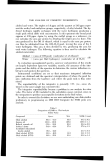
CYSTEINYL AND S-SULFOCYSTEINYL BESIDUES 463 trolled, blocking of the Ker-CySH prior to keratin hydrolysis. Nitroprusside is used as the indicator in the reaction. This mercurial-nitroprusside titration procedure is abbreviated as MNP. Derivation of the Method The new method reported here is essentially a variation of that of Valk and Gerthsen but with some changes introduced to avoid losing CySSOa- residues when the pH is raised in an uncontrolled manner. Additionally, the alkylation of CySH residues is carried out in a more quantitative fashion. For this new method, three separate subsamples are required for the simul- taneous determination of CySH and CvSqO.:- Subsample 1 is hydrolyzed in acid and the cysteinyl content is determined by mercurial titration. This step, which is identical to Valk and Gerthsen's initial step, yields the MNP• value and is a measure of the total cleavage level of the keratin sample assuming that the CySSCy is cleaved in a nucleo- philic process (e.g., by bisulfite, thioglyeolate, ete). 6N H2SO,t x Ker-CySH + y Ker-CySSOa- • (x + y) CySH Subsample 2 is extensively water-rinsed and treated with alkali to reverse the cystine-bisulfite reaction in a controlled manner. The sample is hydro- lyzed in acid and the results obtained are expressed as the MNP2 value. x Ker-CySH + y Ker-CySSOa- (OH-) • z Ker-CySSCy-Ker + (x - z) Ker-CySH + (y - z) Ker-GySSOs- 6N HeSO4 • (x+y-2z) CySH Clearly, one-half of the value of MNP• minus MNPo is a measure of the amount of CySSOa- residues consumed during the reversal step. Subsample 3 is water-rinsed and treated with alkali in a manner identical to subsample 2, and is then alkylated with acrylonitrile. This treatment con- verts remaining CySH groups to nontitratable fi-cyanoethylsulfide residues (CySCH2CH2CN). Because the alkylation is performed after alkali reversal, no further reversal during alkylation is likely. The sample is then hydrolyzed in acid and the MNP.• titer is determined. (On-) x Ker-CySH + y Ker-CySSOa- , z Ker-CySSCy-Ker + (x - z) Ker-CySH + (y - z) Ker-CySSOa-CH• = CHCN
Purchased for the exclusive use of nofirst nolast (unknown)
From: SCC Media Library & Resource Center (library.scconline.org)