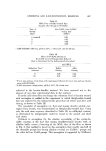
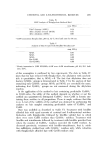
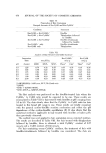
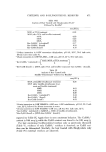
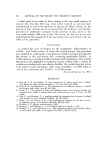
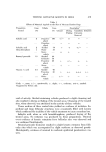
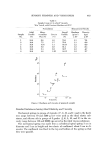
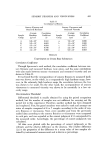
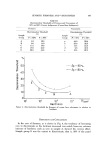
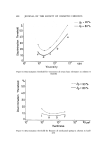
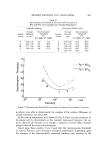
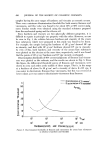
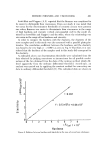
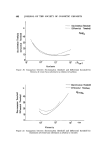
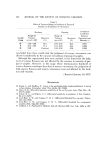
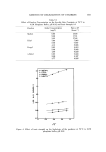
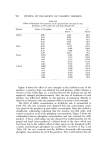
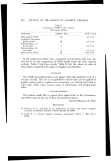
494 JOURNAL OF THE SOCIETY OF COSMETIC CHEMISTS Table V Effect of Variance Range in Hardness of Prepared Samples on Evaluation of Viscousness Hardness Viscosity ß . Range of Range of Sample Variance Maximum Variance Maximum Group (g/era" x 102) (%) (cps x 10 •) (%) Correlation Coe•cient between Viscousness and Viscosity (r) 2.26--4.25 61.0 1:69-2.56 40.5 0.917 2.33-3.20 31.4 1.64-2.69 48.4 0.886 2.40 Constant 1.62-2.56 45.0 0.826 concluded from these results that the judgment of sensory viscousness xvas affected considerably by the var[ance in hardness of prepared samples. Although the experimental data were omitted, it was found that the judg- ment of sensory firmness was not affected by the variance in viscosity of pre- pared samples. Moreover, in the range where discrinfination threshold of sensory timmess xvas larger than that of sensory viscousness, the judgments of both sensory firmness and sensory viscousness were not affected by the hard- hess and viscosity. (Received January 10, 1973) REFERENCES (1) K6nig, A., and Brodhun, E., Unters ii die psyehophysische fundamentalformel in bezug auf gesichtsinn. Sitzungber. Akad. 'Wiss. Berlin, 641 (1889). (2) Biesz, R. R., Differential intensity sensitivity of the ear for pure tones, Phys. Rev., 31, 867-75 (1928). (3) Schutz. H: G.. and Pilgrim, F. J., Differential sensitivity in gustation, J. Exp. Ps•chol., •4, 41-8 (1957). (4) Scott-Blair. G. W., and Coppen, F. M. V., Differential threshold for viscosity, Nature, 143, 164 (1939). (5) Scott-Blab-. G. W., and Coppen, F. M. V., Differential threshold for compression modules. Ibid., 144, 286 (1939). •6) Guilford, J.P., Psgchometric Methods, 2nd ed., McGraw-Hill, New York, 1954, p. 597.

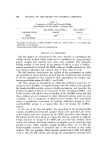
J. Soc. Co,•met. Chem., 25, 495-506 (September 1974) Kinetics of Degradation of the Parabens SEYMOUR M. BLAUG, Ph.D.,* and DONALD E. GRANT, Ph.D.t Synopsis-The effect of pH and TEMPERATURE on the HYDROLYSIS of methyl, ethyl, propyl, and n-butyl PARABEN was studied at 70øC in 0.1M phosphate buffer so]u- tions at ionic strength 0.3 from pH 2.75 to 9.16 and at 40 ø and 50øC at pH 9.16. The REACTION xvas first order with respect to paraben. ENERGIES OF ACTIVATION were determined from Arrhenius plots. RATE CONSTANTS and HALF-LIVES of each paraben at 25øC were obtained by extrapolation of the Arrhenius plots. The half-life of each paraben at 70øC and pH 8.24 was essentially independent of the initial concentration of paraben. Increasing ionic strength resulted in a slight increase in the rate of hydrolysis of each paraben. Increasing the phosphate concentration in buffer solutions at pH 8.24 at 70øC produced an increase in the rate of hydrolysis of each paraben. This indicated that the parabens undergo general base catalysis and that hydroxyl ion is not the only species that can catalyze their hydrolysis. INTRODUCTION The parabens have been reported to be stable, and to show no hydrolysis under conditions of heat steril/zat'on (2 hours at 100øC or 0.5 hour at 120øC) at a pH range of 3-8 (1). Pekkarinen and Tommila (2) studied the alkaline hydrolysis of ethyl esters of para and meta hydroxybenzoates in potassium hydroxide solution, and in various organic solvents. They con- c]uded that the hydrolysis takes place solely as a reaction between the ester ion and the hydroxide ion. Other authors found that the methyl ester of p- hydroxybenzoic acid is hydrolyzed at high temperature and in strongly acid solution (3). Ravel and Parrott (4) studied the hydrolysis of methyl paraben in aqueous solutions at temperatures of 70-85øC in a pH range of 6-9. * University of North Carolina, School of Pharmacy. Chapel Hill, N.C. Investigation was conducted at University of Iowa, Iowa City, Iowa 52242. '• Beecham-Massengill Pharmaceuticals, Bristol, Tenn. 495
Purchased for the exclusive use of nofirst nolast (unknown)
From: SCC Media Library & Resource Center (library.scconline.org)