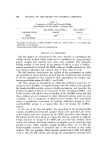
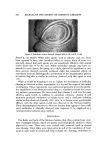
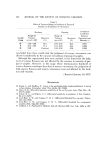
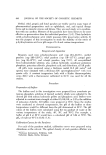
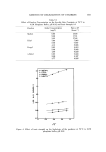
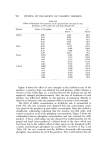
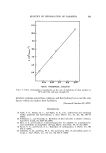
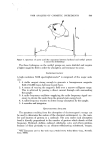
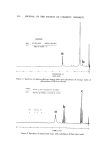
508 JOURNAL OF THE SOCIETY OF COSMETIC CHEMISTS is due to the thermal motions of the nuclei. It is these 7 which make the NMR phenomenon possible. Energy is required to change their orientation. The energy difference be- tween the two alignments under an applied field of Ho is expressed by eq 1: E =y x Hop-,r r (1) where T = gyromagnetic ratio (a constant for each isotope) h = Planck's constant Ho = applied magnetic field To elevate a nucleus from the ground state to the excited state, energy of E is required. in NMR, this energy is in the radio frequency region or mathe- matically: (2) Substituting A E in eq 1 and solving for • we obtain the fundamental NMR equation: 1 •'--7 X H0 x 2--•r (3) This equation states that there is so•ne frequency of electromagnetic radia- tion that will cause the nuclei to change their orientation in a field of strength Ho. Under an applied magnetic field of Ho = 14,092 Gauss, all protons will undergo the NMR transition requiring 60 Megahertz as the frequency neces- sary to cause the realignment discussed. We have explained the NMR phenomenon in reference to protons only. The orbiting electrons for each nucleus create a magnetic field of their own op- posing Ho. Thus, the nucleus is shielded to some extent from Ho and the proton experiences a true magnetic field of Ho (1-o-), where cr is the shield- ing or screening constant for that nucleus (1). One must instrumentally increase or decrease the applied magnetic field, depending upon the type of electronic environment surrounding the nucleus (shielding) in order to allow the proton to experience approximately 14,092 Gauss and absorb a quantized energy of 60 Megahertz. The different magnetic field strengths required give rise to unique spectra for each substance. In the case of acetic acid (Fig. 1), the proton from the hydroxyl group requires less of a magnetic field in undergoing an NMR transi- tion because it is deshielded by the presence of the two electron withdrawing oxygens. This proton appears downfield from TMS (tetramethylsilane), a highly shielded compound generally used as a reference.

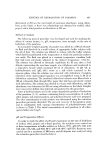
NMR ANALYSIS OF COSMETIC INGREDIENTS 5O9 e o II H 0 Figure 1. Spectrum o{ acetic acid (the separation between hydroxyl and metlay] protons is caused by aleshielding) The three hydrogens on the methyl groups are more shielded and require a higher magnetic field in order for absorption and resonance to occur. INSTRUMENTATION A high resolution NMR spectrophotometer* is composed of five major units (2): 1. A stable magnet strong enough to generate a homogeneous magnetic field of 14,092 Gauss between its pole faces. 2. A means of varying the magnetic field over a narrow milligauss range. This is achieved by passing a direct current through coils surrounding the sample. 3. A radio frequency oscillator-supplying the radio frequency signal nec- essary to elevate the nuclei from the ground state energy level. 4. A radio frequency receiver to detect energy absorption by the sample. 5. A recorder and integrator. QUANTITATIVE ANALYSIS The spectrmn resulting from the absorption of eleetromagnet!c energy can be used to determine the nature of the chemical environment, i.e., the num- ber and location of protons in a molecule. The area under each absorption band is directly proportional to the number of protons which absorb at that frequency. Hydroxyl, olefinie, earboxyl, aldehydie, ester, and ethoxy protons, because of their proximity to an electron-withdrawing substituent, oxygen, *The instrument used in this work was a Model R-24, Perkin-Elmer Corp., Norwalk, Conn. 06852.
Purchased for the exclusive use of nofirst nolast (unknown)
From: SCC Media Library & Resource Center (library.scconline.org)