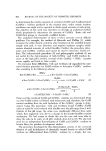
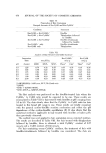
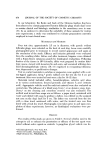
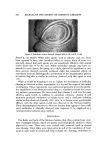
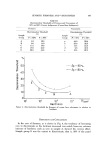
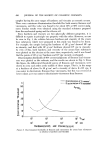
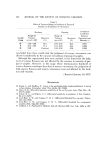
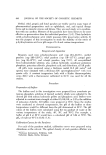
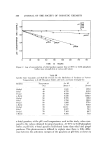
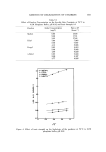
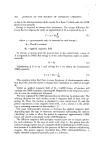
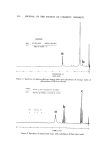
490 JOURNAL OF THE SOCIETY OF COSMETIC CHEMISTS samples having the same ranges of hardness and viscosity as cosmetic creams. There was a minimum discrimination threshold for both sensory firmness and viscousness, and this value was found to be about 10% at 80% correct judg- ment. Similar results were obtained using the standard substance prepared from the mechanical spring and the silicone oil. Since hardness and viscosity are two physically different properties, it is difficult to equate in principle one property with the other. However, as can be seen in Fig. 1, the relation between hardness and viscosity of the cream base substances which were prepared in this study was found to be linear. For example, the sample having the hardness of 102g/cm 2 showed 10:6 cps in viscosity, and that with 10 a g/cm -• hardness showed 104 cps in viscosity. In vie•v of this, both hardness and viscosity of the cream base substances were plotted on the abscissa at the same time, respectively, and it was found that the points of 102g/cm'-' hardness and 10 :• cps viscosity overlapped. Discrimination thresholds of 80% correct judgments of firmness and viscous- ness were plotted on the ordinate, and the results are shown in Fig. 8. From this figure, the differential threshold curves of firmness and viscousness were shown to cross each other at the middle of those ranges. That is, in the range at a hardness of above 9 x 10 g/cm'-' and a viscosity of above 9 x 10'-' cps, it was easier to discriminate firmness than viscousness, but this was reversed at lower values as it was easier to discriminate viscousness than firmness. 5O Discrimination of'Fi rmness', Discrimination of'Vi scousness •P=80• 10' 10 • 10 • 10 ' g/cm • 10 • 10 • 10 ' 10 • cps Hardnesslg/cm and Viscosity(cps) Figure 8. Discrimination thresholds of firmness and viscousness for cream base substances in relation to hardness and viscosity

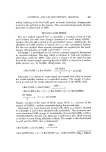
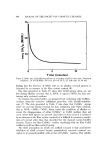
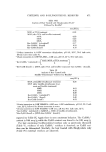
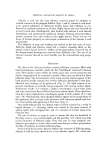
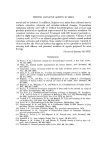
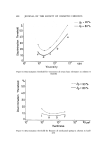
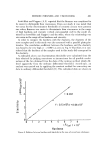
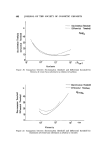
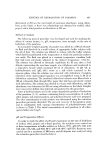
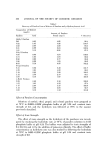
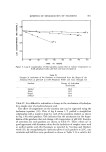
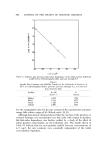
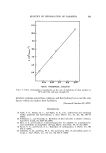
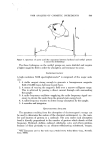
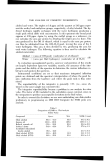
SENSORY FIRMNESS AND VISCOUSNESS ,491 Scott-Blair and Coppen (4, 5) reported that the firmness was considered to be easier to distinguish than viscousness. From our study it was rioted that two areas for the discrimination thresholds of cosmetic creams were present, one where firmness was easier to discriminate than viscousness in the range of high hardness and viscosity (which corresponded well to the 'result ob- tained by Scott-Blair and Coppen) and the other, where the relationship was vice versa in the range of low hardness and viscosity. In order to compare the hardness with the elasticity, the elasticity of the same samples used in this study was also measured •vith a parallel plate plas- tometer. The correlation coefficient bet•veen the hardness and the elasticity vas found to be very high (r = 0.997) as seen in Fig. 9. Therefore, it is con- sidered that the hardness of the samples used in this study did correspond to the elasticity. As indicated above, our discrimination thresholds •vere calculated from the data obtained by judging correctness or incorrectness for all possible combi- nations of the two obtained from the data of the ranking method, vhich dif- fered apparently from the ordinary differential threshold. Aceord:ngly. an analysis was carried out by applying the constant method for converting our data to ordinary differential threshold (6). The calculated data are sho•vn in 97 Y= 0.73x10²X +0.06x10⁴ i i i {g/crn2) x102 Hardness Figure 9. Relation between hardness and elasticity in the case of cream base substances
Purchased for the exclusive use of nofirst nolast (unknown)
From: SCC Media Library & Resource Center (library.scconline.org)