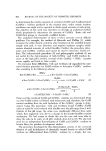
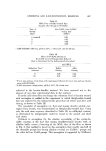
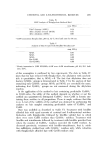
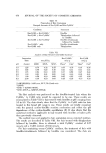
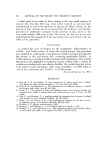
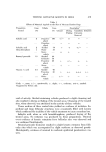
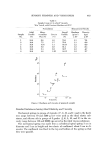
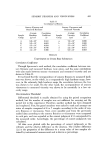
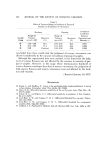
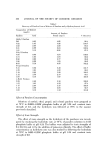
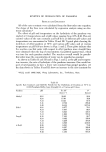
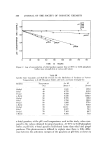
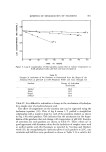
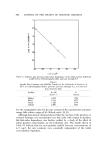
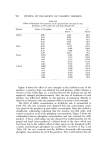
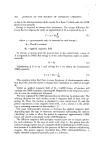
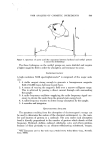
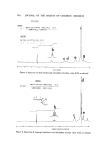
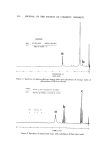
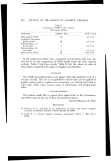
514 JOURNAL OF THE SOCIETY OF COSMETIC CHEMISTS Table II Comparison of NMR rs. Wet Analysis Ethoxyl',ation (Moles) Compound Suppliers Spec. NMR (3 runs) Oleyl alcohol (ETO) 10 --10 _•0•- - Acetylated ethoxylated lanolin alcohol 10 9.7 ñ 0.9 Polyoxyethylene (2) stearyl ether 2 2.2 _4- 0.3 Polyoxyethylene (2) cetyl ether 2 2.3 _ 0.1 Oleyl alcohol (ETO) 20 19.8 ñ 0.6 In the analysis for iodine value, concurrent wet chemistry tests were car- ried out to see the comparisons of NMR results versus the more classical methods. Table I lists these results. Table II lists the values of moles of ethoxylation compared to the approved supplier's specification. SU•vI•X•ARY. The NMR spectrophotometer is no longer solely the qualitative tool of a research chemist. The cost is not prohibitive and its data can be applied to quality control work to replace time consuming wet analysis tests such as ester value, iodine value, average moles of ethoxylation, and alcohol-water ratios. ACKNOWLEDG3elENT The authors would like to express their appreciation to the Communica- tion Skills Corp. for the use of their demonstrati.on figures. ( Received January 31, 1974) I•EFERENCES (1) Flockhart, B. O., and Pink, R. C., Applications of nuclear and electron magnetic resonance in analytical chemistry, Talanta, 12, 529-57 (1965). (2) Parfitt, R. T., Nuclear magnetic resonance spectroscopy, Pharm. J., 203, 300-3 (1969).

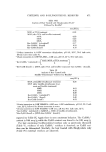
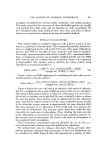
Letter to the Editor Sir: We were interested to read the paper by Kligman et al. (1) in a recent issue of your Journal. Having been concerned with the clinical testing of antidandruff compositions for many years, we should like to comment on some of the views expressed in th•s paper. The authors made the surprising assertion that dandruff is often confused with seborrheic dermatitis and that the fluctuations reported by us (2) per- tained to the latter condition. We look forward to the forthcoming publica- tion in which KIigman and co-•vorkers promise to elaborate their views on the distinction between the two conditions. In our studies, volunteers are in- cluded only if scaling is the sole recognizable manifestation. Microscopic ex- amination, as we and others have shown• indicates that dandruff scales us- ually show layers of parakeratotic and of normal corneum. This suggests that parakeratosis in a limited region of the scalp is a transient phenomenon and helps to explain our macroscopic observation that areas of scaling are not static on the scalp the scaling is undoubtedly patchy in distribution, though often symmetrically distributed. Taking the scalp as a whole, we frequently see in untreated subjects that the overall level of scaling varies, presumably according to which areas are parakeratotic at a particular time. There are obviously many different ways in which a clinical assessment O f scaling may be attempted. Kligman et al. refer to our segment measuring systems as if they are unbearably tedious, but we can assure these authors that we have routinely operated them for at least 10 years quite successfully. We have felt it necessary to operate in this way partly because of our strong objection to using any procedure which itself interferes with the state of scal- ing on the scalp for this reason, we do not favor Kligman et al.'s method of using a tongue depressor to "throw up some scurf," which could well have an unpredictable effect on subsequent scaling. A possible explanation for the differences between our views and those of Kligman and co-workers is that they prefer to study the course of dandruff on institutionalizcd subjects and that they do not consider it feasible to have simultaneous test and control groups (although they sometimes ap- parently use such groups-as reported on page 86 of their paper). In the absence of clear information on etiology, e.g., with respect to the significance 515
Purchased for the exclusive use of nofirst nolast (unknown)
From: SCC Media Library & Resource Center (library.scconline.org)