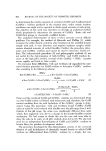
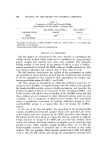
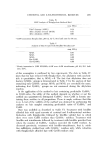
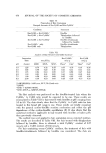
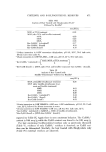
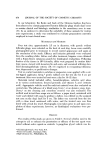
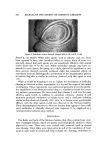
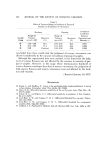
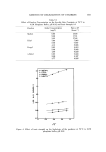
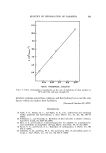
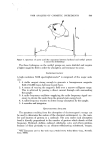
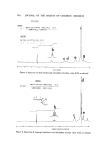
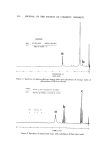
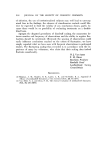
512 JOURNAL OF THE SOCIETY OF COSMET1C CHEMISTS MOLES ETO CALCU•TION (ETO PEAK AREA) - (HYDROXYL PEAK AREA) (AREA PER PROTOll) POLYOXYETHYLEIIE (2) STEARYL ETHER Figure 4. Spectrum of polyoxyethylene stearyl ether and calculation of average moles of ethoxylation (CDCI• as solvent) ALCOHOL (AREA OF OH PEAK) (NOLECULAR liT, OF ETHAIIOL) _ WATER (AREA PER H20 HYDR06oe•O (IiOLECU•R WT, OF H20) H20 CH 3 CH 2 OH A C B A ETHANOL & WATER Figure 5. Spectrum of ethanol and water with calculation of their ratio (neat)

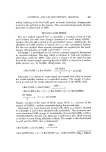
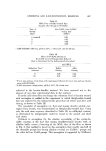
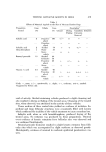
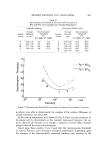
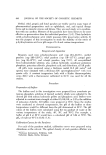
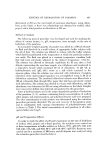
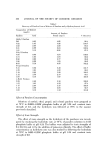
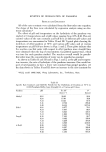
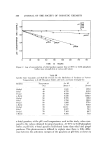
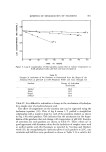
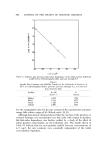
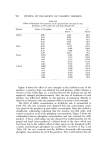
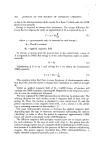
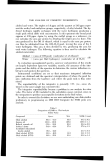
NMR ANALYSIS OF COSMETIC INGREDIENTS 513 alcohol and water. The triplet at 1.0 ppm and the quartet at 3.45 ppm repre- sent the methyl and methylene groups, respectively, of ethyl alcohol. The hy- droxyl hydrogen rapidly exchanges with the water hydrogens producing a single peak which shifts with concentration. In this spectrum the broad peak appears at 4.55 ppm. Again, by using, the methyl group as a reference, we can calculate the area per proton by dividing the triplet area by three. The area produced by the OH of ethanol, which is equal to the area per proton, can then be subtracted from the OH-H2 peak, leaving the area of the 9, water hydrogens. This area is then divided by two, producing the area for each water hydrogen. The following equation is then used to calculate the alcohol-water ratio: Alcohol = (area of OH peak) (molecular wt of ethanol) Water = (area per H20 hydrogen) (molecular wt of H_oO) (8) In evaluating uncomplicated spectra, accuracy and precision of the results are largely dependent upon two variables, namely, the accuracy of the inte- grator and the ability of the operator to determine the various inflections re- lat ng to each peak in the spectrum. Instrumental conditions are set so that maximum integrated inflection points are obtained and the operator's interpretation of where the peak be- gins (inflection from the baseline) and where the peak ends is thus mini- mized. The reproducibility of the integrator is generally -+5% (i.e., areas ob- tained on the same sample run consecutively). The integrator reproducibility became a problem in our analysis for ester value. The factor of 58.1 included in the calculation causes minimal errors in the integration to produce unacceptable deviations in the final values. In order to correct this deviation, we are now undertaking raw data studies preliminary to programming an 1800 IBM Computer for NMR peak area analysis. Table I Comparison of NMR rs. Wet Analysis Iodine Value Compound Oleyl alcohol Specs. Wet NMR (3 runs) _ 89.0-- 93.0 94.6 94.0 ñ 0.2 Sesame oil Refined avocado oil Isodecyl oleate Acetylareal ethoxylated }anolin alcohol Oleyl alcohol (ETO) Oleyl alcohol (ETO) 103,0 - 116.0 105.0 105,6 _+_ 1.1 65.0 - 95.0 83.0 83.4 -+ 0.8 54.0- 62.0 57.8 57.6 ñ 1.3 18.0 - 22.0 ... 21.7 -+- 0.4 30.0- 40.0 33.2 34.1 _+__ 1.2 19.0- 25.0 21.0 21.6 -+- 1.4
Purchased for the exclusive use of nofirst nolast (unknown)
From: SCC Media Library & Resource Center (library.scconline.org)