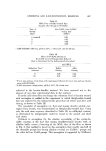
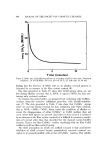
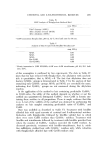
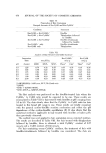
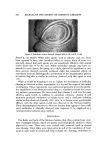
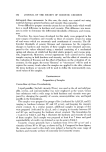
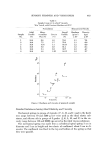
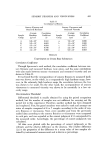
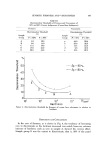
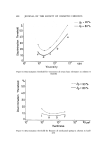
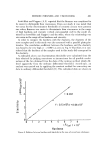
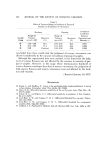
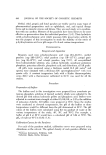
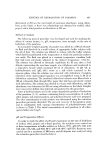
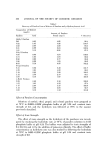
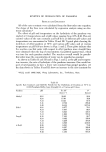
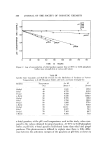
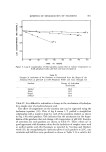
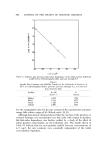
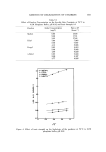
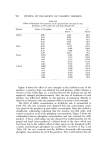
SENSORY FIRMNESS AND VISCOUSNESS 493 Figs. 10 and 11, and these curves show similar behavior with those of differ- ential threshold obtained previously, although slight differences were ob- served. Therefore, the discrimination thresholds obtained by these authors were considered to correspond well to the ordinary differential threshold,• In this study, the differential thresholds of sensory firmness and v•scous- hess were determined by preparing cream base substances having a constant viscosity and variable hardness and vice versa. Additional samples were pre- pared which varied both in hardness and viscosity simultaneously, and the effect of viscosity on the judgment of firmness and the effect of hardness on the judgment of viscousness were investigated. Samples with a hardness of about 2 x 10 2 g/cm'" and a viscosity of about 2 x 10 a cps were selected within the range where discrimination threshold of firmness was smaller than that of viscousness. Viscousness was evaluated with 3 sample groups (O, P, and Q) in the range where viscosity variance was kept almost constant, while that of the hardness variance was given in the 3 stages as shown in Fig. 12. In sample group Q, the viscosity was varied while the hardness was almost constant. In the case of P and O, both hardness and viscosity were made variable, where the rate of variance of hardness in group O is higher than that of group P, and the range of viscosity in each group was kept about the same. The results, shown in Table V, show that the correlation coefficient is high- est in the case of sample group O, when the hardness variance is the maxi- mum, and lowest in the case of samples Q without hardness variance. It was x 102 2 1 Maximum A*I, of Hardness 0 61.0 % P 31.4% g. Constant 2 • X 10 3 Viscosity (cps) Figure 12. Prepared samples to investigate the effect of hardness on evaluation of viscous-

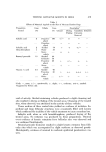
494 JOURNAL OF THE SOCIETY OF COSMETIC CHEMISTS Table V Effect of Variance Range in Hardness of Prepared Samples on Evaluation of Viscousness Hardness Viscosity ß . Range of Range of Sample Variance Maximum Variance Maximum Group (g/era" x 102) (%) (cps x 10 •) (%) Correlation Coe•cient between Viscousness and Viscosity (r) 2.26--4.25 61.0 1:69-2.56 40.5 0.917 2.33-3.20 31.4 1.64-2.69 48.4 0.886 2.40 Constant 1.62-2.56 45.0 0.826 concluded from these results that the judgment of sensory viscousness xvas affected considerably by the var[ance in hardness of prepared samples. Although the experimental data were omitted, it was found that the judg- ment of sensory firmness was not affected by the variance in viscosity of pre- pared samples. Moreover, in the range where discrinfination threshold of sensory timmess xvas larger than that of sensory viscousness, the judgments of both sensory firmness and sensory viscousness were not affected by the hard- hess and viscosity. (Received January 10, 1973) REFERENCES (1) K6nig, A., and Brodhun, E., Unters ii die psyehophysische fundamentalformel in bezug auf gesichtsinn. Sitzungber. Akad. 'Wiss. Berlin, 641 (1889). (2) Biesz, R. R., Differential intensity sensitivity of the ear for pure tones, Phys. Rev., 31, 867-75 (1928). (3) Schutz. H: G.. and Pilgrim, F. J., Differential sensitivity in gustation, J. Exp. Ps•chol., •4, 41-8 (1957). (4) Scott-Blair. G. W., and Coppen, F. M. V., Differential threshold for viscosity, Nature, 143, 164 (1939). (5) Scott-Blab-. G. W., and Coppen, F. M. V., Differential threshold for compression modules. Ibid., 144, 286 (1939). •6) Guilford, J.P., Psgchometric Methods, 2nd ed., McGraw-Hill, New York, 1954, p. 597.
Purchased for the exclusive use of nofirst nolast (unknown)
From: SCC Media Library & Resource Center (library.scconline.org)