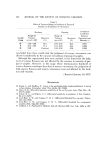
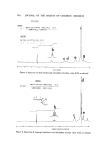
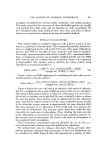
I. Soc. Cosmet. Chem., 25, 507-514 (September 1974) NMR--A New Instrumental Tool for the Analysis of Cosmetic Ingredients RICHARD KAPLAN, B.S., and STEPHEN F. LAczYNsKI, B.S.* Presented October 9, 1973, Joint Symposium of the Society of Cosmetic Chemists and the Association of O•ficial Analytical Chemists, Washington, D.C. Synopsis-A basic introduction into the theory and quality control applications of a '60 Megahertz NMR Spectrophotometer is given. Quantitative methods for evaluation of IODINE NUMBER, ESTER VALUE, HYDROXYL NUMBER, and MOLES OF ETHOXYLATION on cosmetic raw ingredients are presented. Determination of ALCO- HOL-WATER RATIOS on finished ingredients are shown to comply with a time-consum- ing distillation method. Determinates affecting accuracy and precision in compliance with classical wet chemistry tests for the above are also discussed. INTRODUCTION Basic NMR Theory Many atomic nuclei, in addition to carrying a positive charge, spin about an axis of rotation. These particles because of their charge and movement behave as tiny bar magnets. One such nucleus (the one with which we are most concerned) is the proton, the nucleus of ordinary hydrogen. The hydrogen protons exist in a ground state consisting of two or more in- distinguishable energy levels in the absence of an applied magnetic field. If the nuclei are placed in an external magnetic field, alignment with and against this field occurs. It would appear plausible that the majority would align with the applied magnetic field. Actually, quantum mechanics theory states that only an extremely small portion aligning with the field are in excess. Protons aligning with the field have lower energy and those aligning against the field are said to have higher energy. The Boltzman distribution equation states that in a field of 10,000 Gauss only an excess of 7 out of i million protons are in the lower energy state. This *Avon Products, Inc., Suffern, N.Y. 10901. 5O7

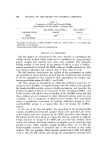
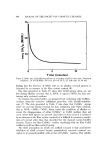
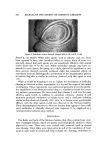
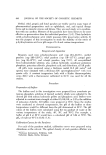
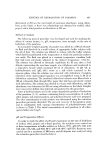
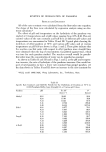
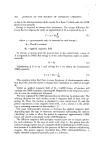
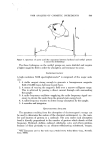
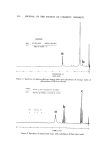
508 JOURNAL OF THE SOCIETY OF COSMETIC CHEMISTS is due to the thermal motions of the nuclei. It is these 7 which make the NMR phenomenon possible. Energy is required to change their orientation. The energy difference be- tween the two alignments under an applied field of Ho is expressed by eq 1: E =y x Hop-,r r (1) where T = gyromagnetic ratio (a constant for each isotope) h = Planck's constant Ho = applied magnetic field To elevate a nucleus from the ground state to the excited state, energy of E is required. in NMR, this energy is in the radio frequency region or mathe- matically: (2) Substituting A E in eq 1 and solving for • we obtain the fundamental NMR equation: 1 •'--7 X H0 x 2--•r (3) This equation states that there is so•ne frequency of electromagnetic radia- tion that will cause the nuclei to change their orientation in a field of strength Ho. Under an applied magnetic field of Ho = 14,092 Gauss, all protons will undergo the NMR transition requiring 60 Megahertz as the frequency neces- sary to cause the realignment discussed. We have explained the NMR phenomenon in reference to protons only. The orbiting electrons for each nucleus create a magnetic field of their own op- posing Ho. Thus, the nucleus is shielded to some extent from Ho and the proton experiences a true magnetic field of Ho (1-o-), where cr is the shield- ing or screening constant for that nucleus (1). One must instrumentally increase or decrease the applied magnetic field, depending upon the type of electronic environment surrounding the nucleus (shielding) in order to allow the proton to experience approximately 14,092 Gauss and absorb a quantized energy of 60 Megahertz. The different magnetic field strengths required give rise to unique spectra for each substance. In the case of acetic acid (Fig. 1), the proton from the hydroxyl group requires less of a magnetic field in undergoing an NMR transi- tion because it is deshielded by the presence of the two electron withdrawing oxygens. This proton appears downfield from TMS (tetramethylsilane), a highly shielded compound generally used as a reference.
Purchased for the exclusive use of nofirst nolast (unknown)
From: SCC Media Library & Resource Center (library.scconline.org)