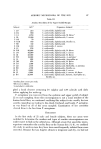
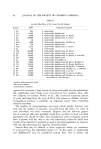
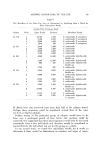
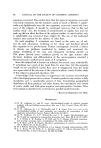
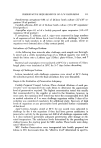
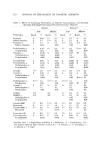
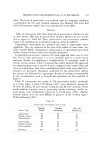
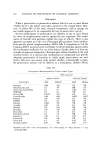
116 JOURNAL OF THE SOCIETY OF COSMETIC CHEMISTS The authors would be guilty of extreme negligence were they not to point out that the data given here cannot be extrapolated to all oil-in-water emul- sions. These data were obtained using model systems with relatively low levels of emulsifiers Any significant increase in concentration of emulsifier may require an increase in concentration of preservative or may even contra- indicate an otherwise satisfactory preservative or preservative system. Per- haps, to a lesser degree, particular types of anionic or nonionic emulsifiers will also determine whether or not a preservative is effective. Hence, the "effective" levels of preservatives given in this report should be considered only as a guide to be interpreted according to the particular formulation in question. Following a selection based on types and concentra- tions of emulsifiers, pH, and other pertinent characteristics of the formula, the suitability •of the preservative must be demonstrated by a satisfactory re- sponse in a challenge or preservation test (13-15) if the formulator is to be assured of a microbiologically acceptable product. Finally, the authors wish to emphasize that rather strict standards of ac- ceptance have prevailed in this study, viz., less than 7 days survival at the MIC and less than 3 days at higher concentrations. Although less sevcre re- quirements, e.g., a longer survival time or microbiostasis of one or more species, would result in a greater number of acceptable compounds and re- duced levels of preservatives in a formula, the strength of the protection aga-'nst microbial spoilage would be greatly reduced. ACKNOWLEDGlX•ENTS The authors gratefully acknowledge the suggestions of Dr. Arnold D. Marcus and the cooperation of Messrs. Ara Nersesian, Richard Alonso, Fred Hubner, and Taras Durbak in developing and formulating the lotions used in this investigation. (Received January 15, 1974) REFERENCES (1) I. R. Gucklhorn, Antimicrobia!s in cosmetics series, MIg. Chem. Aerosol News, 40-42 (1969-1971). /2) N. K. Patel, Interaction of some pharmaceuticals with macromolecules. III, Can. .1. Pharm. Sci., 2, 77-80 (1967). (3) N. K. Patel• and H. B. Kostenbauder, Interaction of preservatives with macro- molecules. I, ]. Amer. Pharm. Ass., 47, 289-93 (1958). (4) M. G. deNavarre, The interference of nonionic emulsifiers with preservatives with special references to cosmetics, ]. Soc. Cosynet. Chem., 8, 371-80 (1957). (5) D. L. Wedderburn, Preservation of toilet preparations containing nonionics, Ibid., 9. 215 (1958). (6) Martin Barr, and L. F. Tice, The preservation of aqueous preparations containing non•onic surfactants. II, .1. Amer. Pharm. Ass., 46, 445-51 (1957). (7) G. Schuster, and H. Modde, Examination of the efficiency of preservatives and anion- active emulsifiers, Amer. Perrum. Cosynet., 84, 37-46 (1969). (8) D. N. Entrekin, Relation of pH to preservative effectiveness. I, J. Pharm. Sci., 50, 743-6 (loC61).

PRESERVATIVE REQUIREMENTS OF O/W EMULSIONS 117 (,9) (10) (12) (13) (14) (15) Billie Wickliffe, and D. N. Entrekin, Relation of pH to preservative effectiveness. II, Ibid., 53, 769-73 (1964). E. E. Boehm, Synergism in vitro of certain antimicrobial agents, I. Soc. Cosmet. Chem., 19, 531-49 (1968). R. H. Tilbury, The effect of the hydrophilic-lipophilic balance of nonionic sur- factants on the efficiency of preservatives in simple emulsions, Specialties, i (11), 3-8 (1965). H. S. Bean, G. H. Konning and J. Thomas, Significance o• the partition coefficient of a preservative in cosmetic emulsions, Amer. Perrum. Cosmet., 85, 61-5 (1970). F. E. Halleck, Chairman, Preservation SubeommiRee o• the TGA Microbiological Committee, A guideline •or the determination o• adequacy of preservation of cosmetics and toile•ry •ormulations, TGA Cosmet. ]., 2 (1), 20-3 (1970). J. A. Rodgers Chairman, Preservation Subcommittee o• the CTFA Microbiological Committee, Evaluation of methods •or determining preservative efficacy, CTFA Cosmet. 1., 5 (1), 2-7 (1973). S. M. Henry, What constitutes a microbiologically acceptable cosmetic, Ibid., 3 (3), 28-32 (1971).
Purchased for the exclusive use of nofirst nolast (unknown)
From: SCC Media Library & Resource Center (library.scconline.org)