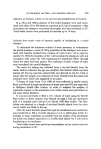
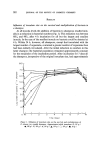
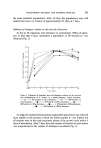
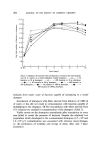
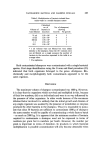
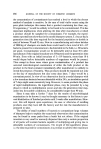
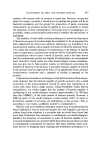
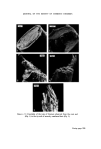
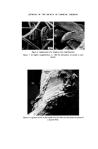
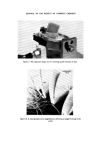
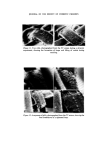
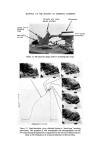
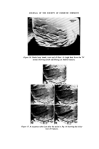
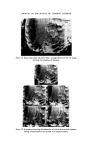
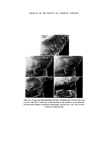
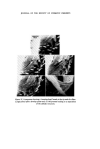
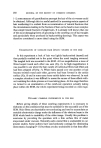
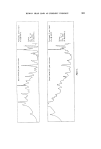
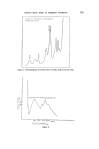
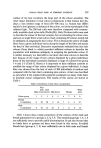
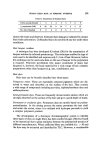
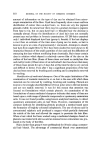
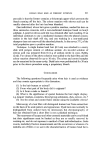
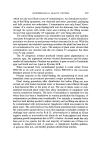
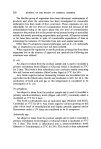
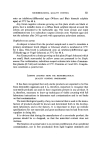
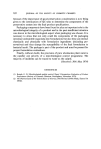
•^m •^K^•e 291 samples were collected by retrieving those which fell out naturally during brushing and combing and only those which had an intact root were selected. Starting at the root end a 40 mm long segment was clamped between the cross heads of an Instron tensile tester and, at ambient room temperature and relative humidity, extended at various rates of extension until fracture occurred. Fractures were obtained in this manner from root to tip of the various fibres and all were mounted for examination in the SEM. Five main types of fracture were encountered and these are illustrated in Figs 1-5. Type 1 (Fig. 1) was found at the root end of all the hairs but was also observed towards the tips of the less weathered hair samples. It con- sists of a clean transverse fracture and appears almost as if cut with a knife. Also, the cuticle has split circumferentially about the transverse fracture through the cortex. Type 2 (Fig. 2) was also found near the root ends of the hairs. It consists mainly of a transverse fracture with the cortex stepped and with some disturbance of the cuticle behind the point of fracture, either in the form of a longitudinal split back from the main fracture or a narrow circumferential split some distance from the point of primary fracture. In type 2 (Fig. 3) part of the primary fracture is transverse but the remainder tails off with segments of cortex pulled out. Damage to the cuticle behind the point of fracture is more severe, usually in the form of lifting of the cuticle as well as more longitudinal and circumferential splitting than in type 2. Types 4 and 5 (Figs 4 and 5 respectively) are typical of fractures occurring close to the tip of extensively weathered hair. In type 4, although the hair may still retain its cuticle, there is no clean transverse fracture of the type encountered in types 1-3. Instead the fracture is ragged with the cortex separating into fibrillar elements (presumably individual cortical cells and macro fibrils) and there are nearly always one or more longitudinal splits back along the fibre from the point of primary fracture. In type 3 there is extensive fibrillation of the cortex resembling that encountered in tri- chorrhexis nodosa. There is a general progression in the type of fracture 1-5 proceeding from root to tip of the various hairs, with 2, 3, 4 and 5 being reached more quickly for badly weathered hairs than for hairs which have not been so extensively weathered. In the case of hairs which have not received appreciable weathering, types 4 and 5 are not encountered even at the tips of the hairs. The classification of fracture types has served well as a guide to the extent of degradation of the hair and correlates satisfactorily with other methods we have used for assessing the extent of hair weathering. By deter- mining the type of fracture at a given distance from the scalp and scoring
Purchased for the exclusive use of nofirst nolast (unknown)
From: SCC Media Library & Resource Center (library.scconline.org)