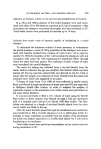
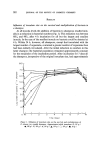
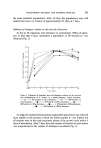
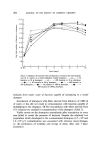
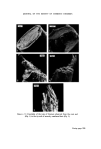
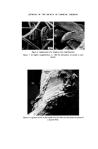
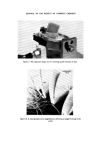
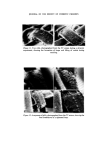
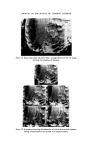
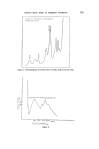
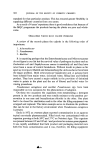
292 JOURNAL OF THE SOCIETY OF COSMETIC CHEMISTS 1-5, some measure of quantification amongst the hair of the six women could be obtained. Although this is a useful method for assessing certain aspects of hair weathering it is evident from our examination of natural fractures that the circumstances leading to the fracture of hair on the head is more complex than simple tensile fracture of single hairs. It is already well known that one of the most damaging forms of grooming is the combing out of hair tangles and particularly those produced in backcombing (teasing). This aspect was therefore considered in more detail using the SEM. EXAMINATION OF TANGLED HAIR (STATIC STUDIES IN THE SEM) In this experiment a lock of hair was lightly backcombed (teased) and then partially combed out to the point where the usual tangling occurred. The tangled lock was mounted in the SEM. At low magnification a mass of fibres looped round each other was seen (Fig. 6). At high magnification it was possible to see where the hair cuticle of individual fibres had lifted and had been stripped off (Fig. 7). Where hairs passed over one another or had become twisted round each other, grooves had been formed in the cuticle surface (Fig. 8) and in some cases loose cuticle debris was observed. In such a complex situation it was difficult to assess the causes of these effects with- out watching the whole process as it was taking place. At this stage therefore we turned to an examination of the comb-out operation actually taking place within the SEM, the whole experiment being recorded on video tape. DYNAMIC COMBING EXPERIMENTS IN THE SEM Before giving details of these combing experiments it is necessary to elaborate on the conditions that must be satisfied for the successful use of the SEM. Hair fibres are electrically non-conducting and tend to accumulate an unstable electrostatic charge under the influence of the electron beam in the SEM which leads to instability of the video image. Usually this problem is overcome by providing the specimen with a thin surface film of metal evaporated under vacuum. Naturally such a metal film is undesirable in our present studies. Some authors have used antistatic coatings for eliminating electrostatic charging (9-11) but these are also undesirable in that they affect

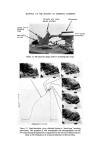
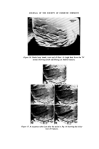
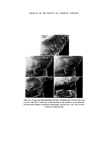
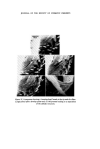
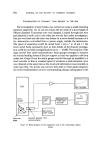
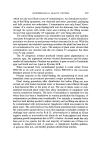
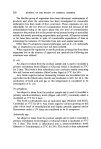
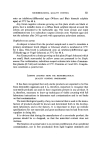
HAIR BREAKAGE 293 the surface properties of the hairs. An alternative procedure is to examine the hairs at low electron accelerating voRages (8, 12). Although image resolu- tion tends to be somewhat poorer at these low accelerating voRages, with experience and by using minor modifications of the SEM we are now able to obtain very acceptable results (13). In addition we have established that at these low voRages, the electron beam causes imperceptible damage to the uncoated hair surface (13). The combing experiments were set up with the minimum of modifica- tion to the microscope specimen stage. A small section of an aluminium comb was fixed to a suitable brass base (Fig. 9) and a small lock of 30-40 hairs, which had been teased and then partially combed-out, was laid over the comb. Continuation of the comb-out operation was effected by pulling the 'root ends' through the tines of the comb on to a shaft which was rotated from the outside of the microscope. A Cambridge Stereoscan 600 SEM was used in this work. The microscope gave a TV video output compatible with standard closed circuit TV equipment and was also linked to a Shibaden «" video tape recorder so that the results of the work could be played back for further detailed analysis. In addition, by stopping the comb-out operation at various points, still micrographs were obtained. One striking feature of the present dynamic studies of hair comb-out was the wealth of information contained in even a short run. In particular there were so many processes occurring at the same time that one had to be very selective in choosing an appropriate field of view or specific feature to study at high magnification. At low magnification the hairs moved from all directions to line up and pass between the tines of the comb (Fig. 10). During this process, the hairs became twisted together to form tight bends and loops. As loops were pulled over stationary hairs, cuticle cells were stretched and lifted on the outside of the bend (Fig. 11). These exposed scale margins readily broke off as they came into contact with other fibres. While 'running loops' lost cuticle in this manner the stationary fibres with which they were in contact became dis- torted at the point of contact and became grooved by the continual abra- sion. Deformation and stripping of cuticle also occurred as fibres were pulled through stationary loops of other hairs and this became an important factor as the loops tightened. Eventually the tangle tightened to the extent that a few individual hairs began to break and this occurred predominantly at a loop (Fig. 12). This proved such a common occurrence that we decided to investigate loop fracture in more detail using a simple system of straining a hair over a metal wire of comparable diameter.
Purchased for the exclusive use of nofirst nolast (unknown)
From: SCC Media Library & Resource Center (library.scconline.org)