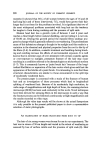
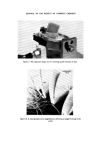
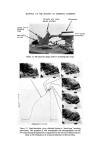
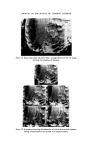
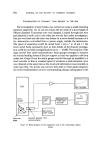
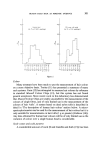
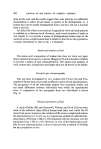
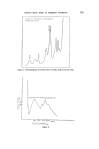
294 JOURNAL OF THE SOCIETY OF COSMETIC CHEMISTS EXAMINATION OF DYNAMIC 'LOOP BREAKS' IN THE SEM The investigation of loop breaks was carried out using a small extending specimen stage (Fig. 13). In one set of jaws the two ends of a short length of 100-gm diameter Constantan wire was clamped. Looped through this wire and attached at both ends to the other jaw was the hair under investigation. One jaw was fixed and the other was driven on a screw thread by means of a d.c. micromotor controlled from a power supply outside the microscope. The speed of separation could be varied from 1 mms 4 to 10 gm s 4, the lower speed being necessarily slow so that details of the fracture propaga- tion could be recorded at magnifications up to x 10,000. The fixed jaw of the stage carried four small semiconductor strain gauges arranged to measure the minute bending forces of the jaw support as load was applied to the loop under test. Output from the strain gauges was fed through an amplifier to a chart recorder so that at constant speed of extension a load/extension curve was obtained at the same time as the structural information was recorded on video tape (Fig. 14). In this way we have been able to relate small irregulari- ties in the load/extension curve to corresponding changes taking place in the SEM Strain J gauges Specimen stage Micromotor •ower supply Electron detector and photomultiplier Pen recorder recorder o o o o Figure 14. Block diagram of the equipment used in the 'loop-break' experi- ments.

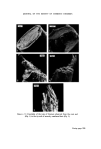
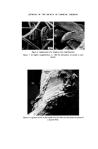
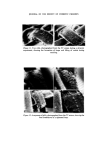
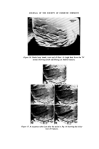
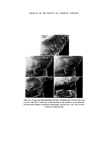
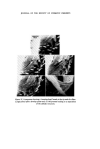
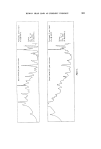
HAIR BREAKAGE 295 structure. This is illustrated by the example in Fig. 15 where the chart trace shows irregularities near the yield point which relate directly to structural failures in the cuticle and cortex of the fibre as the fracture developed. In examining loop breaks, hair was obtained from the same women as for our earlier fracture experiments. Two types of loop breakings were studied. The first type, which we will refer to as the 'static loop', was pro- duced when both ends of the hair were pulled so that no slipping of the hair on the wire occurred. The second type was a 'running loop' where one end of the hair was fixed to the specimen stage and the other end held firmly in the extending stage and pulled. In this case the hair moves slowly over the wire as the hair elongates under load. Several interesting effects were observed. For static loops, the type of fracturing process and the final structure of the fibre end at break, for hairs from the various women and for various positions along each hair, were in good accord with the results described in Section 1 of this paper (i.e. Figs 1-5). At the root end, stretching of the cuticle about the loop was observed, usually accompanied at moderate loads by cuticle cell lifting (Fig. 16). Fracture usually began in this region as a split through the cell layers of the cuticle along a circumferential segment (Fig. 17). When this split had propagated about halfway round the fibre with the exposure of the underlying cortical surface, the rest of the fracture was catastrophic, the cortex fracturing transversely or in low transverse steps. At the tips of weathered hairs where little or no cuticle remained, the fracture process was initiated by the separation of surface fibrils from the cortex (Fig. 18). As the load increased further, separation of fibrillar elements from the cortex occurred (Fig. 19). At this stage some gross longitudinal splitting of the fibre occurred with more and more cortical fibrils rupturing until the two parts of the fibre separated abruptly. Running loops always resulted in longitudinal splitting of the hair irrespective of whether root or tip segments were examined. At the root end the fracture began transversely through the cuticle but split longitudinally once this crack had reached the middle of the fibre (Fig. 20). At the tip the fracture started in much the same way as for the static loop but longitudinal splitting was accentuated (Fig. 21).
Purchased for the exclusive use of nofirst nolast (unknown)
From: SCC Media Library & Resource Center (library.scconline.org)