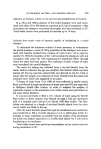
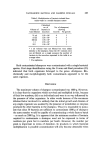
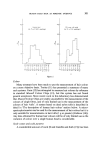
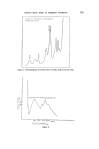
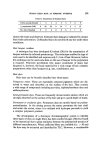
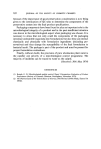
HUMAN HEAD HAIR AS FORENSIC EVIDENCE 301 3O •'ø l 20- Grand total (as % of 500 readings) 4O 3O 0 ¸000 000 0000 0 00000000 0000 0 --• C,dl"q d' •0 LD r'• OD Oh 0 -- C,,.I 2o 28-year-old male (as % of 50 readings) ,o[ F -I O00000000 O0 I I I I I I I I I I I O00000000 O0 I z lz Figure 1. Colour Many attempts have been made to put the measurement of hair colour on a more objective basis. Trotter (11) has presented a summary of many such systems. Garn (12) has attempted to measure hair colours by reference to standard Munsell Colour Chips (13), but this system has not found general acceptance. More recent work in this laboratory has demonstrated that Munsell Colour Chips are totally unsuitable for the measurement of the colours of single fibres, and of only limited use in the measurement of the colours of hair 'tufts'. A system based on dyed nylon tufts is described in detail in 'The description of human hair colour' section below. A micro- spectrophotometer can be used for the measurement of hair colour but it is only suitable for measurements on hair tufts (1 g or greater) (Unilever (14)). Any data obtained for human hair colours will be of only limited use as the variation of colour over a single human head is considerable. Scale counts and scale patterns A considerable amount of work (9 and Gamble and Kirk (15)) has been

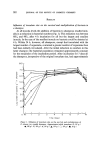
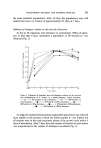
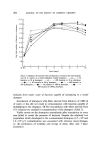
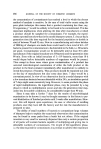
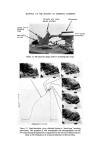
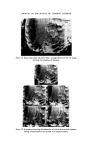
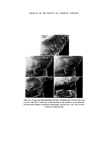
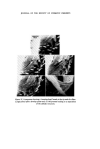
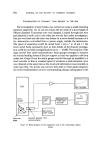
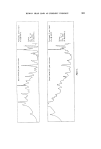
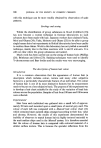
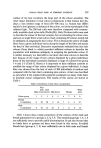
302 JOURNAL OF THE SOCIETY OF COSMETIC CHEMISTS done in this area, and the results suggest that scale patterns are sufficiently characteristic to allow broad classes or species to be distinguished, i.e. a human hair can be readily distinguished from a cat hair, but not a dog hair from a cat hair. An Atlas (16) of hair cross-sections, longitudinal views and scale patterns is available as a reference work. However, scale counts (number of scales in unit length) do not provide a means of distinguishing human hairs as the variation across a single human head is similar to that across the population, a similar distribution to that in Fig. 1 is obtained. Amino-acid analysis of hair The amino-acid composition of human hair does not show any signi- ficant variation from person to person (Bogaty (17)) and is therefore unlikely to provide a means of hair characterization. The amino-acid analyses of wool, human hair, animal hairs and finger-nails are all known to be similar. Pyrolysis gas chromatography This has been investigated by two workers (De Forest (18) and Fou- weather (19)) but does not provide an effective means of hair discrimination. The pyro grams of all the individuals studied were essentially similar and any small differences between individuals were within the experimental error. A comparison of two pyro grams from two individuals is shown (Fig. 2). Physical parameters of hair A study (Dabbs (20) and Greenwell, Wittmer and Kirk (21)) has been made of the refractive index (RI) of human head hairs and, whilst the RI varies from person to person, the variation of RI across a single head reduces the discrimination to 1 in 2/3, e.g. in a typical case studied an individual dis- played hairs of RI from 1.546 to 1.550 compared with the variation over the population from 1.542 to 1.555. However, in view of the limited data avail- able for hair characterization, it does at least provide a method of dividing the hair population in two.
Purchased for the exclusive use of nofirst nolast (unknown)
From: SCC Media Library & Resource Center (library.scconline.org)