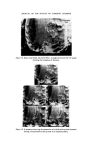
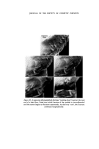
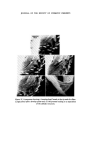
HUMAN HEAD HAIR AS FORENSIC EVIDENCE 311 peroxide is that the former contains a thixotropic agent which prevents the bleach running off the hair. The colour reaction with nitrous acid can be readily observed after the hair has been bleached. One individual, whose hair gave a positive reaction, washed his hair on three successive occasions with a non-medicated shampoo based on lauryl sulphate. A positive nitrous acid test was obtained after each washing. If an individual continues to use a medicated shampoo then the phenol concen- tration in the hair shaft will rise, and one washing in a non-medicated shampoo does not remove all the absorbed phenols. In the survey 37•o of the total population gave a positive reaction. Technique. A single human head hair (0.5 cm) was attached to a cavity slide with perspex cement or cellulose acetate. An ice-cold solution of nitrous acid was prepared from 0.14 g of sodium nitrite in conc. HgSO4 (2 ml). Two drops of the above solution were added to the hair fibre and the colour reaction observed for up to 10 min. The crime and control samples can be examined in the same cavity. Dark hairs were prebleached for 30 min prior to the above procedure using a proprietary bleach. CONCLUSIONS The following questions frequently arise when hair is used as evidence and they remain appropriate to this discussion. (1) Is the hair human or animal? (2) From what part of the body did it originate9. (3) Is it from a male or female? (4) What is the significance of special features the hair might display, e.g. lacquer residues, cosmetics, blood group substances, dyes, colours, etc. ? (5) Are the crime and control hairs similar using the available criteria? Microscopy of a hair fibre will distinguish human hair from animal hair on the basis of its scale pattern and appearance. Dyed hairs can normally be distinguished from undyed hairs by microscopy but chromatography of hair dye obtained from a short fibre is not a practical technique. The occurrence of lacquer and other cosmetic materials can be established but their significance must be limited as they are so readily removed by washing etc, and do not represent a method of hair individualization. Scale counts, medullary fraction measurement and the occurrence or absence of a medulla are of little or no use in the characterization of human head hairs.

3]2 JOURNAL OF THE SOCIETY OF COSMETIC CHEMISTS Whilst the colour of human hair remains one of its most characteristic features, its use for a particular individual is limited by the variation of the colour of single fibres over an individual head. Hair colours are obviously significant for the rarer colours such as black, blonde, red-brown. Normally little difficulty is experienced in distinguishing human hairs from different parts of the body, e.g. moustache hairs are frequently triangular in section, whereas pubic hairs are short, curly with worn pointed tips. Trace elemental analysis may in the future provide a satisfactory means of characterizing a single fibre, but at the present time it still has problems. The cosmetic treatments of bleaching and dyeing can be readily identified and these techniques can provide a useful addition to the limited techniques available at the present. The active ingredients of medicated shampoos can be identified using a simple colour reaction. A definite method of relating a hair fibre to a particular individual is still not a reality, but in favourable cases of rare colours, the presence of cosmetic treatments such as bleaching or dyeing, good discrimination can be achieved. ACKNOWLEDGMENTS The authors would like to thank Wella International for generous gifts of chemicals and for their advice, and Unilever Research Laboratories for much helpful discussions on this subject. (Received: 25th August 1974) REFERENCES (1) Simpson, K. in Forensic medicine, 159 (1969) (Arnold, London). (2) Polson, C. J. in The essentials o f forensic medicine, 61 (1965) (Pergamon Press Ltd, Oxford) (3) Peterson, F., Haines, W. S. and Webster, R. W. in Legal medicine and toxicology, (1923) (Saunders Co., London). (4) Wynkoop, E. M. A study of the age correlations of the cuticular scales, medullae and shaft diameters of human hair. Am. J. Phys. ,4nthropol. 13 177 (1929). (5) Trotter, M. The form, size and color of head hair in American whites. Am. J. Phys. ,4nthropoL 14 433 (1930). (6) Trotter, M. and Dawson, H. L. The hair of French Canadians. Am. J. Phys. Anthropol. 18 443 (1934). (7) Kind, S.S. Home Office Forensic Science Laboratory, Newcastle, unpublished results. (8) Fouwether, C. Home Office Forensic Science Laboratory, Nottingham, unpublished results. (9) Owen, G. W. Home Office Central Research Establishment, Aldermaston, unpublished results.
Purchased for the exclusive use of nofirst nolast (unknown)
From: SCC Media Library & Resource Center (library.scconline.org)