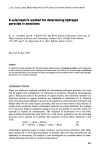
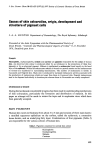
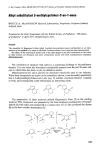
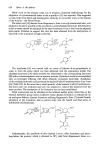
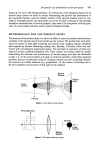
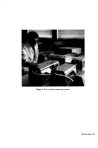
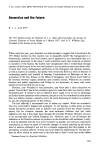
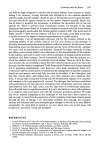
J. Soc. Cosmet. Chem. 28 629-639 (1977) ¸ 1977 Society of Cosmetic Chemists of Great Britain Alkyl substituted 5.methylcyclohex-2-en-l-ones B R U C E A. McAN D RE W Research Laboratories, Proprietary Perfumes Limited, Ashford, Kent Presented at the Joint Symposium with the British Society of Perfumers, "The future of perfumery" 4 April 1977, Stratford-upon-A yon. Synopsis The versatility of Hagemann's Ester (ethyl 2-methyl-4-oxocyclohex-2-ene-l-carboxylate) as an inter- mediate in the synthesis of a range of alkylated 3-methylcyclohex-2-en-l-ones has been demonstrated. The effects of the substitution pattern and of the chain length of the alkyl substituent on the odour of these ketones are discussed and some comparisons drawn with their cyclopentenone analogues (dihydrojasmones). The correlation of structure with odour is a continuing challenge to the perfumery chemist. It is one which has stimulated considerable research over the last 20 years and one to which there has been, as yet, no definitive answer. Dihydrojasmone [1] and Lyral [3] are chemicals extensively used in our industry. When these compounds are drawn in the orientation shown, it can be readily appreciated that a 2-alkyl-methylcyclohex-2-en-l-one [e.g. 2] exhibits structural features common to both, and consequently could well possess an interesting odour. i 2 5 The preparation of these materials utilised Hagemann's Ester [7] as the starting material. This compound was prepared by the base catalysed condensation of formal- dehyde [5] with ethyl acetoacetate [4] in a molar ratio of 1:2 this produced the diester [6] as the first isolable intermediate (1). 629

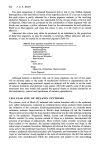
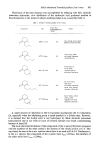
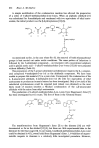
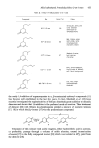
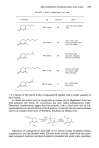
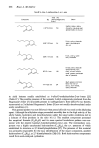
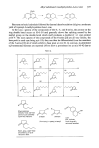
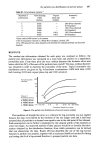
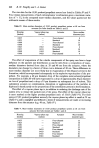
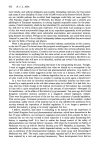
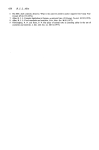
630 Bruce A. McAndrew Careful hydrolysis and decarboxylation under basic conditions removed the 13-ethoxy- carbonyl group to yield Hagemann's Ester [7] in 61•o yield. Use of acidic reaction conditions to effect hydrolysis and decarboxylation produced material contaminated with 3-methylcyclohex-2-en-l-one [8]. Hagemann's Ester [7] is a vinylogous 13-keto-ester i.e. a double bond has been intro- duced between the ester group and the carbonyl function consequently the corresponding ambidentate anion should be capable of reaction at the O-atom, C-2 and C-4. Further- more, if dianion formation can be induced [2], the position (C-6)* analogous to the methyl group of ethyl acetoacetate should be activated. By altering the reaction conditions, there- fore, it should be possible to alkylate at different sites round the ring. When Hagemann's Ester [7] was treated with sodium ethoxide in ethanol, followed by an alkyl halide, alkylation occurred predominantly at the 2-position (3) to yield the substituted product [9]. In the present study, alkylation has been carried out using a CO•EI [•"•i)KOH/E,OH • - 4 COzEt R • NoOEt/EtOH m R 9 IO • (ii)RX ,, R o • R , I /CO2El ? ! • • {i) KOH / E._•tOH • series of straight chain primary bromides (butyl, pentyl, hexyl), and one substituted primary bromide (iso-amyl), all of which gave satisfactory yields of alkylated keto-esters [9]. When a secondary halide (sec-amyl bromide) was used, a much lower yield of alkyl- ated product was obtained (4). The one allylie halide used (3-methylbut-2-enyl chloride =prenyl chloride) reacted appreciably faster, and produced the highest yield of alkylated ester. * It should be pointed out that Hagemann's Ester [7] and related [3-keto-esters have been deliberately numbered as substituted cyclohexenones - so ensuring that the numbering of the C-atoms is self-consistent.
Purchased for the exclusive use of nofirst nolast (unknown)
From: SCC Media Library & Resource Center (library.scconline.org)