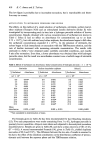
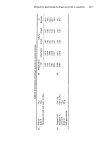
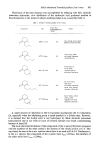
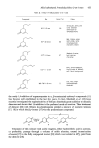
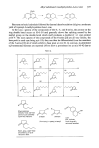
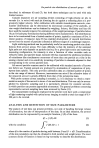
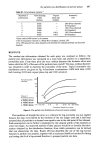
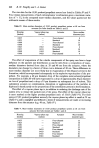
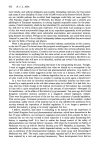
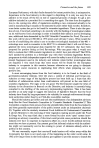
A lkyl substituted 3-methylcyclohex-2-en-l-ones 631 Hydrolysis of the ester function was accomplished by refluxing with 10•o alcoholic potassium hydroxide slow distillation of the carboxylic acid produced resulted in decarboxylation to the desired 2-alkyl-3-methylcyclohex-2-en-l-one [10] (Table 1). Table I. 2-Alkyl-3-methylcyclohex-2-en-l-ones Yield (%) Compound Bp, (from Hagemann's 0 dour Ester) Very strong, minty, some 69ø/O' 7 mm :59 phenolic/chemicol notes. 8 Iø/0' 4 mm 44 Less minty, some salicyla•e / benzoate cha racterisfics, 0/• no minty notes 84ø/0.7ram :59 increasing amyl salicylote character.
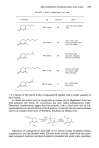
Practic 90 ø / O. 5 mm 49 No minly notes, faint amyl salicylate character some fatty, buttery, josmonyl character. 0•/ herbalamylwithnotes aimos celery, 97ø/0'5 mm 63 together salicylate character.
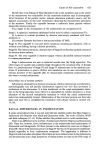
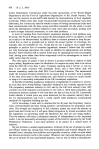
Some A small amount of alkylation in the C-4 position accompanies the C-2 alkylation (5), especially when the alkylating group is small (methyl) or a [I-halo-ester. However, it is claimed that the 4-alkyl ester is not hydrolysed by dilute alcoholic potassium hydroxide (5) and in our work no trace of isomeric ketones was found contaminating ketones of type [10]. The most characteristic feature of the compounds of the 2-series [10] (when compared with the members of the other series) is the absence of the vinylic proton at C-2. This can clearly be seen in the n.m.r. spectra where there is no peak at 85.6-5-8. Furthermore, in the u.v. spectra, the compounds of the 2-series have %max _•235mp: the members of the other series have %ma,, -• 224mp.

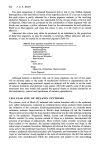
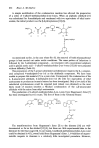
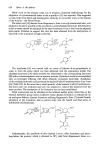
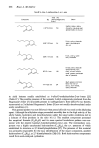
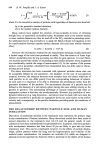
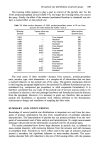
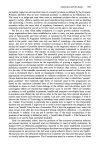
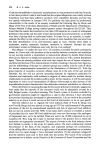
632 Bruce •4. Mc•4ndrew A simple modification of the condensation reaction has allowed the preparation of a series of 5-alkyl-3-methylcyclohex-2-en-l-ones. When an aliphatic aldehyde [11] was substituted for formaldehyde and condensed with two equivalents of ethyl aceto- acetate, the initial product was the 13-hydroxyketone [12] (6). E•OzC R H COzE• t 0" ' 0 0 4 II 4 12 OH H2S04/CH3CO2 R As mentioned earlier, in the case where R-=H, the removal of both ethoxycarbonyl groups is best carried out under acidic conditions. The same pattern of behaviour is followed by the 5-substituted compounds - on treatment with concentrated sulphuric acid in glacial acetic acid- 5-alkyl-3-methylcyclohex-2-en-l-ones [13] (6) were prepared without difficulty (Table II). The preparation of the 5-prenyl substituted cyclohexenone requires the [5, 7-unsatur- ated compound 4-methylpent-3-en-l-al as the aldehydic component. We have been unable to prepare this material (7) in a pure state. Consequently the condensation of the tt, [5-unsaturated aidehyde, 4-methylpent-2-en-l-al (8) with two equivalents of ethyl acetoacetate to produce an isomeric ketone has been investigated. Only a low yield of the substituted cyclohexenone could be expected (and indeed was obtained) as the most likely mode of reaction involves a Michael condensation of the tt,[5-unsaturated aldehyde with the anion from ethyl acetoacetate. The production of 4-alkyl-3-methylcyclohex-2-en-l-ones from Hagemann's Ester [7] has been investigated by two routes. The first of these is the 'Dienone Route'. C02Et /• C02Et • OH OH •so-'- ,,o----L • benzene • I V •- benzene o 7 N---o 14 /•--o 15 ••OH HCl/THF 16 The transformations from Hagemann's Ester [7] to the dienone [16] are well- documented as far as the alcohol [15] (9), but there are little experimental data in the literature for the final stage (10). In our hands, 3-methyl-4-methylenecyclohex-2-en-l-one could be obtained in 45•o overall yield from Hagemann's Ester. l, 6-Addition of organo- metallic reagents to dienones is a relatively little investigated procedure. However,
Purchased for the exclusive use of nofirst nolast (unknown)
From: SCC Media Library & Resource Center (library.scconline.org)