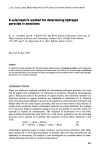
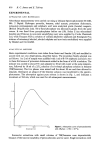
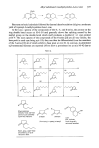
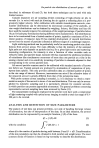
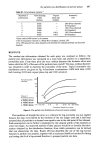
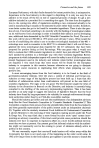
616 K. C. James and E. Tsirivas EXPERIMENTAL APPARATUS AND MATERIALS Absorbance measurements were carried out using a Unicam Spectrophotometer H 1620, Mk. 2 Digital. Hydrogen peroxide, benzene, ethyl acetate, potassium dichromate, potassium permanganate and sulphuric acid were analytical grade (Analar) reagents, (British Drug Houses Ltd). Tri-n-butyl phosphate was laboratory grade, from the same source. It was freed from pyrophosphates before use (10). Solan E (an ethoxylated lanolin) and Polawax (a non-ionic emulsifying wax) were supplied by Croda Chemicals Ltd, while Texapon N25 (a solution of sodium alkylether sulphate) and Emulgrade F (a mixtree of cetostemyl alcohol, alcohol sulphate and non-ionic emulsifiers) were supplied by Henkel and Cie GmbH. ANALYTICAL METHOD Basic experimental conditions were taken from Sastri and Sundar (10) and modified in accord with our own observations, described below. The procedure finally adopted was as follows: 1 to 2 ml of sample were acidified with 1 ml ol'0.5 N sulphuric acid and a two to three fold excess of potassium dichromate added in the form of a 0.01 M solution. The mixture was cooled to about 8øC and adjusted to 10 ml with water at the same tempera- ture, followed by 10 ml of a 25•o solution of tri-n-butyl phosphate solution in benzene (TBP/benzene). The two phases were mixed well for about 30 sec and then allowed to separate, whereapon an aliquot of the benzene solution was transferred to the spectro- photometer. The absorption against pure solvent is shown in Fig. 1, and indicates a maximum at 584 nm, which was used for all subsequent measurements. 0.8 0.4 I • I • I 500 600 700 Wavelength (nm) Figure 1. Absorption curve of peroxochromic acid. [HaOa] = 2'82 X 10-3M. Successive extractions with small volumes of TBP/benzene were impracticable, because of the known instability of peroxochromic acid in water. Single extractions with

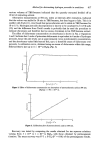
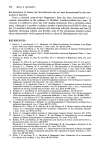
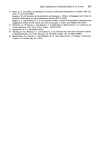
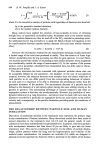
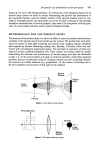
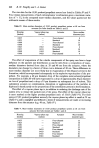
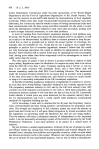
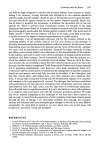
Method for determining hydrogen peroxide in emulsions 617 various volumes of TBP/benzene indicated that the quantity extracted levelled off at 10 ml of extracting solvent. Absorption measurements at 584 nm, taken at intervals after extraction, indicated that the colour was stable for 30 min in TBP/benzene, but then began to fade. This is in conflict with Tuck (11), who found that peroxochromic acid is stable in TBP/benzene for 10 to 15 h. Hydrogen peroxide decomposition is known to be catalysed by Cr (VI) salts (12), and the difference from Tuck's results is probably that he used the procedure to estimate chromium and therefore had no excess chromium in his TBP/benzene extract. The effect of dichromate concentration on absorbance is shown in Fig. 2. Equations 1 and 2 indicate that 1 mole of potassium dichromate is equivalent to 4 moles of hydrogen peroxide, hence the plot levels out at approximately twice stoichiometric concentration, and the absorbance varies little beyond this, up to a threefold excess of dichromate over peroxide. A calibration curve, obtained using an excess of dichromate within this range, followed Beefs law up to 4 x 10 4 M HaOa (Fig. 3). 0-6 0ø0.4 0'2 I • ! • I 2 4 6 [K•Cr•07] x 10 '• m Figure 2. Effect of dichromate concentration on absorption of peroxochromic acid at 584 nm. [H•O•] = 1.96 X 10 4 M. ['2- 0'8 I I I I 2 3 4 [•o:,] x I o :• m Figure 3. Calibration plot of peroxochromic acid at 584 nm. Recovery was tested by comparing the results obtained for ten aqueous solutions varying from 3 x l0 4 to 1 x l0 -a •t HaO2, with those obtained by permanganate titration. The mean recovery was 97.5 __ 0'5•o (P' = 0.01) of the permanganate results.
Purchased for the exclusive use of nofirst nolast (unknown)
From: SCC Media Library & Resource Center (library.scconline.org)