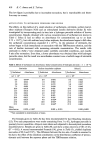
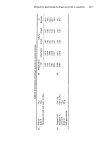
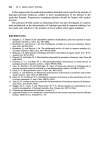
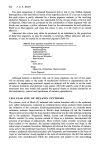
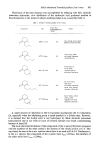
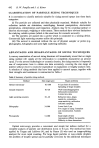
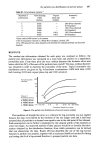
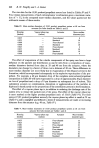
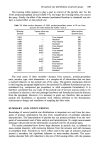
618 K. C. James and E. Tsirivas The low figure is probably due to incomplete extraction, but is reproducible and there- fore easy to correct. APPLICATION TO HYDROGEN PEROXIDE EMULSIONS The effects on the method of a small selection of surfactants, cetrimide, sodium lauryl- ether sulphate (Texapon N25) and an ethoxylated lanolin derivative (Solan E) were investigated by incorporating each in turn into a hydrogen peroxide solution of known concentration. Results obtained with various concentrations of surfactant are shown in Table L Solan E had no effect on absorbance for concentrations up to at least 2.75 x 10-: •, but with sodium lauryl-ether sulphate, the absorbance began to fall when the surfactant concentration exceeded 8 x 10 -a •o. In the presence of cetrimide, the colour began to fade immediately on extraction with the TBP/benzene solution, and the rate of decline increased with increasing cetrimide concentration. The results with cetrimide in Table I were obtained under carefully controlled conditions, and exactly 9 min after extraction. Even then, a lower absorbance was obtained than with hydrogen peroxide alone, but the result was nevertheless constant over a tenfold range of cetrimide concentration. Table I. Effects of surfactants on absorbance. Initial concentration of hydrogen peroxide = 1 X 10-: % Cetrimide Sodium laurylether sulphate Solan E • Surfactant Absorbance • Surfactant Absorbance • Surfactant Absorbance w/v • 10: w/v X 10 a w/v X 10 a 0'0 0.879* 0'0 0'894 0'0 0.842 2'5 0.822 1'0 0'882 2'5 0'865 5'0 0'813 2'0 0.872 5'0 0'847 7'5 0.805 3'0 0'890 7'5 0'840 10'0 0.819 4'0 0'881 10'0 0'845 12'5 0'814 5'0 0'902 12'5 0'860 15'0 0-832 6'0 0.897 15.0 0'870 17'5 0.820 7'0 0'883 17'5 0'838 20'0 0'822 8.0 0'895 20'0 0'842 22.5 0'828 9'0 0'869* 22'5 0'845 25'0 0'825 10'0 0'853* 25'0 0'858 27'5 0'818 11'0 0-842* 27'5 0'848 Mean absorbances 0.820 + 0-007 0.888 + 0'010 0.850+0.009 * Not considered in determination of mean. The formula given in Table IIa has been recommended for hair bleaching emulsions (13). Five such preparations were made containing from 3 to 6•o hydrogen peroxide in precisely known quantities. Aliquots were taken and subjected to the analytical procedure described above. Results are given in Table IIb, and show a mean recovery of 101 +3'4•o (P' = 0-01). A second recommended formula (14), given in Table IIc, yielded duplicate recoveries of 99.2 and 97.2•o. The difference between the two sets of results is assumed to be due to the effect of the emulsion constituents on the distribution coefficient of peroxo- chromic acid between the aqueous phase and the TBP/benzene solution.

Method for determining hydrogen peroxide in emulsions 619
Purchased for the exclusive use of nofirst nolast (unknown)
From: SCC Media Library & Resource Center (library.scconline.org)