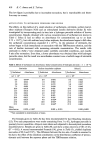
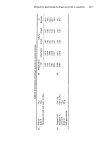
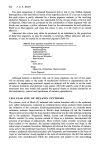
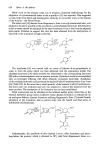
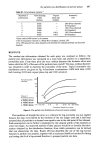
642 R. W. Pengilly and J. A. Keiner CLASSIFICATION OF PARTICLE SIZING TECHNIQUES It is convenient to classify methods suitable for sizing aerosol sprays into three basic categories: (i) The particles are collected and then physically examined. Methods suitable for collection include air elutriation, centrifuging, thermal precipitation, electrostatic precipitation, sedimentation and impaction. Analysis may be by counting (optical or electron microscopy), weighing or other means. These methods have obvious limitations for studying volatile systems (which is the usual case for cosmetic aerosols). (ii) The particles are passed into a probe which is connected to a sensing device. Commercial light scattering counters utilise this principle. (iii) The aerosol is examined without the use of physical sampler or probe (e.g. photography, holography and some light scattering methods). ADVANTAGES AND DISADVANTAGES OF SIZING TECHNIQUES A cursory examination of aerosol sizing literature will immediately reveal that no single sizing method will supply all the information to completely characterise an aerosol spray. For the aerosol technologist or cosmetic chemist, the sizing exercise is frequently one of compromise: how to obtain size data accurately, covering the size range of interest without resort to excessive expenditure on equipment or lengthy analysis time. A selection of sizing methods that have been applied to aerosol sprays, together with their strengths and weaknesses is summarised in Table I. Table I. Summary of particle sizing methods Method Size range (gm) Major problems Optical microscopy 0'2-300 0'2 gm limit of resolution Spreading of larger droplets Cascade impactors Wall losses/disaggregation Rebound/re-entrainment Limited size data 0.1-20 Refractive index, shape, sensitivity, coincidence, cross-sensitivity, calibration isokinetic sampling Lower limit 3 gm Two stages in sizing: formation and reconstruction. Analysis time. Small depth of field Automation difficult but possible. Difficulty in three dimensions. Light scattering counters 0'2-20 Holography 3-1000 Photography 5-1000 Optical microscopy provides a convenient and simple but tedious method for a complete analysis of particle size distribution down to 0.2 I•m. The method has been applied by Tregan and Lefebvre (4), and by Rance (5) who used an image-splitting analyser for more rapid counting. For large liquid particles or non-volatile droplets the problem of droplet spread can be partially overcome by the additional techniques

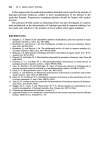
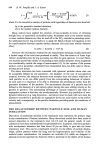
On particle size distributions of aerosol sprays 643 described in references (6) and (7), but both these techniques can be used with only limited success. Cascade impactors are air sampling devices consisting of high-velocity air jets in cascade (i.e. in series) with each jet directing the air against a collecting plate at a pro- gressively higher velocity. After calibration with suitable monodisperse aerosols, size- number distributions can be determined by microscope counting of the particles, or size-weight distributions can be obtained by weighing. Sciarra, McGinley and Izzo (8) have used the cascade impactor for estimation of the weight percentage of particles below 10 gm for hairspray formulations having different valve characteristics. Size distributions have to be constructed from a limited number of points, typically a maximum of five. A recent analysis of impactor data (9) has enabled development of smooth distribution curves from the masses of particles collected at different stages of a multistage impactor. Light scattering methods can be particularly useful in monitoring particle size distri- butions from aerosol sprays. The main difficulty is that the intensity of the scattered light pulse not only depends on particle size but, for a given light source and scattering/ measuring configuration, the intensity is also a function of other variables such as refractive index and particle shape. Jaenicke (10) has examined the additional problems of coincidence (the simultaneous occurrence of more than one particle at a time in the sensing volume) and cross-sensitivity (counting of particles in channels adjacent to that corresponding to the correct particle size). All aerosol particle counters need to be calibrated with standard aerosols of known size before use. Typical aerosols are produced by atomisation of suspensions of poly- styrene latex spheres. This only provides calibration data at a limited number of points in the size range of interest. Moreover, inaccuracies can arise if the refractive index of the measured aerosol is greatly different from that of the polystyrene latex. With probe systems correct sampling is essential, i.e. it is necessary to obtain a repre- sentative sample of the aerosol in terms of size and distribution. This can only be accom- plished by isokinetic sampling and it is particularly relevant for cosmetic aerosols, in which particles can possess appreciable momentum. The general problems concerning representative aerosol sampling have been reviewed by Fuchs (11). The measurement techniques employed in the present work have used a compromise of light scattering coupled with optical array imaging to enable a total size range of 0'3- 300 gm to be covered. ANALYSIS AND DEFINITION OF SIZE PARAMETERS The analysis of size data can present problems, not only of handling the large volume of information, but also of interpretation of the data. In an ideal situation, the aerosol distribution can be represented by an analytic function, f (D) of the form df = f (D) dD (1) with the condition f (D) dD = 1 (2) where dfis the number of particles having radii between D and D + dD. Transformation of the size parameters can then be obtained in both number and weight terms. The most common choice of function is based on log-normality to describe the distribution:
Purchased for the exclusive use of nofirst nolast (unknown)
From: SCC Media Library & Resource Center (library.scconline.org)