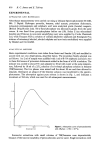
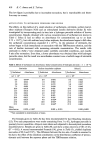
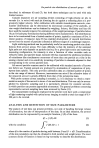
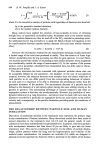
644 R. W. Pengilly and J. A. Keiner F (2g) • In bg exp -- •n • • _] d (lnO) (3) where F is the cumulative number of particles with logarithms of diameters less than InD. bg is the geometric standard deviation Dn is the number median diameter. Many authors have applied the criterion of log-normality in terms of obtaining straight lines on logarithmic-probability scales. Parameters such as the number-median or mass-median diameter can then be read off at the 50•o cumulative percentage point. An additional test for log-normality is to apply the Hatch-Choate (12) equation to test for transformation between number median diameter (Dn) and mass median diameter (Din): In (Dn) = In (Din) + 3 In s fig (4) However the information obtained by the measurement technique usually represents a limited range of the total sizes produced in reality. Thus the criterion of linear loga- rithmic-probability plots for log-normality can often be quite spurious. Vos and Thom- son recently queried the validity of calculating a mass median diameter whose magnitude was considerably outside the range of measurement (13). In the opinion of the present authors, such a parameter, calculated from extrapolated data, has little value in charac- terising aerosol sprays. The above discussion has been concerned with spherical particles whose sizes can be completely defined by one parameter- the diameter. In the case of non-spherical material, however, the situation becomes more complex since the kinetic behaviour of such particles in air can differ greatly from the corresponding behaviour of spheres. In such cases it is important to be able to determine the aerodynamic rather than the geometric diameters of the particles. The aerodynamic diameter of a particle may be defined as the diameter of a unit density sphere having the same settling velocity as the particle in question. The outstanding advantage of cascade impactors and other air segregation systems is that they size aerodynamically. However, any prediction of aero- dynamic behaviour (e.g. lung deposition - see below) must be made with care since the diameters recorded by a particular air segregation device are only relative to the airflow velocity and, consequently, to the particle orientation prevailing under the conditions of measurement. THE RELATIONSHIP BETWEEN PARTICLE SIZE AND HUMAN INHALATION Deposition of particulate material in the respiratory tract represents the primary stage in any consideration of human inhalation. Many theoretical models have been made of aerosol deposition in the respiratory tract (14-17) and the general results of such calculations have been substantiated by experimental tests. In general, only those particles with aerodynamic diameters less than about 10 •tm are likely to pass into the lower respiratory tract. This can be complicated, however, by the effects of particle density, shape, airflow patterns within the lung, and the hygroscopicity and volatility of the material under consideration. Air samplers are available (18) which are designed to separate air-borne material into fractions likely to penetrate to the depths of the human

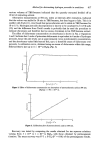
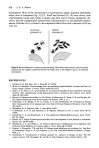
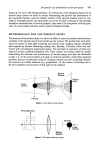
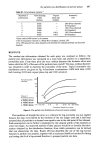
On particle size distributions of aerosol sprays 645 lung (e.g. for use in the mining industry). An estimation of the inhalation hazard of an aerosol spray cannot be made by merely determining the particle size distribution or the respirable fraction, since the relative toxicity of the sprayed material must be con- sidered. Although particle size parameters are of use in rapid screening of the potential inhalation characteristics of aerosol products, they need to be interpreted with the guid- ance of a toxicologist and they cannot replace biological testing. METHODOLOGY FOR THE PRESENT STUDY The purpose of the present study is to show the effect of some formulation and hardware variables on the particle size of some model aerosol systems. The particle sizes were deter- mined by means of laser light scattering and optical array imaging systems (designed and supplied by Particle Measuring Systems Inc., Boulder, Colorado, USA) and cali- brated with monodisperse polystyrene latices. The principle of operation of these two systems has been published elsewhere (19). These systems are ideally suited for rapidly determining the airborne size distributions of aerosol sprays and they are illustrated in Figs 1-3. As the measurements are made on airborne particles, rather than captured particles, they are of particular value for studying cosmetic aerosols containing substan- tial amounts of volatile materials (e.g. propellants). To the authors' knowledge this is the first published measurement of this type by this method. Optical • Ss'em/ i ....... •//J},,• • A ! •/•/•,•A• Array Source • •+'•/'•""•••••••••••••••••• g '•/•• Particle • Figure 1. The optical array system. Photodetectors Optical System Figure 2. The light scattering system. Particle Laser Source
Purchased for the exclusive use of nofirst nolast (unknown)
From: SCC Media Library & Resource Center (library.scconline.org)