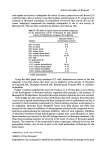
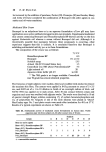
18 D. M. Bryce et al. 21 days oeost oeartum. In this study bodyweight gain of the males that received 40 mg/kg daily was slightly reduced. Mutagenicity Bronopol did not exhibit mutagenic activity under in vitro or in vivo conditions. It was tested using Salmonella typhimurium in the 'Ames' system and in the host-mediated assay in mice in a dominant lethal assay in mice, the only noteworthy finding was anti- fertility arising from toxicity rather than dominant lethality. Irritancy and Contact Sensitivity Animal Studies. Preliminary studies on irritancy and contact sensitisation have been reported by Croshaw et al. (3). Bronopol was tested for local effects to the mucous membrane of the eye in rabbits. A concentration of 0'5•o in normal saline was non-irritant when applied once daily for four successive days, whereas solutions in polyethylene glycol 400 were irritant at 5•o but not at 2•o following a single application. Skin irritancy was investigated by application of Bronopol in a variety of solvents to the non-abraded, clipped and shaved backs of rabbits for 6 h, with or without occlusion. Acetone solutions of Bronopol were non-irritant at 1•o when given as a single applica- tion under occlusion though highly irritant at 0'5•o on repeated application without occlusion. Similar results were obtained with Bronopol in 2'5•o aqueous methylcellulose solution tested under these conditions at 0'5•o concentrations. Bronopol in polyethylene glycol 300 was non-irritant at 5•o as a single application with occlusion. These findings indicate that the irritancy of Bronopol to the skin is dependent upon the vehicle employed, thus it would be advisable to test each new formulation containing Bronopol for local effects on topical application. Bronopol was without skin-sensitising activity in the guinea pig when tested as a 1 •o solution in acetone by the ear-flank method (Stevens (22)), whereas dinitrochloro- benzene was strongly positive. Human Studies. The skin irritant effect of Bronopol was investigated both on volunteers and on patients attending a contact dermatitis clinic. The volunteer study showed that Bronopol is slightly irritant to human skin at 1 •o in soft paraffin (petrolatum), and at 0'25•o in aqueous buffer at pH 5.5. The study con- sisted of a closed patch test using 1 cm lint squares backed with Blenderm surgical tape on the forearms of ten subjects. Concentrations of 0, 0.5, 1 and 2•o Bronopol in soft paraffin and of 0, 0'05, 0.1 and 0'25•o in aqueous buffer at pH 5-5 were used. Any skin reaction after 24 h was graded from 0 (= normal skin) to 5 (= marked erythema with vesicles and induration). The results are shown in Table VIII. The study carried out on patients attending a contact dermatitis clinic showed that Bronopol is a mild irritant when applied in yellow soft paraffin (yellow petrolatum) at 0'25•o. No evidence of sensitisatlon was seen in this study nor was there any suggestion of cross-sensitisation with any other substance, including formalin. The compound was applied as one of a battery of closed patch tests used in that clinic to screen the patients for a potential allergen. The patches were applied for 48 h and examined on the second and fourth days after the application. Of the 149 patients studied, three showed a slight erythema on the

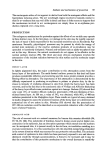
Activity and safety of Bronopol Table VIII. The irritancy of Bronopol to human skin 19 Base Bronopol Positive concentration • skin response Degree of reaction Soft Paraffin 0 0/10 -- 0.5 0/10 -- 1 2/10 both slight erythema 2 4/10 all moderate erythema Aqueous 0 0/10 -- buffer 0.50 0/10 -- pH 5.5 0.1 0/10 -- 0.25 1/10 slight erythema second day which had faded by the fourth day, and one a moderate erythema on the second day this patient did not return for the second examination. Marzulli and Maibach (23, 24) have studied the contact sensitisation in man of a number of commonly used biocides and have concluded that, under the conditions of a closed patch test, Bronopol in yellow soft paraffin was a potential sensitizer. The chal- lenge concentration in these studies was 2'5•o which according to these authors was a non-irritant concentration. However, the studies reported above are not consistent with this view. The patch tests carried out by Marzulli and Maibach showed a dose-response relationship, and since the response decreased very rapidly to zero at an induction con- centration of 2•o which is considerably greater than that used in formulations, the authors inferred that Bronopol may be safely used in cosmetic formulations. In a further study, Maibach (25), has confirmed that Bronopol was a direct irritant to human skin at concentrations greater than 15/o under these conditions. A subsequent sensitisation test included 93 normal subjects who were induced with 10 applications of 5•o Bronopol in yellow soft paraffin under an occlusive dressing over a period of 3 weeks. After a rest period of 2 weeks the subjects were challenged at 0'25•o Bronopol in yellow soft paraffin at a different site. No evidence of contact sensitisation was observed. FORMULATION STUDIES Bronopol has been in use for more than 10 years at a level of 0.01-0.02• or more in conventionally formulated shampoos based on sodium lauryl ether sulphates and alkanol- amine alkyl sulphates with 2• or more of a foam-boosting alkanolamide. When a freshly prepared formulation is challenged with 1 x 10 ø pseudomonads per ml the bac- terial count is reduced to 10 per ml within 24 h. The inclusion of protein-derived materials, e.g. 0.1-0.$• Crotein C (hydrolysed collagen, Croda Chemical Ltd) does not affect this result. The use of Bronopol in the preservation of shampoos has been described by Bryce and Smart (14), Schuster (26) and in protein shampoos by Tuttle, Phares and Chiostri (27). Barnes and Denton (28) found Bronopol at 0.02• to be one of the most satis- factory preservatives against Gram-negative bacteria in a cream, suspension and solution in their capacity test. Combinations of preservatives can be justified on several grounds, one of these being to increase the spectrum of antimicrobial activity. It is established that the anti- bacterial activity of Bronopol is greater than its antifungal activity and its spectrum can
Purchased for the exclusive use of nofirst nolast (unknown)
From: SCC Media Library & Resource Center (library.scconline.org)