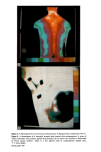
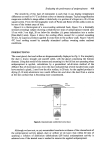
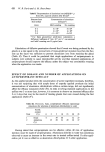
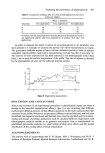
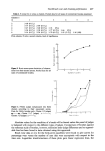
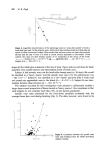
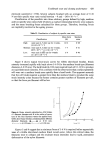
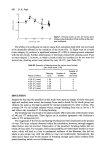
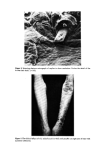
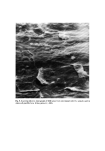
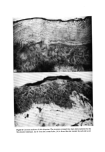
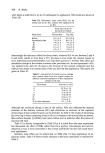
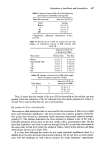
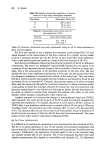
J. $oc. Cosmet. Chem. 29 413--422 (1978) Evaluating the performance of antiperspirants W. B. DAVIS and A.M. REES-JONES Beecham Products Research Department, Leatherhead, Surrey, England Presented at the Symposium on 'Product Evaluation' 18 April 1978, at Eastbourne Synopsis Particular attention is paid to two methods of performance evaluation (thermography and hygrometry) that allow antiperspirant activity measurements to be made under controlled conditions that do not interfere with the normal operation of the glands or the cooling caused by the evaporation of sweat at, or near, the skin surface. Thermography involves imaging the axillary vault region from the long-wave radiations emitted by the warm skin surface and uses the cooling effect of evaporation to map out areas where water is evaporating from the surface. Hygrometry involves relative humidity measurements of ambient air passing over the skin surface: sweat evaporating increases the relative humidity of the current of air. The results obtained from these methods are compared with those derived from conventional gravimetric tests on the back and the axillae in which sweat is collected in occluded absorbent pads. INTRODUCTION Therma-regulation in man is a complex efficient system in which the thermal energy released as a result of the chemical and physical activities within the body is used, in conjunction with local and central temperature control systems, to maintain the body and blood temperature near 37øC (Fig. 1). Heat gain Heat loss Muscular activity Metabolism External heat supply Conduction Radiation Sweat evaporation Figure 1. The thermal balance. Heat is gained from within the body as a result of metabolic activities. Sources such as the heart and liver are relatively constant whereas heat generated by skeletal muscular activity produces a variable contribution. Heat production under resting conditions is approximately 4.2 kJ/kg of body weight per hour (1 kcal/kg/h). During physical activities this heat production rate increases ten-fold. Heat is gained from the environment by radiation and conduction. Heat is lost by conduction and evaporation in the lungs and by radiation, conduction and evaporation at the skin surface. In a temperate climate a resting, clothed person loses approximately half of his heat by radiation and conduction and half by evaporation. 0037-9832/78/0700-0413 $02.00 ¸ 1978 Society of Cosmetic Chemists of Great Britain 413

414 W. B. Davis and A.M. Rees-Jones Clothes are intended primarily as a means of adjusting the balance of heat gain and loss. Civilisation and fashion often interfere with this freedom to adjust our clothing, therefore products such as antiperspirants and deodorants become necessary. Sweating is a mechanism by which the body can involuntarily lose heat by the evaporation of sweat in a short time in order to dissipate heat that would otherwise cause a rise in blood temperature. For every gram of sweat that is evaporated up to 2 kJ is extracted from the environment at the skin surface. This heat extraction occurs only when the sweat evaporates, which is why a slightly elevated ambient temperature such as 38øC, can be almost unbearable when the relative humidity is near 100•o, but pleasant and even exhilarating when the humidity is low. The sources of copious, watery sweat are the eccrine glands (atrichial) situated 1-3 mm below the skin surface, connected to the surface via spiral ducts in the epidermis. The eccrine glands are distributed generally over the body surface but are more dense on the palms and soles. The eccrine sweat glands in the axillary vault can be activated as a result of emotional or thermal stress. The sweat produced in the axillae can be particularly troublesome because sweat evaporation is limited except when the arms are raised, thus liquid sweat may accumulate, wetting surrounding clothing and inducing feelings of discomfort. To reduce the output of sweat in the axillae manufacturers provide solutions of aluminium salts, in easily used dispensers. The mode of action of aluminium salts has not yet been established unequivocally. Three possible modes of action involve (a) blockage of the ducts, (b) increased perme- ability of the duct wall, and (c) reduced activity of the gland. In measuring the efficacy of antiperspirants it is not necessary to know how or where the product is working, provided that the parameters used to define efficacy are realistic in terms of user perception. If, however, research leads to the mode of action being elucidated, subsequent improvements in efficacy may be anticipated. The efficacy of an antiperspirant is best defined as the percentage reduction in the rate of sweating in the axilla that may be achieved after a realistic application or series of applications of the test product. There are three basic methods by which we measure efficacy: (1) gravimetric, tared pads collect sweat for a fixed period (2) hygrometric, the increased humidity of air passing over the skin is recorded at a fixed flow rate. (3) thermographic, the extent of localised lack of cooling when an antiperspirant treatment is working is imaged and quantified using a scanning camera sensitive to infrared radiations. It is the aim of cosmetic chemists to produce a product that will consistently achieve a temporary decrease of the sweat rate in the axillae in the order of 20-60•o reduction. Such treatment would reduce the formation of liquid sweat on the skin surface without the risk of undesirable side effects. Although it is possible to achieve this efficacy in the majority of subjects, some do not respond well to treatment and some are even induced to sweat more. This type of reaction to a product is described as 'properspirant'. SWEAT INDUCED BY THERMAL AND EMOTIONAL STRESS In order to determine the efficacy of a product and its consistency in action from subject to subject it is necessary to standardise the experiment without making it unrealistic or non-representative of the whole population
Purchased for the exclusive use of nofirst nolast (unknown)
From: SCC Media Library & Resource Center (library.scconline.org)