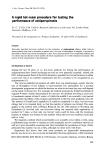
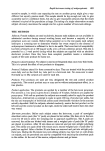
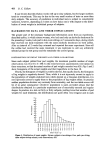
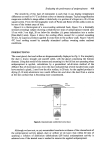
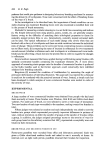
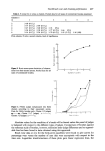
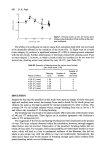
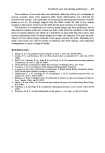
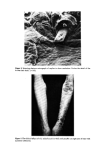
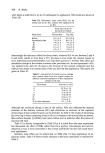
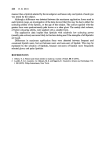
442 R. G. Drew This paper describes an apparatus giving realistic measurements of the force of (ease of) application and force to fracture. EXPERIMENTAL MATERIALS Ten lipsticks manufactured for retail distribution were selected for examination from two lipstick ranges*. They were chosen to cover a range of colours from clear gloss, through shades of pink, red and light brown to dark brown. These lipsticks were then arbitrarily coded. The first range was coded a, b, c, d and e, and the second range was coded v, w, x, y and z. All lipsticks tested were 41 mm long and 11 mm in diameter at their base. APPARATUS The apparatus consisted of a brass beam carrying strain gauges, spike and base onto which the lipstick was impaled (Fig. 1). A conventional polystyrene holder to match the base diameter of the lipstick was fixed to the beam with epoxy resin. Figure 1. Brass beam, with semiconductor strain gauges, used to hold the lipstick. Sample lipsticks were impaled on the spike set in a cylindrical holder on the left. Applied forces were transmitted to two pairs of strain gauges fitted on opposing sides of the beam. A semiconductor strain gauge** was fixed to each of the four sides of the square- sectional beam. The strain gauges formed two half Wheatstone resistance bridges. The other half of each Wheatstone bridge circuit was a balancing variable resistor incor- porated in the main recording equipment situated away from the device. In the recording equipment the outputs from the two bridge circuits were amplified by a factor of 1000 and fed into a vector sum computation unit.'• Hence, by carrying out a vector sum treat- ment of the two messages the resolved load on the lipstick at any instant could be com- puted electronically and the output fed to the pen recorder.** The bridges were powered * Margaret Astor Silver Frost and Ultra Soft lipstick from Cola GmbH, Cosmetik-Fabrikations- Gesellschaft mbH 612 Michelstadt/Odenwald, Bundesrepublik Deutschland. ** The strain gauges used were encapsulated axiaMead type supplied by Kulite Ltd, 20 Wote Street, Basingstoke, Hampshire, U.K. (Code No. DCP-120 090). t The vector sum circuit was designed by Analog Devices Inc., Norwood, Massachusetts 02062, U.S.A., and based on an integrated circuit chip, ADS31 KD. :• Phillips pen recorder PM 8221.

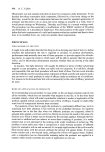
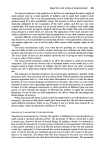
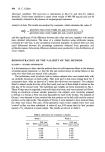
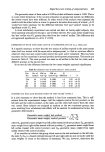
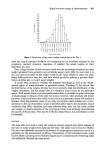
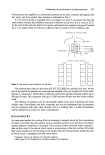
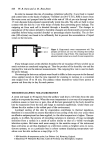
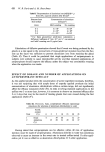
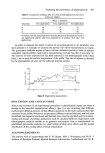
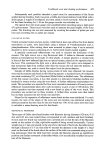
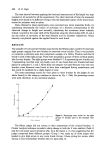
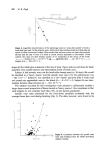
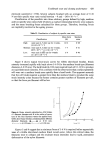
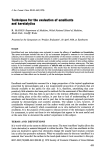
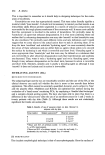
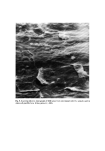
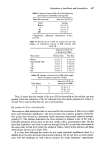
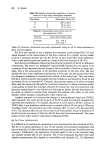
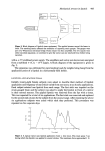
Mechanical stresses in lipstick 443 Figure 2. Block diagram of lipstick stress equipment. The applied stresses caused the beam to bend. The resulting strains affected the resistance of opposing strain gauges. The gauges were part of a Wheatstone resistance bridge whose output was then amplified. The two signals were either recorded separately, or combined to give the vector sum (or resolved) force before being recorded. with a -t- 5 V stabilised power supply. The amplifiers and vector sum device were energised from a stabilised -t- 15, 0, - 15 V supply. A block diagram of the equipment is given in Fig. 2. The apparatus was calibrated for pure bending loads by weights being hung from the application point of a lipstick in a horizontally held holder. LIPSTICK APPLICATION TRIAL Initially twenty-eight female subjects were asked to describe their method of lipstick application and frequency of use (which varied from non-users, to an hourly application). Each subject selected one lipstick from each range. The first stick was impaled on the strain-gauged beam and the subject was asked to apply the lipstick in front of a mirror in their normal manner. The applied lipstick was removed from the lips with a tissue. This was repeated for a total of six applications. The first stick was removed and replaced by the second stick chosen by the subject from the second range. After repeating the above six applications subjects were asked which stick they preferred. This procedure was repeated on five separate days. • 0'( ,,o 0.4 J'O -- I o I 2 3 4 5 6 7 8 Time (sec) Figure 3. A typical vector sum lipstick application force v. time trace. This trace spans 7 sec during which the lipstick was applied in several strokes. The maximum force approached 1 N.
Purchased for the exclusive use of nofirst nolast (unknown)
From: SCC Media Library & Resource Center (library.scconline.org)