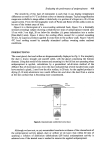
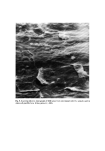
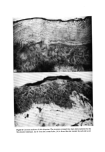
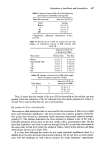
436 R. Marks were taken at intervals for up to 4 h subsequent to application. The results are shown in Table III. Table Ill. Surfometric areas (cma+S.D.) for six normal and six dry skin subjects after application of an HA Areas (cma+ S.D.) in tracing from replicas Time (rain) Normal skin Dry skin Before 9-2+3.2 10.5+2.0 Immediately after 7.9 + 2.6 10.1 + 3.7 30 7.8+2.8 9.1+2.4 60 7.4+1.1 8.8+3.2 120 6.7+ 1 '7 8-0+2-4 240 6.9+3.1 9.0+1.8 Interestingly the maximum effect has always been, whatever HA we use, between 2 and 4 h and rarely results in more than a 25• decrease in area under the contour traced. A more interesting and fundamentally more important question is whether HAs effect any cumulative change in the stratum corneum after persistent use. In one experiment a HA was applied twice daily for 28 days to the forearm of five normal volunteers and the replicas were taken at a constant time of the day after the last application. The results are given in Table IV. Table IV. Area (cm • + S.D.) under contour tracings from replicas taken from five normal subjects at different times after application of HA. Application stopped at 28 days Time (days) Area (crn • +_ S.D.) 0 10'78_+ 1.56 2 9'68+ 1.12 7 9-32+0.77 14 8.68+0.91 21 9'66+ 1.27 28 9-16+0'8 33 (5, after treatment) 9' 5 + 2.28 Although the maximum change is seen at the surface, HAs also influence the internal structure of the stratum corneum (SC) and alterations in contours of the ruptured internal face of skin surface biopsies can be detected In Table g the results of immersing the lower leg in water containing a bath oil for six volunteers with normal skin are shown. Skin surface biopsies (5) (SSBs) were taken before and at intervals after the period of exposure (20 rain). Table VI is directly comparable to Table III as it is taken from the same experiment but documents the effect of SSBs rather than from replicas. Interestingly the trend to reduction in area is more noticeable in the normal individuals but does not reach statis- tical significance. Similarly some effect can be determined on SSBs after 14 days application of an aqueous cream. Table VII shows results obtained in the same experiment as outlined for Table I.

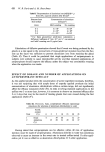
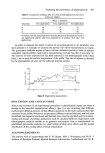
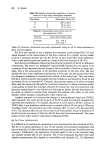
Evaluation of emollients and keratolytics 437 Table V. Results of use of bath oil to lower leg in six individuals on surfometer tracing area Time after exposure Area (cm2+ S.D.) in (min) tracing Before 8.5 + 2- 2 5 5.6+ 1.5* 60 8.2+ 1.9 240 6.9 + 2.3 * Significance difference fromcontrol 0-05 P0-02. Table VI. Results of use of HA on normal and dry skin subjects on surfometric tracing of SSB contrast with Table III Areas (cm2+ S.D.) in tracings from SSBs Time (min) Normal skin Dry skin Before 6.2+ 1.2 6.4+ 1.8 Immediately after 5.2 + 1.3 6.6 + 2.0 30 5.5+1-7 7.9+0.8 60 6.5+1.9 6.6+0.9 120 5.4+1.7 5.8+1.8 240 5.0+ 1.2 5.7+ 1.7 Table VII. Results obtained from SSBs after appli- cation of aqueous cream for 14 days Area (cm a + S.D.) in Time (days) n tracing from SSBs 0 8 12.9+3-7 7 9 12.0+1.8 14 8 11-7+2.0 Thus, it seems that the results of the use of HAs discernible at the surface, are also present within the substance of the SC although from the results presented in Tables V, VI and VII it may be that they are not as pronounced. (d) OTHER In Vivo TECHNIQUES There are two other techniques that we have used for the evaluation of HAs in vivo which have some functional significance. The first concerns the cohesive property of the SC. Our group have devised an instrument which measures intracorneal cohesion (coheso- graphy) (7). The method determines the force required to distract a disc of SC with a vertically orientated piston stuck to the skin surface with a cyanoacrylate glue. On the basis that 'hydration' was likely to alter the strength of the SC we used this instrument in the same study as that from which the results in Tables I and VII are derived, and these observations are set out in Table VIII. It is clear that although the results do not reach statistical significance there is a definite trend towards decreased intracorneal cohesion. We do not have as much experi- ence with this technique as with contour analysis for 'acute hydration' experiments.
Purchased for the exclusive use of nofirst nolast (unknown)
From: SCC Media Library & Resource Center (library.scconline.org)