Rapid hot-room testing of antiperspirants 403 sentative sample, in which case repeating the test on another group might give a very different but equally precise result. The sample should be big enough not only to give acceptably narrow confidence limits, but also to give reasonable certainty that the result obtained is typical of the population at large. The taking of a single observation on each subject obviously maximises the sample size for a given number of hot-room sittings. THE METHOD Subjects. Female subjects are used exclusively, because male subjects are not available in substantial numbers during normal working hours, and because a majority of anti- perspirant users are women. Before being accepted on to the test panel, each subject undergoes a screening test to determine whether her sweat output in the absence of antiperspirant treatment is sufficient for her to be useful. The lower limit of acceptability has been arbitrarily set at 100 mg per axilla over a 20 min collection period. This test is preceded by a 2 week period during which the subjects are supplied with an alcoholic deodorant product. Once they have been accepted, panellists receive a continuous supply of the same product for home use. Frequency of participation. No subject is used more frequently than once every third week. This is to permit the effect of test products to disappear. Protocol. Subjects attend for three consecutive days. They are treated with the products once daily and on the third day take part in a hot-room test. No cross-over is used. Normally up to fifty subjects are used for each test. Products. Two products are used per test, designated the test and control product respectively. The control product may or may not be without antiperspirant effect, i.e. a true placebo. Product application. The products are applied by a member of the hot-room personnel. For aerosols a 2 sec spray is given from a distance of 6 inches. Solutions are applied by pump-spray. With roll-on products the subjects are normally asked to apply the product themselves. Alternatively an attempt is made to apply 200 mg of product per axilla, but the size and topography of individual axillae cause considerable variation in the amount actually deposited. Half the subjects, selected randomly, receive the test product on the left side and the control product on the right, while the other half receive them the other way round. Hot-room procedure. Before each subject enters the hot-room, a pair of unweighed absorbent cotton pads (the 'A' pads) are placed in her axillae. She then sits in the hot- room for 40 min to allow her sweating rate to approach equilibrium. The A pads are removed, the axillae are blotted with tissues and a weighed pair of pads (the 'B' pads) are placed in position. After 20 min these are removed and put into airtight polythene jars. The axillae are again dried with tissues and a second weighed pair of pads (the 'C' pads) are applied. After a further 20 min these are removed and put into airtight poly- thene jars. During the 80-minute hot-room sitting subjects may have hot or cold drinks on request, and are permitted any activity compatible with retaining the absorbent pads in the axillae. At the end of the session, subjects shower and go home.

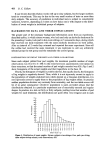
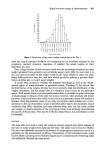
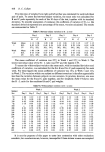
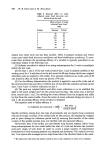
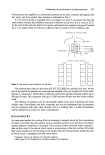
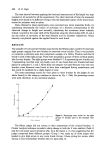
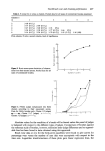
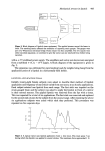
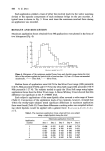
404 D. C. Cullum Hot-room conditions. The hot-room is maintained at 40+ IøC and 40+2•o relative humidity. Under these conditions a mean sweat weight of 400-500 mg per pad can be consistently obtained in the absence of antiperspirant treatment. Analysis of data. The results are analysed by computer, which calculates the value of 100(1 -- geometric mean sweat weight per pad, test product geometric mean sweat weight per pad, c-•nt•-•ol p--•-oduct'/ and the significance of the difference between this value and zero, together with certain more detailed information. The value of a similar function using arithmetic means, corrected for side bias, is also calculated, at present manually. In general there are only small differences between the percentage reductions obtained from geometric and arithmetic means. Substantial differences indicate some peculiarity in the distributions of sweat weights. DEMONSTRATION OF THE VALIDITY OF THE METHOD PLACEBO 1L PLACEBO EXPERIMENTS It is first necessary to show that the method does not yield spurious effects in the absence of antiperspirant treatment, i.e. that the test and control arrays of axillae behave in the same way when both are treated with a placebo. The preliminary work involved a test on sixteen subjects who were treated daily with an alcoholic deodorant on both axillae. They took part in hot-room sittings daily for 5 consecutive days. After an interval of 2 weeks the whole test was repeated. Two subjects failed to attend on the first day of the first week, and one of them failed to attend on the first day of the second week. The individual pad weights are those illustrated in Fig. 1. These 10 days may be regarded as ten individual mini-tests, and were analysed as follows. Using an electronic random number generator, the subjects were randomly assigned to Group 1 or Group 2. This was done separately for each of the 10 days. The subjects of Group 1 were deemed to have received the test product on the left axilla and the control product on the right axilla. The subjects of Group 2 were deemed to have received them the other way round. The ratio of the geometric mean sweat weights from 'test' and 'control' axillae was then calculated. A value of, say, 0.95 meant that the 'test' product caused a 5•o reduction in sweat output. The results are shown in Table I. Table I. Calibration test of placebo v. placebo Week 1 Week 2 GM 'test' Day Ratio Day GM 'control' GM 'test' Ratio GM 'control' 1 o.884 1 1.041 2 0.915 2 0.983 3 1.078 3 1.037 4 1.026 4 0.923 5 1.009 5 1.109
Purchased for the exclusive use of nofirst nolast (unknown)
From: SCC Media Library & Resource Center (library.scconline.org)