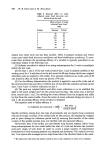
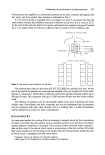
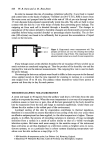
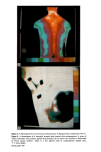
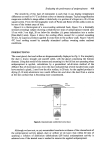
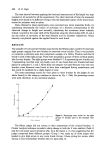
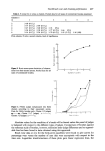
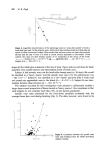
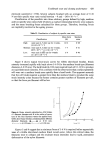
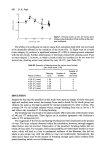
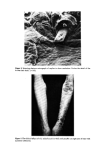
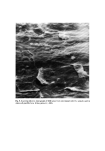
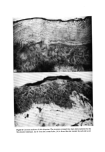
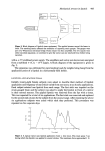
Evaluating the performance of antiperspirants 419 The sensitivity of this type of instrument is such that it can display temperature differences as small as 0.1 øC as distinct colour or intensity changes. Typical magnification ranges are available to image either a whole body or a portion of a finger on a 10 x 10 cm square screen. From the thermographic work of Parke and Reece (5) the axilla is seen to be one of the hottest areas of skin. Figure 4 is a thermogram of a non-sweating untreated back, Figure 5 is a thermally stressed (sweating) subject showing a relatively hot strip of antiperspirant treated skin 15 cm wide 3 cm high, 20 cm below his shoulder. (A green indentation into a cooler [blue-black] area). Figure 6 shows the cooling effect, caused for a period exceeding 10 min, by aqueous products applied in cross-form to the axillary vault Figure 7 shows 4øC local cooling caused by mentally stimulated axillary sweating under ambient conditions. PREDICTIONS The sweat gland, duct and orifice are diagrammatically displayed in Fig. 8. For simplicity the duct is drawn straight and parallel sided, with the gland comprising the bottom element. Using this model of the system and assuming it to be full but not operating when antiperspirant is applied, calculations by a geometrical sub-division method of the diffusive flux of aluminium ions down the duct indicated that several hundred ions could have reached a gland, 2 mm from the skin surface, in 20 min. As the applied product is drying (5-10 min) aluminium ions would diffuse into and down the duct from a source at the skin surface that is becoming more concentrated. Antiperspiran• ::::::,,: Skin ./.•,...•urføce .-• Duct Gland Figure 8. Geometrically subdivided sweat duct. Although we have not, as yet, accumulated conclusive evidence of the whereabouts of the antiperspirant activity (gland, duct or orifice) we do know that within 40 min of applying a solution of aluminium chlorhydrate (5/6 basic) antiperspirant activity is achieved even if the treated area is washed to remove the applied antiperspirant.

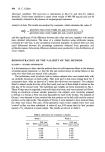
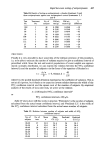
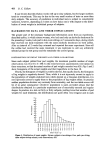
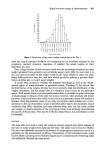
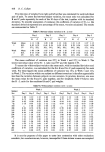
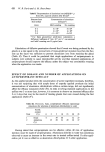
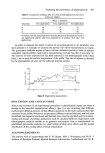
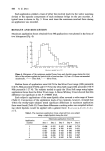
420 W. B. Davis and A. M. Rees-Jones Table II. The penetration of aluminium ions (AI[H•O] 3 + s) from 20•o aqueous solution after 20 min* Distance from skin surface Concentration of aluminium (ions/gm a) (mm) Mild sweating No sweating 0.2 4x 10⁷ 8x 10⁸ 0'6 4x 10 a 4x 10⁸ 2'0 1 x 10 -3 4 x 10⁴ * For these geometrical subdivision calculations a Diffusion Coefficient of 7.66 x 10 -7 cm • s -• was assumed and 'mild' sweating was 15 I.tg/cmymin. Calculations of diffusive penetration showed that if sweat was being produced by the glands at a rate equal to the normal rate of trans-epidermal moisture loss then the flow rate up the ducts was sufficient to prevent aluminium ions from reaching the gland (Table II). Thus it could be predicted that single applications of antiperspirants to subjects were unlikely to cause reproducible activity and that repeated applications of antiperspirant should improve the efficacy unless the subject was consistently sweating when the application was made. EFFECT OF DOSAGE AND NUMBER OF APPLICATIONS ON ANTIPERSPIRANT EFFICACY As the applied product dries the concentration of active ingredient increases, therefore, it was not surprising that with ample doses of expertly applied products the initial concentrations of aluminium chlorhydrate within a certain range, did not significantly affect the efficacy measured (Table III). In tests involving repeated applications to the axillae over 3 or more days, however, it is common to observe an increased efficacy after 2 or 3 days that may be the result of treating glands that were missed during the first application (Table IV). Table Ill. Hot-room, back, antiperspirant efficacies (percentage reductions) for solutions of aluminium chlorhydrate in water A1.Chl. content Trial (%) 0 2 5 10 15 20 25 1 Sweat 4 39 44 32 27 2 reductions 25 29 24 29 30 37 (%) Having stated that antiperspirants can be effective within 40 min of application mention must be made of properspirancy. Aluminium chloride in water was sometimes observed to cause an increase in the sweat rate in treated axillae tested 1 h after appli- cation yet it was as effective as aluminium chlorhydrate 22 h after application.
Purchased for the exclusive use of nofirst nolast (unknown)
From: SCC Media Library & Resource Center (library.scconline.org)