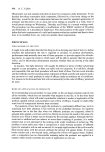
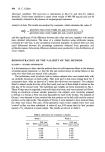
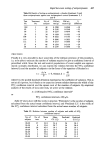
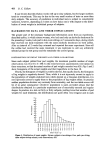
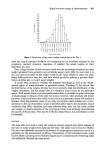
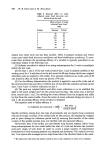
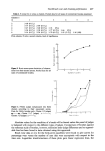
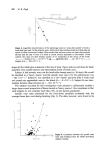
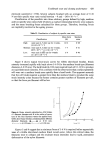
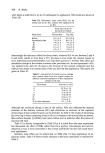
RaoeM hot-room testing of antioeersoeirants 405 The geometric mean of these ratios is 0.998 and their arithmetic mean is 1.0130. This is to some extent fortuitous if the random allocation to groups had turned out differently the results would have been different. In other words if the analysis were repeated the results could be either better or worse. In general a deviation from unity of at least + 0.15 would have been necessary for the difference between 'test' and 'control' means to be significant at the 5•o level. A more satisfactory experiment was carried out later on twenty-eight subjects, who were randomly allocated to Groups 1 and 2 before the test. The mean sweat weight from the 'test' axillae was 4•o greater than that from the 'control' axillae. This difference did not approach significance (t=0.83, P 0'25). EXPERIMENTS WITH THE SAME ACTIVE ANTIPERSPIRANT ON ALL AXILLAB It is equally necessary to show that the two arrays of axillae respond to the same extent when both are treated with the same active antiperspirant, i.e. that no spurious effect is observed when test and control sides receive the same active treatment. This has been necessary on four occasions in normal product development programmes. The results are shown in Table H. The same product was used on all axillae in the first two tests, and a different product in the second two. In no test did the difference between the two mean weights approach significance. Table H. Calibration test of active control v. active control Test No. of GM wt. GM wt. • No. subjects 'test' (g) 'control' (g) difference t 23A 49 0.3780 0.3940 -4 1.05 0.25 75 24 0.3568 0.3566 0 0.01 0.25 82 22 0.2936 0-2800 +5 0.53 0.25 102 26 0.1864 0.1952 -5 0.80 0.25 SYSTEMATIC BIAS AND ELIMINATION OF THE •SIDES' EFFECT It is also necessary to show that the method is free from systematic bias. This is self- evident from the experimental design: half the subjects receive the test product on the left side and the control product on the right, and the other half receive them the other way round. Since subjects are assigned at random to the two treatment groups, any error resulting from unbalanced side effects will be random. In mathematical terms, the parameter determined is Geometric mean weight, test product •/T•. TR Geometric mean weight, control product = • • where Tx., geometric mean weight from left axillae treated with test product TR, geometric mean weight from right axillae treated with test product Cx., geometric mean weight from left axillae treated with control product and Ca, geometric mean weight from right axillae treated with control product. If we consider in isolation the group which receives the test treatment on the left side, the ratio T•./C•t is a biased estimate because left and right sides do not normally yield the same weights of sweat in the absence of treatment. We can, however, determine the

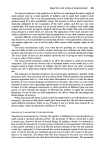
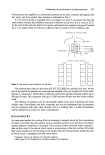
406 D. C. Cullum right: left ratio Rx (at least hypothetically) and apply a correction, so that the 'true' (i.e. unbiased) ratio Tx/Cx is given by Tx _ Rx Tx. Tx. Tx •, or -- C• C• C• C• R• Similarly TR T•R•. Cx. C•. the correction factor Rx appearing in the numerator because the products were applied the other way round. Combining and substituting, •/TL TR __ T• R•. C L C R • C •.
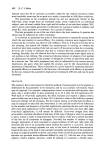
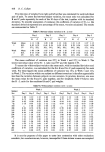
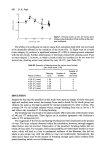
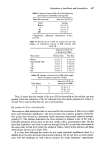
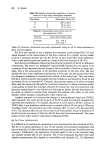
•Tx Rx That is, our experimentally found test: control ratio is biased to the extent of v'R•./Rx. Since the two groups are randomly selected, R•/Rx will vary randomly about a mean value of unity and there will be no systematic bias in the observed result. It is another matter whether the error resulting from the 'sides' effect is reduced to an acceptable degree by the allocation of products as described, without cross-over. Let us consider the placebo v. placebo experiments described above, in which the same anti- perspirant was applied to 'test' and 'control' axilhe. In these cases the true effect was by definition zero, and any observed effect is an error. The observed percentage effect is given by 100 (1 /TLT• / = 100 (1-x/TxT•.R•.) --¾CL CR / •11 C•. Rx Since the unbiased ratio Tx T•. Cx C•. -- 1 by definition, this reduces to The observed deviations from zero effect are thus direct measures of 100x/(R•./R0. Only in a few of the mini-tests on sixteen subjects did the error resulting from the 'sides' effect exceed 5•o, and the method of allocating products to sides may be considered to minimise this effect to an acceptable degree. POSITIVE EFFECTS AND REPRODUCIBILITY It is of course also necessary to show that the method succeeds in demonstrating a difference between products when there is one, and that the value found for this difference is reasonably reproducible. This has been done in four sets of experiments. In the first three, an active anti- perspirant was tested against a placebo (an alcoholic deodorant). In the other three pairs of tests, different active antiperspirants were tested against another antiperspirant as control. The control was the same in all three pairs. The results are shown in Table III. In all cases the replication of the result is very satisfactory. The near-constancy of the mean control weight in the experiments with large numbers of subjects suggests that these groups of subjects were representative of the population at large.
Purchased for the exclusive use of nofirst nolast (unknown)
From: SCC Media Library & Resource Center (library.scconline.org)