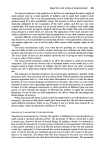
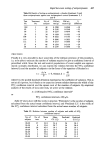
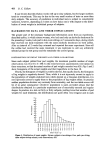
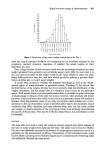
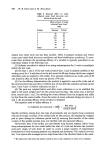
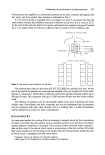
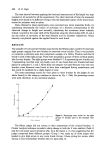
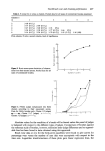
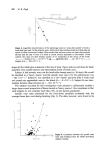
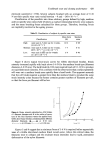
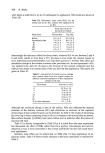
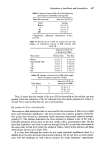
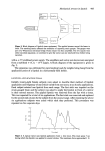
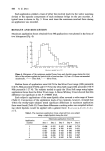
Toothbrush wear and cleaning performance 429 extremely scattered (r=0'50). Several subjects brushed with an average force of 9-10 N yet their specific wear rates varied between - 9 and - 240 x 10 -4 t -x. Classification of the panellists into three arbitrary groups defined by high, medium and low specific wear rates (Table H) shows a marked relationship between wear category and the mean brushing forces calculated for these groups. Therefore, brushing forces are implicitly involved in the ageing process. Table II. Classification of subjects by specific wear rates Mean force Standard Classification (N) error High wear scale 6, 7 after use for 4 weeks. 10.2 0.69 (k•84x 10 -4 t -•) Medium: wear scale 4, 5 after use for 4 weeks. 7.7 0.51 (28.5 x 10 -4 t-•k 84x 10 -4 t -•) Low: wear scale 3 after use for 4 weeks 6.4 O. 40 (k 28.5 x 10 -4 t -•) Figure 6 shows typical force-strain curves for Gibbs short-head brushes. Strain •ntensity increased rapidly with loads above 5-6 N for the medium brush type (filament diameter, d, 0'25 mm). The hard brush (d, 0.33 mm) required loads of 12-13 N to produce an equivalent strain intensity. This correlates with the observation that a subject generally will wear out a medium brush more quickly than a hard brush. The apparent anomaly that the soft brush required a greater force than the medium brush to produce the same strain intensity arises because the former contains greater numbers of filaments per tuft, so that the force per filament will be less. Figure 6. Strain intensity calculated as d/2R (where d = filament diameter and R is the radius of curva- ture of the bent filament) versus the applied load. Gibbs short-head brushes containing three different diameter filaments. ß ß d, 0.33 mm x -- x d, 0-25 mm (3 (3 d, 0.20 mm. E 0.0• c_ 5 Force ( N ) I 15 20 Figures 5 and 6 suggest that a minimum force of 5-6 N is required before appreciable wear of a Gibbs short-head medium brush would occur. Above this critical value, the filaments tend to collapse and the resultant strain intensities lead to rapid, permanent deformation of the nylon filaments.

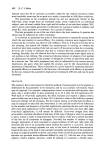
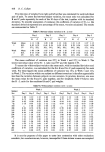
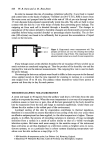
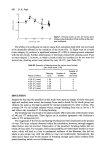
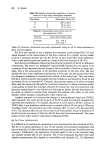
43O B. R. Pugh I..5 25 50 75 I00 Percenfoge weor Figure 7. Cleaning scores in vitro for various worn brushes using Pepsodent (Elida Gibbs) as the refer- ence toothpaste. The ability of a toothpaste to remove stains from extracted, dyed teeth was not found to be drastically affected by the condition of the brush (Fig. 7). Slight wear of a brush (wear category 4) produced a significant increase (P=0.05) in cleaning scores compared with the new brush. Further deterioration of the brush reduced the cleaning score. Even at wear category 7, however, at which a brush would be considered to be too worn for normal use, cleaning scores were reduced by only 10-15•o (see Table III). Table III. Summary of cleaning scores for various worn brushes (new brush score, 1'00) Number of Cleaning Number of mosiacs Brush condition score brushes per brush 3 (24.4% wear) 1.03 2 6 4 (36-3•o wear) 1.28 2 6 5 (52.6% wear) 1' 10 2 6 6 (75.5% wear) O. 86 4 6 7 (95.6% wear) O' 89 4 6 __ DISCUSSION Despite the fact that the panellists in this study were made up largely of those who gave high and medium wear scores, the average force used to brush for the whole group was virtually the same as the figures quoted for normal populations by other workers. This average (7.4 N) did include subjects whose average brushing force was as low as 3 N and others who exceeded 17 N during brushing. The brushing rate was found to be approximately 260 strokes/min with extreme values of 340 and 177 strokes/min. These figures are in excellent agreement with Robinson's value of 275 strokes/min (11). The magnitude of the forces used during brushing have been implicated in the process of wear. The large variance observed within the correlation, however, strongly suggests other factors may be involved. Observation of the panellists' brushing habits did not reveal obvious clues For example, while some panellists pre-wetted their brushes in warm water, which will lead to a loss in mechanical resilience of the filaments, this did not relate in any simple way with the ability to wear out toothbrushes. Speculatively, the other major factor may be the manner of brushing, though again direct evidence from actual brushing habits was not forthcoming.
Purchased for the exclusive use of nofirst nolast (unknown)
From: SCC Media Library & Resource Center (library.scconline.org)