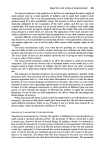
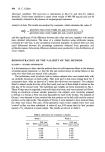
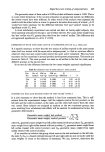
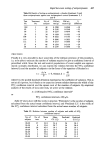
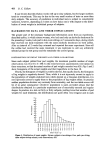
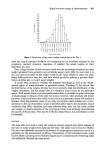
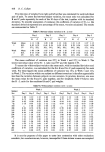
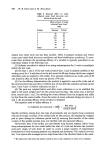
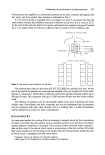
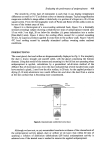
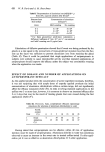
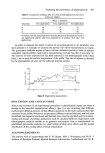
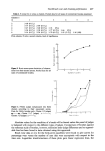
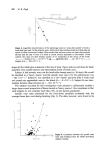
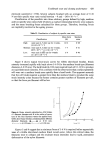
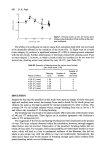
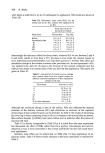
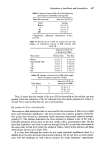
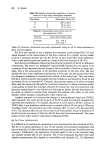
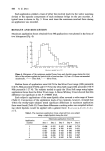
Evaluating the performance of antiperspirants Table IV. Comparison of efficacy after two, four and six applications, hot-room axilla, ten subjects 421 Mean % reduction Treatment Two applications Four applications Six applications X 26 27 35 Y 25 34 37 Z 24 36 39 A student t-test for paired data shows that the efficacies of formulations Y and Z are significantly greater after four applications of product than after two applications. In order to measure the speed of action of an antiperspirant or its durability over short periods it is necessary to decrease the period over which measurements are made. The gravimetric methods require at least a 20 min collection period in order to achieve acceptable reproducibility hygrometry measurements can take less than 2 min (Fig. 9). The extreme of short response time has been achieved in our thermography work which takes 1 sec to map the surface temperature of the axilla. The rate of repeats is dictated by the photographic process not the infra-red detector system. 60 2O 40øC 52% RH flow rate 150 ml/min Test 0 20 50 60 Time (rain) Figure 9. Hygrometric measurements. DISCUSSION AND CONCLUSIONS Almost any variation in an experimental procedure or physiological aspect can cause a change in the recorded antiperspirant efficacy, thus it is not surprising that different methods give different answers, or that efficacy measured on the back is greater than that measured in the axillae. Whenever antiperspirant efficacy is quoted the basic method must be defined, the degree of emotional and thermal stress must be specified and the number, timing and dosage of product application must be specified. Both the hygrometric and thermographic methods enable us to generate information that is unobtainable by established gravimetric methods, i.e. observations of short term effects and the spatial distribution of the cooling effect of sweat evaporation. ACKNOWLEDGMENTS The authors wish to acknowledge Mrs P.M. Baxter, Miss J. Winchester and Dr R. J. Jackson of Beecham Products Applied Research Laboratories, Leatherhead and Dr R.

422 W. B. Davis and A. M. Rees-Jones Woodrough of St Bartholomew's Hospital, London for the considerable contribution toward the work and methods referred to in this paper. REFERENCES 1 Majors, P. A. and Wild, J. E. The evaluation of antiperspirant efficacy: influence of certain variables. J. Soc. Cosmet. Chem. 25 139 (1974). 2 Kuno, Y. Charles C. Thomas, Illinois. Human Perspiration (1956). 3 Quatrale, R. P., Stoner, K. L. and Felger, C. B. A method for the study of emotional sweating. J. $oc. Cosmet. Chem. 28 91 (1977). 4 Shelley, W. B. and Hurley, M. J. Studies on topical antiperspirant control of axillary hyperhidrosis. Acta Derm.-Vener. 55 241 (1975). 5 Park, W. M. and Reece, B. L. Fundamental Aspects of Medical Thermography (1976) British Institute of Radiology, London.
Purchased for the exclusive use of nofirst nolast (unknown)
From: SCC Media Library & Resource Center (library.scconline.org)