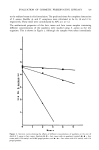
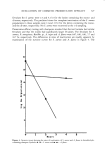
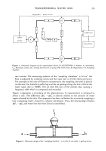
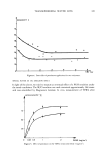
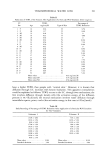
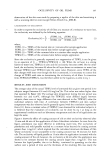
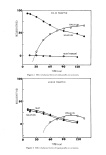
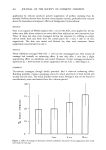
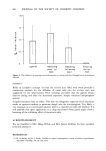
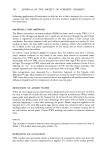
366 JOURNAL OF THE SOCIETY OF COSMETIC CHEMISTS 100- 75 Control Sweat ing Sweat ing Sweatincj prior to following during appl. appl. appl. Figure 3. The influence of sweating on anhidrosis prior to, during and after the application of aluminum chloride. COMMENT Reller & Luedder's concept (13) that the eccrine duct filled with sweat provides a continuous medium for the diffusion of metal salts into the eccrine duct was supported by our observations. Prior sweating, provided that the glands remain inactive during and after the aluminum exposure, sharply enhanced antiperspirant activity. Scopolominization had no effect. This was not altogether expected since aluminum needs an aqueous medium to penetrate deeply into the acrosyringium. Very likely, a 3-hr exposure to a concentrated solution held in a chamber provides the medium. It is still possible that open application to a drug-inactivated sweal gland might show a lessening of the inhibiting effect of aluminum salts. ACKNOWLEDGMENT We are thankful to Mrs. Helga H 31zle and Mrs. Janice Stebbins for their excellent technical assistance. REFERENCES (1) W. B. Shelley and H.j. Hurley, Studies on topical antiperspirant control of axillary hyperhidrosis, ,4cta Derm. Venerolog., 55,241-260 (1975).

ANTIPERSPIRANT ACTION OF ALUMINUM SALTS 367 (2) H. H. Relier, Factors affecting axillary sweating,J. $oc. Cosmet. Chem., 15, 99-110 (1%4). (3) E. H•51zle and A.M. Kligman, Mechanism of antiperspirant action of aluminum salts,J. Soc. Cosmet. Chem., (submitted for publication). (4) H. Tronnier and G. Rentschler, Experimentelle Untersuchungen zur Wirkungsweise aluminiumhal- tiger Antiperspiranzien,J. Soc. Cosmet. Chem., 24, 281-290 (1973). (5) W. B. Shelley and P. N. Horvath, Comparative study of the effect of anticholinergic compounds on sweating,J. Invest. Dermatol., 16, 267-274 (1951). (6) W. B. Shelley, P. N. Horvath, F. D. Weidman and D. M. Pillsbury, Experimental miliaria in man. I. Production of sweat retention anhidrosis and vesicles by means of iontophoresis,J. Invest. Dermatol., 11,275-291 (1978). (7) F. Herrmann and M. B. Sulzberger, Control of axillary sweating and of body odor, J. Amer. Med. x'zlJJ0oe., 167, 1115 (1958). (8) N. Hunziker and R. Brun, Experiences sur la transpiration. Action et dur•e d'effect de solutions de sels d'aluminium • divers pH, Dermatologica, 117,200-204 (1958). (9) R. Brun, Studies on perspiration,J. Soc. Cosmet. Chem., 10, 70-77 (1959). (10) H. P. Fiedler, "Der Schweiss," 2nd ed., Aulendorf, Cantor: 1%8 pp 303-377. (11) U. Schmid, N. Hunziker, R. Brun and W. Jadassohn, The protective effect of the sebaceous layer, Brit. J. Dermatol., 76, 395-397 (1964). (12) A.M. Kligman, The uses of sebum, Brit. J. Dermatol., 75,307-319 (1%3). (13) H. H. Reller and W. L. Luedders, Pharmacologic and toxicologic effects of topically applied agents on the eccrine sweat glands, in "Advances in Modern Toxicology, Vol. 4. Dermatotoxicology and Pharmacology," Francis N. Marzulli and Howard I. Maibach, Eds., Hemisphere Publishing Co.: Washington, London, 1977.
Purchased for the exclusive use of nofirst nolast (unknown)
From: SCC Media Library & Resource Center (library.scconline.org)