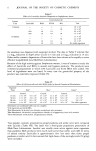
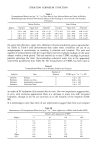
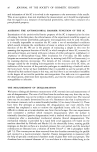
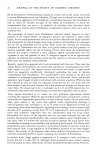
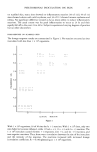
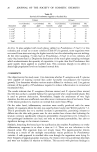
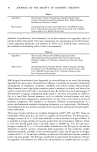
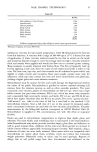
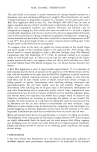
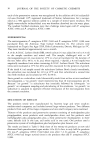
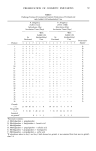
4 JOURNAL OF THE SOCIETY OF COSMETIC CHEMISTS Table I The Minimum Inhibitory Concentration (MIC) of BHT • and BHA 2 (pH 7.0) in Liquid Culture Medium Microorganism BHT BHA Escherichia coli 5000 •tg&ml 2000 •tg/ml Pseudomonas aeruginosa 5000 •tg/ml 5000 •tg/ml Streptococcus mutans 5000/•g/ml 125 •tg/ml Streptococcus agalactiae 5000 •tg/ml 125 •tg/ml Staphylococcus aureus 5000 •tg/ml 250 •tg/ml Corynebacterium sp. 500 •tg/ml 125 •tg/ml Norcardia asteroides 5000 •tg/ml 250 •tg/ml Saccharomyces cerevisiae 5000 •tg/ml 125 •tg/ml Candida albicans 5000 •tg/ml 250 •tg/ml •2,6-di-tert-butyl-4-methyl phenol. 22 and 3-tert-butyl-4-methoxy phenol. EFFECT OF STRUCTURE MODIFICATION OF BIOCIDAL ACTIVITY OF TEST-PHENOLS In order to determine how changes in the alkyl chain of BHT would effect antimicrobial activity of this phenolic compound, a number of n-alkyl derivatives para to the phenolic group were compared. Data are presented for a series of BHT derivatives where the R group was varied by carbon lengths from zero to the decyl derivative (Table II). The optimum length for the para alkyl chain of the 2,6- Table II Effect of Structural Changes on Antimicrobial Activity (MIC) of Some Tert-Butyl Phenol Derivatives 2,6-di-tert-butyl- Streptococcus Mutans -phenol 250 •tg/ml -4-methyl phenol (BHT) 1000 •tg/ml -4-ethyl phenol 62 •tg/ml -4-butyl phenol 31 •tg/ml -4-hexyl phenol 125 •tg/ml -4-octyl phenol 500 •tg/ml -4-decyl phenol 1000 •tg/ml -4-hydroxymethyl phenol 125 •tg/ml -4-methoxy phenol 1000 •tg/ml di-tert-butyl phenol was found in the four carbon chain derivative. Other structural changes strongly influenced biological activity. Hydroxylation of the -4- methyl derivative (BHT), lowered the MIC from 1000 to 125/ag/ml an increase in biocidal activity of ten-fold or more. A -4- methoxy derivative of 2,6-di-tert-butyl phenol was much less active than BHA which has a single tert-butyl group blocking the acidic phenol. That stearic hindrance plays an important part in compound antibacterial action was supported by testing a 2,5-di-tert-butyl phenol. In this case the bulky tert-butyl group is meta to the phenolic group instead of ortho, as in the case of BHT. The stearically blocked 2,6 derivative had a MIC of 250 /ag/ml against Streptococcus mutans while the unhindered 2,5 phenol derivative gave a value of 15.6/ag/ml. POTENTIATING EFFECT OF EDTA ON BIOCIDAL ACTIVITY The MIC for EDTA was determined against a number of organisms. The values for EDTA alone and in conjunction with Lauricidin are presented in Table III. The MIC

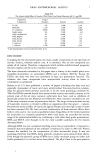
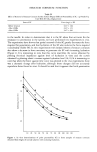
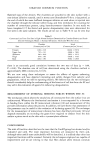
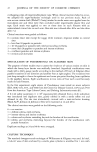
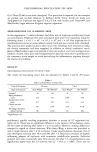
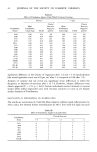
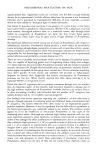
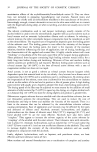
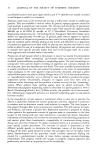
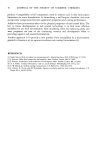
GRAS ANTIMICROBIAL AGENTS 5 Table III Effect of EDTA on MIC of Lauricidin 0 500 1,000 5,000 10,000 EDTA Organism ug/ml ug/ml ug/ml ug/ml ug/ml Alone Escherichia coli NI NI NI NI N! 10,000 Pseudomonas aeruginosa NI NI N! 100 10 5,000 $treptococcus faecalis (Group D) NI NI 1,000 10 10 5,000 $traphylococcus aureus 1,000 500 100 10 10 5,000 $treptococcus pyogenes 10 10 10 10 10 1,000 Corynebacterium sp. 10 10 10 10 10 1,000 Nocardia asteroides 10 10 10 10 10 500 $accharomyces cerevisiae 1,000 100 10 10 10 1,000 Candida albicans NI 100 100 100 100 5,000 Experiment was carried out at pH 7.2. MIC values for Lauricidin were determined with the various indicated concentrations of ethylene dramine-tetraacetic acid (EDTA), i.e. 0.5% EDTA plus 0.01% Lauricidin will prevent the growth of Pseudomonas aeruginosa. of Lauricidin was determined from ten-fold dilutions containing various concentra- tions of EDTA. Concentrations of the chelator from 125 ppm to 10,000 ppm on Lauricidin activity were examined. The most marked changes in MIC values of Lauricidin occurred between 500 and 5000 ppm of EDTA. The most significant decrease in MIC value was measured for Psuedomonas aeruginosa. Significant activation of Lauricidin by EDTA against yeast was also demonstrated. COMBINATION STUDIES WITH FOOD-GRADE MATERIALS During our study with these individual food-grade preservatives it became obvious that each preservative had a limited spectrum of activity against microorganisms. While Lauricidin exhibited high activity against gram (+), yeast and fungal organisms, it had little if any activity against gram (-) strains tested. BHA had a somewhat greater range of activity including gram (--) strains but was also limited to similar organism. This phenolic derivative had higher MIC values for gram (+) bacteria and lower MIC values for yeasts. Of greater interest was the slight activity against E. coli (500 ppm). While EDTA had overall low antibacterial and fungal activity, it did show activity against P. aeruginosa. It should be noted that the germicidal action of the combination in aqueous suspension was slow (Table IV). However, the combination acted more quickly when Table IV Effect of O/W Lauricidin Emulsion on Staphylococcus Aureus Concentration (%) Lauricidin BHA EDTA Titer I 0.0 0.0 0.0 2.3 X 10 6 1.0 0.0 0.0 1.0 x 10⁶ 1.0 0.1 0.0 3.6 x 10⁵ 1.0 0.1 1.0 1.7 X 10 5 1.0 0.5 0.0 No viable organism 1.0 0.5 1.0 No viable organism •Reading made after 1 hr contact.
Purchased for the exclusive use of nofirst nolast (unknown)
From: SCC Media Library & Resource Center (library.scconline.org)