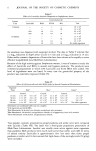
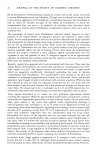
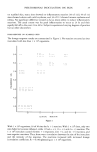
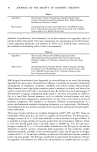
8 JOURNAL OF THE SOCIETY OF COSMETIC CHEMISTS strongly influences biological activity. Optimal antimicrobial activity is reached where the alkyl group is a butyl derivative. It should be noted that where no alkyl group exists in the para position or where the methyl group is replaced by a hydroxy methyl, the resulting 2,6-di-tert-butyl phenolic derivative is more active. The placement of the tert-butyl group from the 2,6- position to the 3,5- position unhinders the phenolic group and results in a more active isomer. When the methyl group of BHT was replaced by a methoxy group, a less active species resulted. The deactivating effect of the methoxy group was not apparent where the di-tert-butyl group of the 2,6- derivative was moved to single a 2- or 3- position, as in BHA. Although BHA was not the most active phenolic derivative tested, it is recognized as a GRAS (Generally Recognized As Safe) chemical suitable for addition to foods. The emphasis on the use of BHA instead of the butyl derivative of BHT was based on its acceptability by the Federal Drug Administration (FDA), and greater biological activity. During the course of our investigation many reports appeared on the antimicrobial role of BHT and BHA. Numerous phenolic antioxidants are currently being used as food preservatives (8). Kaufman and Ahmond (9) reported that 140 ppm of nordihydroguaiaretic acid (NDGA) inhibited growth of Saccharomyces cerevisiae. Epstein, et al. (10) reported that the LD50 for T. pyriformis was only 5 ppm for NDGA. Shih and Harris showed that this antioxidant was lethal at 400 ppm against E. coli. Only 50 ppm of NDGA were needed to inhibit S. aureus (11). Ward and Ward reported that the growth of S. senftenberg was restrained by 10,000 ppm of butylated hydroxy toluene (12). A recent patent by Trelease revealed that the phenolic antioxidant, BHA, showed similar but higher activity than BHT (13). Butylated hydroxy-anisole was shown to be active at 500 ppm. Chang and Branen (14) found that 250 ppm pf BHA could inhibit the growth of A. parasitious and 150 ppm could inactivate S. aureus. BHA at 20 ppm inhibited T. pyriformis growth by 50% (15). Virbio parahaemolyticus growing in TSBS was inhibited by 50 ppm of BHA (16). In addition to their action on bacteria and fungi, butylated phenols (BHT and BHA) are potent inactivators of lipid-containing viruses (17,18). Earlier a closely related derivative, thymol, was shown to inactivate influenza viruses, herpes viruses and several other lipid-enveloped viruses (19). The third multifunctional chemical used to enhance antimicrobial activity of Lauri- cidin was EDTA acid. While this chemical's primary utility is to sequester metals and may provide support for a metal-chelation theory for solubilizing cell walls, factors other than chelation may be involved. Some of these factors stem from the two observations. First, EDTA is as active at acidic pH's as in basic media second, other chelators, including ethylene glycol-bis (fi-amionoethyl ether) NN' tetraacetic acid (EGTA), were not active (unpublished data). The "enhancing" role of EDTA, which has poor antimicrobial action of its own, was noted by facilitating antimicrobial affects of other preservatives on cell walls. This observation is not original with us. In 1958 McGregor and Elliker discovered that mutants resistant to quaternary compound become sensitive when exposed to EDTA acid. Since that time many authors have shown that pretreatment of gram negative bacteria with EDTA renders the cells susceptible to antibacterial agents (20 and references therein). Sheu and Freese (21) showed that the E. coli to deconoic and

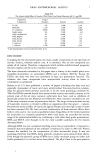
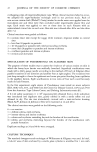
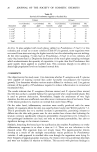
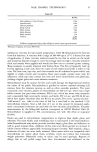
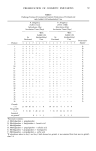
GRAS ANTIMICROBIAL AGENTS 9 linolenic acid was increased by treatment with EDTA. Shibasaki and Kato have reviewed the role of EDTA in extending the range of lipophilic preservatives (22). Hart has recently reviewed the role of EDTA in cosmetics and toiletry products and has emphasized various functional properties beyond its use as a water softner (23). The spectrum of activity of any preservative or biocide is limited. Thus enhanced antimicrobial effectiveness may result from the use of two or more preservatives. Mixed quaternium compounds and combinations of parabens are examples of preservatives of mixtures that are superior to individual family members. In the present report we investigated the combined effect of certain food-grade chemical agents on the antibacterial activity of Lauricidin. The agents picked to enhance the range and activity of Lauricidin were selected from the GRAS classifica- tion in order to assure safety. While a great number of agents have been screened, BHA and EDTA are representative of what can be done with wholly food grade materials and Lauricidin. The art which is presented can easily be extended to other phenolic compounds (parabens) and fatty acids (sorbic, lactic) in combination with Lauricidin and is not limited to the examples given. It also contradicts the notion that phenol compounds form inactive complexes with every nonionic surfactants (26). The specific combinations given in this report indicate that the limited spectrum of Lauricidin can now be extended to gram (-) organisms. Also the kill rate of Lauricidin in aqueous systems can be increased against most organisms in the presence of BHA and/or EDTA. In the example presented in Table VI the dispersion of Lauricidin in isopropyl alcohol greatly enhanced its ability to kill organism in a short period of time. Killing times of a minute or less have been measured for some topical and oral agents now under investigation (unpublished data). SUMMARY The antimicrobial activity of Lauricidin has been reported and found to be active against gram (+) bacteria, yeast, fungi, and some molds. Gram (--) bacteria were not affected by Lauricidin alone. In order to extend the usefulness of Lauricidin as a cosmetic preservative, a number of food-grade (GRAS) materials were examined as useful enhancers. Di-tert-butyl anisole (BHA) and ethylendiaminetetraacetic acid (EDTA) were found to enhance Lauricidin preservative qualities, Lauribic (a propri- etory product of Med-Chem Laboratories) was shown generally to be more active than parabens, or sorbic acid. Both the spectrum of activity and kill time of Lauricidin can be improved by the combination of this food product with other food additives. Examples with BHA and EDTA were given. REFERENCES (1) J. j. Kabara, D. M. Swieczkowski, A. J. Conley and J.P. Truant, Fatty acids and derivatives as antimicrobial agents, Antimicrob. Ag. and Chemother., 2, 23-28 (1972). (2) A.J. Conley and J.j. Kabara, Antimicrobial action of esters of polyhydric alcohols, Antimicrob. Ag. and Chemother., 4, 501-506 (1973).
Purchased for the exclusive use of nofirst nolast (unknown)
From: SCC Media Library & Resource Center (library.scconline.org)