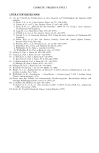
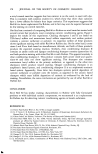
252 JOURNAL OF THE SOCIETY OF COSMETIC CHEMISTS the LC method is accurate, reproducible, and reliable for routine analysis. Our work has shown the UV detector is very sensitive and stable for quantitating nitrosamines. REFERENCES (1) J. M. Barnes and P. N. Magee, Br.J. Ind. Med. 11,167-74 (1954). (2) P. N. Magee andJ. M. Barnes, Br.J. Cancer, 10, 114-22 (1956). (3) H. Druckery, R. Preussman, S. Ivankovic, and D. Schmahl, Z. Krebsforsch. Klin. Onkol. 69, 103-201 (1967). (4) M. L. Douglass, B. L. Kobacoff, G. A. Anderson, and M. C. Cheng, J. Soc. Cosmet. Chem. 29, 581-606 (1978). (5) T. Y. Fan, J. Morrison, D. P. Rounbehler, R. Ross, and D. H. Fine, Science, 196, 70 (1977). (6) L. K. Keefer and P. O. Roller, Science, 181, 1245 (1973). (7) T. Y. Fan, U. Goff, L. Song, D. H. Fine, G. P. Arsenault, and K. Biemann, Food Cosmet. Toxicol. 15, 423-430 (1977). (8) I. Schmeltz and A. Wenget, Food Cosmet. Toxicol. 17, 105-109 (1979). (9) N-nitroso Compound Analysis and Formation, IARC Scientific Publication' No. 14 International Agency for Research on Cancer, Lyon, France (1972). (10) P. Rahn and W. Mitchell, Drug Cosmet. Ind., 123 (5), 56-66, 126, & 130 (1978). (11) I.E. Rosenberg, J. Gross, T. Spears, and U. Caterbone,J. Soc. Cosmet. Chem., 30, 127-135 (1979). (12) Federal Register, 44 (70)21365-21367, April 10, 1979.

j. Soc. Cosmet. Chem., 31,253-267 (September/October 1980) MARGINALIEN ZUM THEMA KONSERVIERUNG.I Dieter Rehn, Dirk Groenewegen und Dieter Schenkenberg* Synopsis During the course of this investigation the potential for microbial contamination of cosmetic raw materials of the following chemical types was examined: Ether sulfates, alkyl sulfates, sulfosucci- nates, phosphoric acid esters, sarcosin derivates, taurates, amphoterics/betains, amine oxides, fatty acid amides, fatty acid esters, fatty alcohol eehoxylates, fatty alcohols, quarternary ammonium compounds, and lanolin derivatives. The number of microbial contaminants was increased by comparison to the types normally used in standard tests. Depending on conditions most of the examined raw materials are more or less readily subject to microbial attack. Repetitive preservation challenge tests indicate that a mixture of 5-chloro-2-methylisothiazolone and 2-merhylisothiazolone exhibits good preservative action. GRUNDLAGEN Trotz einer sehr umfangreichen Literatur (la-k) gelingt aufgrund der komplexen Zusammenh•inge sowohl eine qualitative als auch eine quantitative Vorhersage be- ztiglich mi3glicher Li3sungen von Konservierungsproblemen nur in einem ganz be- grenzten Rahmen, der von der Erfahrung und vom Fingerspitzengefiihl des Pro- duktentwicklers bestimmt wird. Dies schien uns Grund genug, einige Aspekte dieser Problematik aus unserer Sicht zu beleuchten und den Versuch zu unternehmen, die Konservierungsnotwendigkeit in Abh•ingigkeit von den verwendeten Rohwaren oder der Zusammensetzung yon Fertigpr•iparaten zu untersuchen und damit dem Wissen um den Problemkreis Konservierung ein weiteres Mosaiksteinchen hinzuzufiigen. Be- vor wir jedoch das dieser Arbeit zugrundeliegende Experimentelle besprechen und die Ergebnisse der Versuche eri3rtern, sei einiges Generelle angemerkt. Obwohl es eine Reihe von kosmetischen Erzeugnissen gibt, die auch im mikrobio- logischen Sinne haltbar sind und daher a priori keiner Konservierung bediirfen (2),- bietet doch eine groge Anzahl von Kosmetika aufgrund ihrer Zusammensetzung den Mikroorganismen ein giinstiges Wachstums- und Vermehrungsmilieu, so dag Konservierung zur conditio sine qua non fiir die Sicherung eines ausreichenden * Aus den Laboratorien der Firmen Hinds GmbH und Schiilke & Mayr GmbH, Hamburg 253
Purchased for the exclusive use of nofirst nolast (unknown)
From: SCC Media Library & Resource Center (library.scconline.org)